
How to Identify the Gold Dinar of al-Hafiz li-Din Allah
A collector's guide to attributing a Fatimid gold dinar to al-Hafiz: reading the concentric legends, mint and date, checking size and metal, and spotting fakes.
Read the full Gold Dinar of al-Hafiz li-Din Allah encyclopedia entry →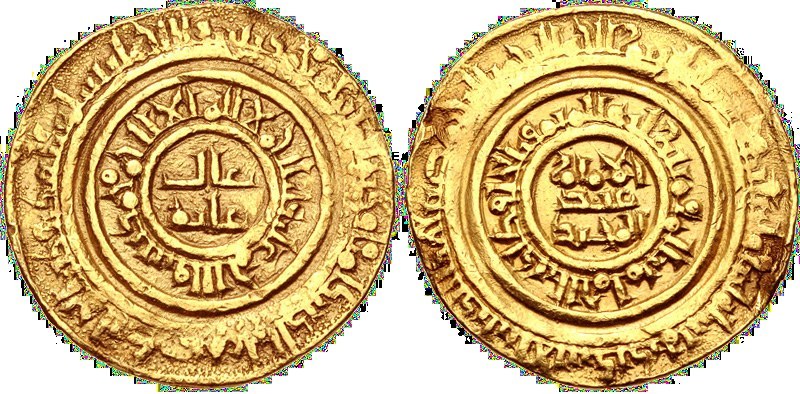
Begin with the metal and flan. A dinar of al-Hafiz should be high-purity gold with a rich yellow color, thin, roughly circular but often slightly irregular, about 20–24 mm across and near 4.0–4.3 grams. A coin that is pale, magnetic, noticeably underweight, or clearly base metal is a different issue, a modern fake, or a gilt replica. Because these were struck by hand, expect a somewhat uneven or off-center strike rather than machine-perfect edges.
The design is the quickest family marker. Fatimid dinars carry two or more concentric circular inscriptions on each face around a short central legend, giving a target-like pattern on both sides. This bull's-eye layout distinguishes them at a glance from the horizontal block-of-text dinars of the Abbasids and from later Ayyubid coins. If your coin instead has lines of text stacked across the field, it is not a classic Fatimid dinar of this style.
Attribution to al-Hafiz depends on reading the legends, not the pattern alone. The central and ring inscriptions carry the caliph's name and titles, the Shia profession of faith, and Fatimid dynastic formulae, while the mint name and the date — here AH 544 — are set into the surrounding circles. Because every Fatimid caliph used the same concentric format, the only reliable way to confirm al-Hafiz specifically is to read his name in the inscriptions; the mint and date reading then determines rarity within his reign.
Watch for look-alikes and imitations. Dinars of other Fatimid caliphs such as al-Amir, al-Zafir and al-Mustansir share the identical style and are easily confused, so never attribute the coin from its appearance alone. Contemporary and later imitations of Fatimid gold also exist, struck by neighboring powers who copied the trusted trade coin. Be especially cautious of cast copies and gilt forgeries: genuine dinars are struck, so casting seams, surface bubbles, a soft or grainy texture, a mold line at the edge, or the wrong weight are all warning signs.
When in doubt, weigh and measure the coin, photograph both faces sharply, and have the Arabic legends read by someone familiar with Fatimid epigraphy or checked against standard references. Confirming the caliph's name, the mint and the AH date is what turns a coin that merely looks Fatimid into a securely attributed dinar of al-Hafiz.
Frequently asked questions
How do I tell an al-Hafiz dinar from another Fatimid caliph's dinar?
Read the inscriptions. All Fatimid dinars share the concentric-circle design, so only the caliph's name and titles within the legends confirm al-Hafiz rather than a predecessor or successor such as al-Amir or al-Zafir.
Where are the mint and date on the coin?
They are woven into the circular ring inscriptions rather than placed in a separate field. On this coin the date reads AH 544 (about AD 1149–1150), and the mint name — typically an Egyptian mint such as Misr or al-Iskandariya — appears alongside it.
How can I check that the gold is genuine?
A real dinar is high-purity gold: rich yellow, non-magnetic, and close to 4.0–4.3 grams at about 20–24 mm. Wrong weight, a pale tone, magnetism, casting seams, or surface bubbles point to a fake or a gilded copy.
Why isn't the strike perfectly centered?
These dinars were struck by hand from dies onto irregular blanks, so slightly off-center or uneven strikes are normal and expected, not a sign of a problem with the coin.