
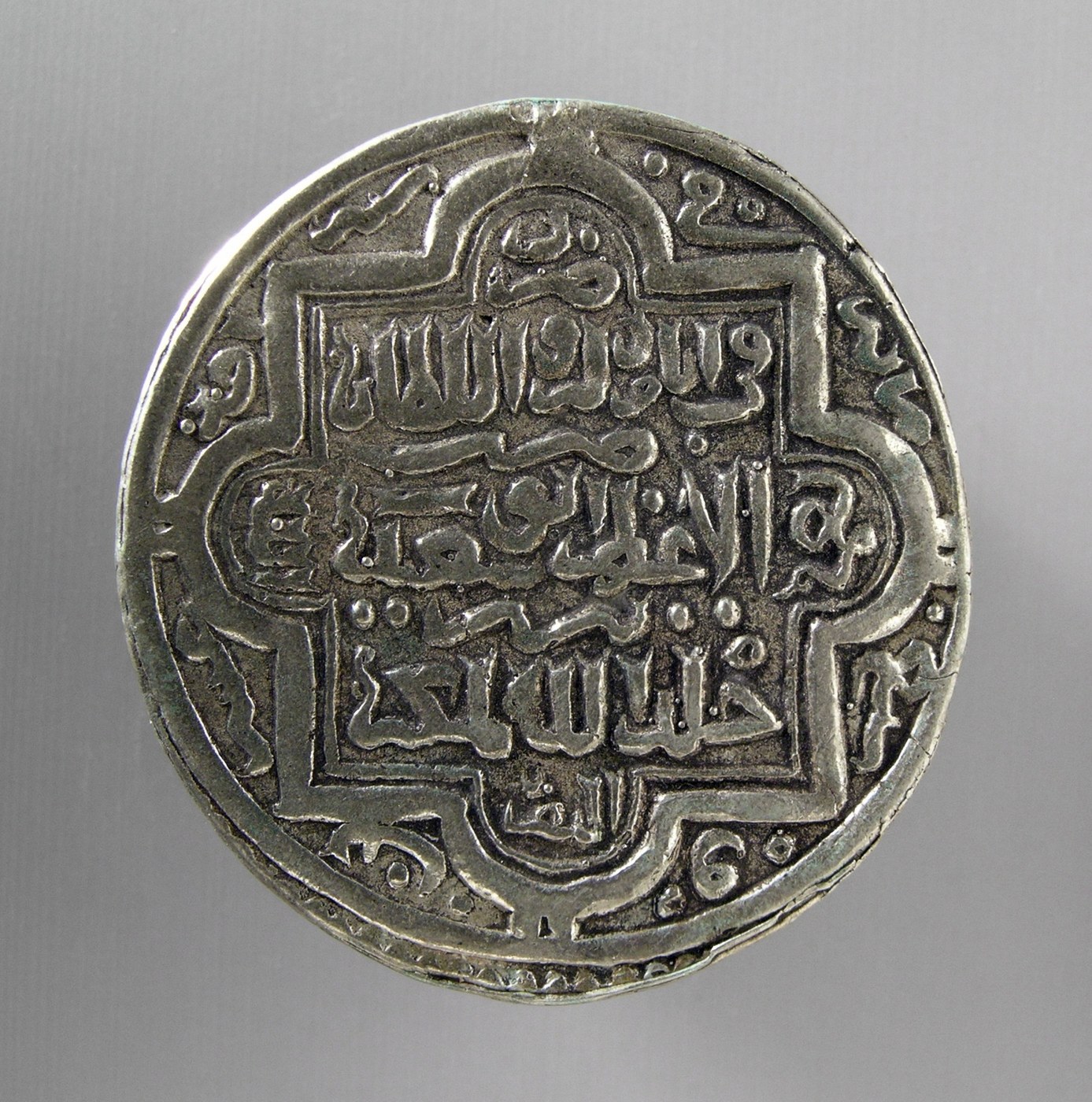
Ilkhanid Dirham
A hand-struck silver dirham of the Mongol Ilkhanate, covered in Arabic and Persian inscriptions arranged in a quatrefoil cartouche and concentric bands.
- Country
- Ilkhanate
- Denomination
- Dirham
- Metal
- Silver
Got a coin like this?
Identify any coin from a photo, free.
Overview
The Ilkhanid dirham is a silver coin of the Ilkhanate, the Mongol dynasty founded by Hülegü that ruled Iran and neighboring lands from the mid-13th to the mid-14th century. The example shown carries Arabic and Persian inscriptions set within a lobed quatrefoil cartouche on the obverse, with concentric lines of legend and a decorative border on the reverse.
The dirham was the standard silver denomination of the Islamic monetary tradition, and the Ilkhans continued to strike it after the Mongol conquest, gradually adopting Islamic forms and, after their conversion, Islamic religious formulas. These coins are entirely epigraphic, relying on calligraphy and geometric framing rather than portraits or figural imagery.
Ilkhanid silver is notable for its varied and often elegant designs: mint officials experimented with cartouche shapes such as quatrefoils, squares, and multi-lobed panels, so the arrangement of the text is itself a diagnostic feature of the series.
History & Background
The Ilkhanate was established when Hülegü, a grandson of Genghis Khan, campaigned into the Islamic world and captured Baghdad in 1258, ending the Abbasid caliphate there. The dynasty ruled a large realm centered on Iran and Iraq, with mints active across Persia, the Caucasus, and Anatolia. It survived until the death of Abu Sa'id in 1335, after which the state fragmented.
Early Ilkhanid coinage reflected the Mongols' non-Muslim rulership, but over the following decades the regime increasingly assimilated to Islamic norms. The conversion of Ghazan Khan around 1295 was a turning point, followed by a major coinage reform that standardized weights and legends and gave later Ilkhanid dirhams a more uniform, distinctly Islamic character.
Because the empire spanned so many provinces and passed through several rulers and reforms, Ilkhanid dirhams vary widely in weight standard, calligraphic style, and design. Coins typically name the reigning Ilkhan or overlord, carry religious formulas, and record the mint and Hijri date, making them a rich record of Mongol administration in the Islamic east.
How to Identify
An Ilkhanid dirham is a hand-struck silver coin, generally thin and roughly circular, though individual pieces can be slightly irregular or off-center because each was struck from dies onto a hammered flan. Both faces are covered in Arabic and Persian calligraphy rather than imagery.
The most distinctive feature of this type is its layout. The obverse inscriptions are enclosed within an ornamental quatrefoil (four-lobed) cartouche, while the reverse arranges its legends in concentric bands framed by a decorative border. The text records religious formulas, the name of the ruler or overlord, and a mint-and-date formula giving the place of striking and the Hijri year in written Arabic words. Star, dot, and floral ornaments often fill the spaces around the panels.
To attribute the coin, read the legends: the religious statements and the ruler's name identify it as an Ilkhanid issue, while the mint name and Hijri date pin it to a specific place and reign. The all-calligraphic design, the geometric cartouche framing, and the bright tone of silver together distinguish it from copper issues and from non-Islamic coinages that carry portraits or Latin lettering.
Value & Collectibility
Ilkhanid dirhams are a widely collected and comparatively accessible area of medieval Islamic silver. Large numbers were struck across many mints and reigns, so ordinary circulated examples generally trade at modest to moderate prices rather than at rarity levels, while scarce mints, short reigns, and exceptional strikes command more.
Value within the series depends on the ruler, the mint, the date, the completeness and legibility of the inscriptions, and overall preservation. Well-centered coins with sharp, fully legible legends, attractive toning, and clear cartouche detail are more desirable than worn, clipped, or weakly struck pieces where the text or mint cannot be read.
Because pricing turns on grade, ruler, mint, and specialist demand, any figures should be treated as general context rather than fixed quotes. For a coin of this kind, a clear reading of the ruler's name, mint, and Hijri date is the single most important factor in determining its interest and value.
Frequently asked questions
What is the Ilkhanate?
The Ilkhanate was a Mongol dynasty founded by Hülegü, a grandson of Genghis Khan, that ruled Iran, Iraq, and neighboring regions from about 1256 to 1335 CE. Its rulers were called Ilkhans.
What is a dirham?
A dirham was the standard silver coin of the Islamic monetary system, ranking above the copper fals and used in commerce. The Ilkhans continued striking dirhams after the Mongol conquest.
Why does the coin have no pictures?
Ilkhanid coinage follows the Islamic aniconic tradition, avoiding portraits and figural images. Instead it uses Arabic and Persian calligraphy framed by geometric cartouches and borders.
What is the quatrefoil shape on the coin?
The quatrefoil is a decorative four-lobed panel used to frame the obverse inscriptions. Ilkhanid mints favored ornamental cartouches such as quatrefoils, squares, and multi-lobed shapes, which help identify the series.
Are Ilkhanid dirhams valuable?
Most are affordable because they were struck in large numbers across many mints. Value depends mainly on the ruler, mint, date, legibility of the legends, and state of preservation.
Ilkhanid Dirham guides
In-depth guides for identifying, valuing, and collecting Ilkhanid Dirham.
Other coins you may enjoy
Gold Dinar of Jaqmaq
1438-1453 CE
Ilkhanid Dirham of Ghazan
14th century (c. 1295-1304 CE)
Gold Dinar of al-Muqtadi
c. 467-475 AH (1074-1082 CE)
Gold Dinar of al-Hafiz li-Din Allah
AH 544 (AD 1149–1150)
Samanid Dirham
9th–10th century CE (roughly AH 3rd–4th century)
Copper Fals of Barquq
1382–1389 CE (first reign of Barquq)
Copper Fals of as-Salih Salih
Mid-14th century CE (reign of as-Salih Salih, AH 752–755 / 1351–1354 CE)
Gold Dinar of Malik Shah I
AH 465–485 (1072–1092 CE)
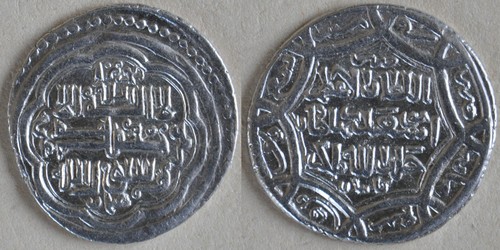
Ilkhanid Dirham of Abu Said
c. 1316-1335 CE (AH 716-736)
Silver Dirham of Salm ibn Ziyad
c. 682-683 CE
Silver Dirham (LACMA M.2002.1.437)
8th century CE (roughly AH 80s–190s)
Imitation Abbasid Dirham
8th–9th century CE