
How to Identify the Ilkhanid Dirham
A collector's guide to attributing an Ilkhanid silver dirham: reading its cartouche and concentric legends, mint and Hijri date, metal, and look-alikes.
Read the full Ilkhanid Dirham encyclopedia entry →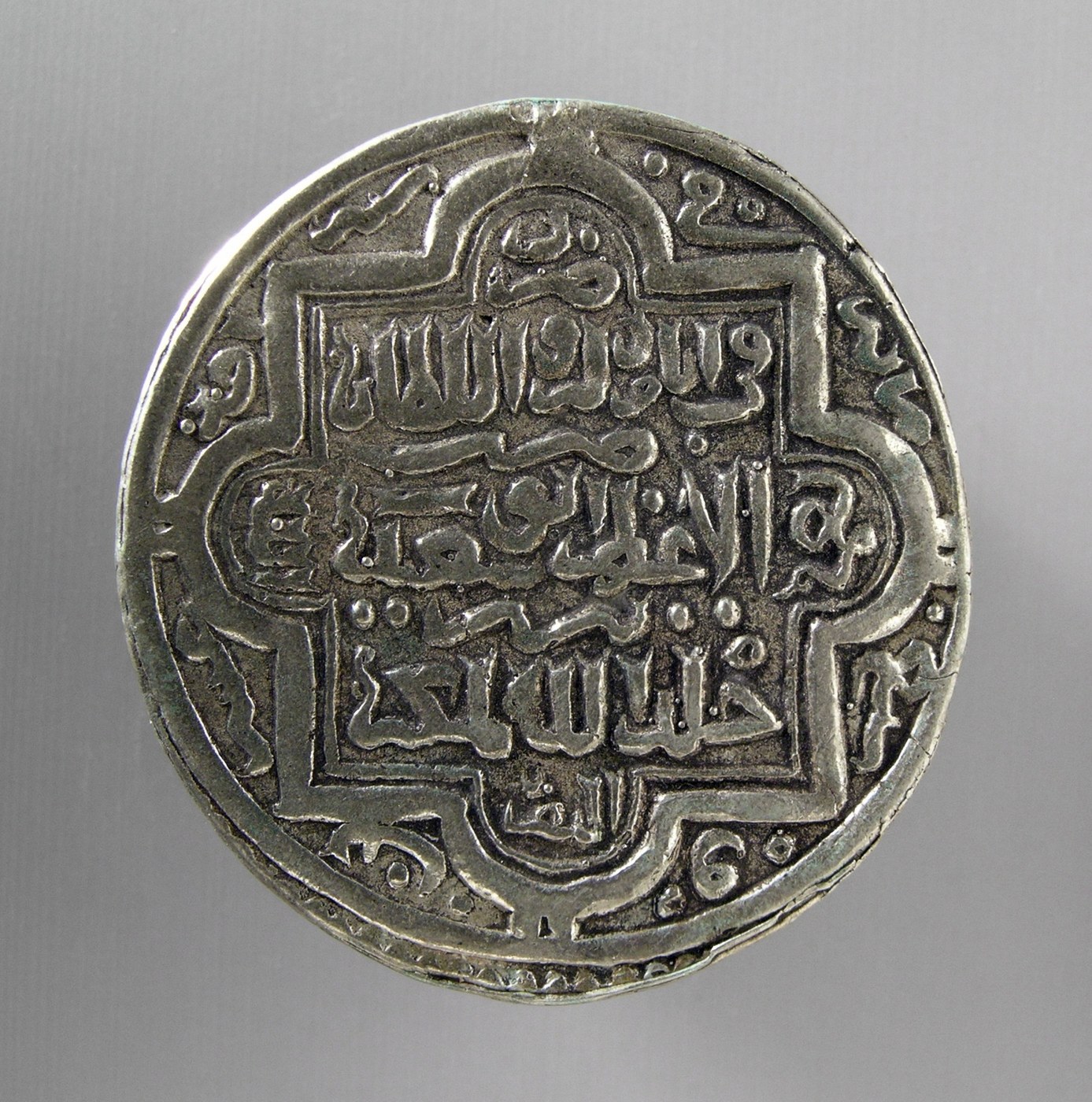
Begin with the layout, which is the most immediate clue. An Ilkhanid dirham is entirely epigraphic, and this type frames the obverse inscriptions inside an ornamental quatrefoil (four-lobed) cartouche, while the reverse arranges its legends in concentric bands enclosed by a decorative border. Small stars, dots, and floral ornaments often fill the fields around the panels. If you see a portrait, an animal, or Latin lettering, the coin is not an Ilkhanid dirham.
Read the legends to attribute the piece. The inscriptions combine religious formulas with the name of the reigning Ilkhan or overlord, and a mint-and-date formula naming the place of striking and the Hijri (AH) year in written Arabic words rather than numerals. Because the Ilkhanate spanned many mints and rulers and went through coinage reforms, matching the ruler's name, the mint, and the date against a specialist reference is what separates one issue from another.
Check the physical coin. This is a silver dirham, so expect a pale grey metallic tone, sometimes with darker toning, and a thin, hand-struck flan that may be slightly irregular or off-center. Weight and diameter vary across the series because different reigns and reforms used different standards; pre- and post-reform coins of Ghazan Khan, for example, differ in size and legend arrangement. Silver will not show the reddish-brown color of copper fulus.
Watch for look-alikes. Many medieval Islamic dynasties struck all-calligraphic silver dirhams, and neighboring or successor states in Iran, Anatolia, and the Caucasus produced superficially similar coins. Ornamental cartouches and concentric legends are characteristic of Ilkhanid work, but the specific ruler's name, mint, and Hijri date — not general appearance — are what confirm an Ilkhanid attribution. Worn coins with illegible legends often cannot be attributed with confidence.
Apply sensible authentication checks. Genuine dirhams are struck, showing the uneven relief and hammered flan of hand production; be wary of cast copies with soft, blurry detail, seams, or bubbles, and of pieces with tooled surfaces or added "toning" hiding modern work. When the legend cannot be read clearly, compare the coin against a catalog of Ilkhanid coinage or seek an expert opinion before accepting a firm attribution.
Frequently asked questions
How do I read the date on an Ilkhanid dirham?
The date is written out in Arabic words as part of the mint-and-date formula, not as numerals, and is given in the Hijri (AH) calendar. Converting it to the Common Era and matching the mint name against a reference gives a precise attribution.
What does the quatrefoil cartouche tell me?
The four-lobed quatrefoil frame around the obverse text is a decorative device favored by Ilkhanid mints. Cartouche shape helps place a coin within the series, but you still need the ruler, mint, and date to attribute it precisely.
How can I tell it apart from other Islamic silver coins?
Many dynasties struck similar all-calligraphic silver dirhams, so appearance alone is not enough. The ruler's name, the mint, and the Hijri date in the legends, together with the characteristic cartouche-and-border layout, identify it as Ilkhanid.
How do I spot a fake or tooled coin?
Genuine dirhams are struck, with uneven relief and an irregular hammered flan. Watch for casting seams, bubbles, and mushy detail, and for artificial toning concealing tooled or modern surfaces. Verify doubtful pieces against a specialist catalog or expert.