
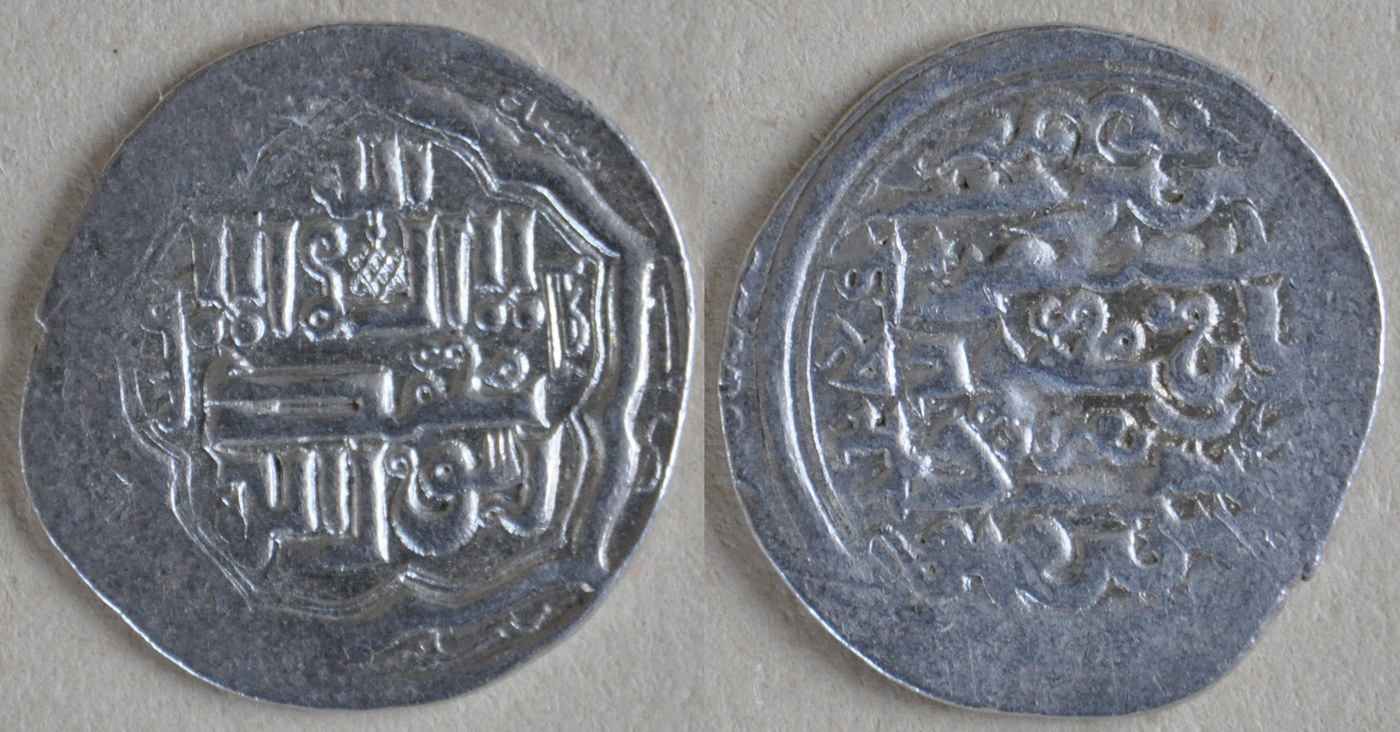
Ilkhanid Dirham of Ghazan
A silver dirham of the Mongol Ilkhanate struck for Ghazan Khan, with an ornamental cartouche bearing the ruler's name and concentric Arabic and Persian inscriptions.
- Country
- Ilkhanate
- Denomination
- Dirham
- Metal
- Silver
Got a coin like this?
Identify any coin from a photo, free.
Overview
The Ilkhanid Dirham of Ghazan is a medieval silver coin struck by the Ilkhanate, the branch of the Mongol Empire that ruled Persia (Iran), Iraq and the surrounding lands. It carries the name of Ghazan, the Ilkhanid ruler who converted to Islam and reformed the realm's coinage around the turn of the 14th century. The example shown has an ornamental cartouche framing the ruler's name on the obverse, and concentric bands of inscription in Arabic and Persian on the reverse.
These dirhams are handsome, purely calligraphic coins: there is no portrait or figural image, in keeping with Islamic coin tradition. Instead the design relies on Arabic script arranged inside geometric cartouches and rings, with religious formulae on one side and the ruler's titles on the other. The distinctive framed, panelled layout of Ghazan's coinage makes it one of the more recognisable Ilkhanid types.
As a widely struck silver denomination of a major medieval dynasty, the Ghazan dirham is a popular and accessible entry point into Islamic and Mongol-era numismatics.
History & Background
The Ilkhanate was founded by the Mongol conqueror Hulagu, a grandson of Genghis Khan, after the Mongol campaigns that overthrew the Abbasid Caliphate of Baghdad in the mid-13th century. Ghazan (reigning from 1295 to 1304 CE) was one of its most important rulers. His public embrace of Islam was a turning point for the dynasty, aligning the Mongol state with the faith of most of its subjects, and he is remembered for wide-ranging administrative, fiscal and monetary reforms.
Among those reforms was an overhaul of the coinage. Ghazan standardised the weight and the design of the silver dirham across the empire's many mints, replacing a patchwork of local issues with a more uniform imperial currency. His reformed dirhams typically carry the Islamic declaration of faith and pious formulae on one side and his name and titles on the other, sometimes styled with his Muslim name Mahmud alongside Mongol titulature.
The coins were struck at a large number of mints spread across Persia, Iraq, the Caucasus and Anatolia, and they circulated widely as the everyday silver money of the realm. They survive today in reasonable numbers, making them tangible relics of the Mongol dynasty's Islamic phase in the Near East.
How to Identify
The Ghazan dirham is a small, thin hand-struck silver coin of the medieval Islamic type. Expect a greyish, sometimes toned silver surface, an irregular flan, and the slightly off-centre striking normal for hammered coinage of the period. There is no image of a person or animal — the entire design is calligraphic.
The defining features are the layout and the script. One face presents the ruler's name framed within an ornamental cartouche, often a lobed or panelled geometric frame, while the other carries concentric rings of Arabic and Persian inscription, typically the Muslim profession of faith together with religious and dynastic formulae. Reading the ruler's name in the cartouche is the key to attributing the coin specifically to Ghazan, since many Ilkhanid rulers used the same general framed style.
Mint and date, where present, are usually recorded in the marginal inscriptions in Arabic script. Because these are aniconic coins covered in Arabic and Persian calligraphy inside geometric frames, they are easily distinguished from contemporary European or East Asian coins, and the specific cartouche-and-concentric-ring arrangement helps separate Ilkhanid dirhams from other Islamic silver of the era.
Value & Collectibility
As a silver coin of a major medieval dynasty that was struck at many mints, the Ghazan dirham is relatively available to collectors and is generally an affordable piece of Islamic silver rather than a great rarity. Ordinary examples in collectable grade trade for modest sums, valued as accessible representatives of Ilkhanid and Mongol-era coinage.
Within the type, condition, completeness of the inscriptions and the strength of the strike drive value. Coins with full, sharp legends, a well-centred design and clear mint and date details are more desirable than weakly struck or clipped pieces where much of the script runs off the flan. Particular mints, dates and die varieties can carry premiums with specialist collectors of the series.
Exact prices depend on grade, eye appeal and demand among Islamic-coin collectors, so figures here are general context rather than fixed values. For a hammered silver dirham of this kind, legibility of the ruler's name, mint and date matters far more to value than the metal content alone.
Frequently asked questions
Who was Ghazan?
Ghazan (Mahmud Ghazan, reigned 1295-1304 CE) was a ruler of the Ilkhanate, the Mongol dynasty governing Persia and Iraq. He is best known for converting to Islam and for reforming the state's administration and coinage.
What is the Ilkhanate?
The Ilkhanate was the branch of the Mongol Empire that ruled Persia, Iraq, the Caucasus and Anatolia after Hulagu's conquests in the 13th century. Its rulers, called Ilkhans, issued their own gold, silver and copper coinage.
Why is there no portrait on the coin?
The dirham follows Islamic coin tradition, which avoids figural images. The design is entirely calligraphic, using Arabic and Persian script arranged in an ornamental cartouche and concentric inscription rings rather than a ruler's effigy.
Is the coin made of silver?
Yes. The dirham is a silver denomination, and genuine examples show a toned greyish silver surface. It is a small, thin hand-struck coin typical of medieval Islamic silver coinage.
Is a Ghazan dirham rare or valuable?
These dirhams were struck in quantity at many mints and are relatively common, so most are affordable. Value comes mainly from condition and from clear, complete inscriptions naming the ruler, mint and date.
Ilkhanid Dirham of Ghazan guides
In-depth guides for identifying, valuing, and collecting Ilkhanid Dirham of Ghazan.
Other coins you may enjoy
Gold Dinar of Jaqmaq
1438-1453 CE
Ilkhanid Dirham
13th–14th century (Ilkhanate, c. 1256–1335 CE)
Gold Dinar of al-Muqtadi
c. 467-475 AH (1074-1082 CE)
Gold Dinar of al-Hafiz li-Din Allah
AH 544 (AD 1149–1150)
Samanid Dirham
9th–10th century CE (roughly AH 3rd–4th century)
Copper Fals of Barquq
1382–1389 CE (first reign of Barquq)
Copper Fals of as-Salih Salih
Mid-14th century CE (reign of as-Salih Salih, AH 752–755 / 1351–1354 CE)
Gold Dinar of Malik Shah I
AH 465–485 (1072–1092 CE)
Ilkhanid Dirham of Abu Said
c. 1316-1335 CE (AH 716-736)
Silver Dirham of Salm ibn Ziyad
c. 682-683 CE
Silver Dirham (LACMA M.2002.1.437)
8th century CE (roughly AH 80s–190s)
Imitation Abbasid Dirham
8th–9th century CE