
How to Identify the Silver Dirham (LACMA M.2002.1.437)
A collector's guide to recognizing an 8th-century Islamic silver dirham: fabric, Kufic legends, mint-and-date margins, look-alikes and authentication cautions.
Read the full Silver Dirham (LACMA M.2002.1.437) encyclopedia entry →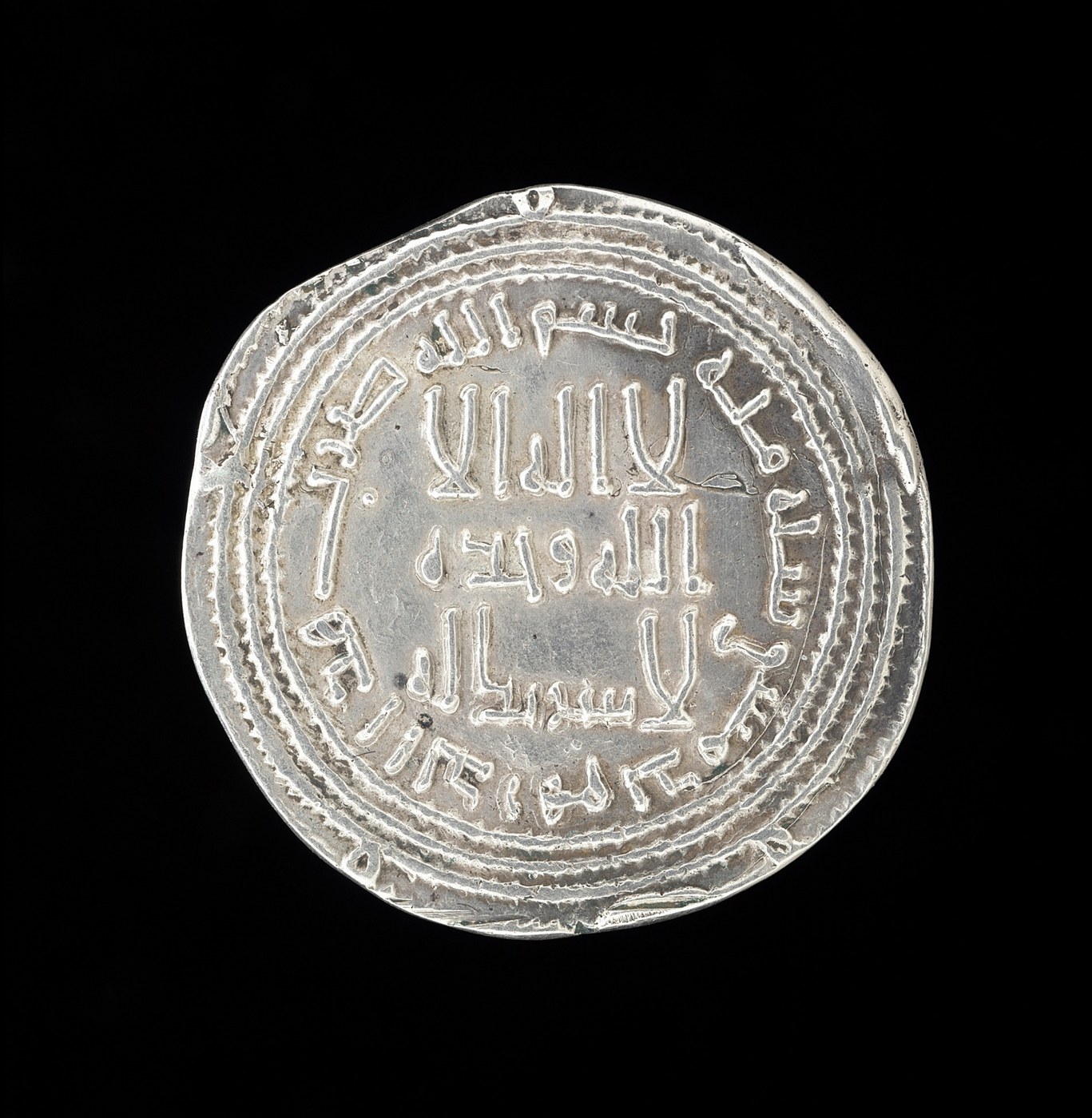
Begin with the physical coin. A dirham of this type is a thin, broad, lightweight silver disc — generally somewhere around 23–28 mm across but only a few grams — noticeably flatter and wider than most later coins. Confirm the metal is silver: it should be non-magnetic, with a white to lightly toned surface. A coin that is thick and heavy, magnetic, yellow-gold, or clearly base metal is a different denomination or not this type at all.
Next, read the layout rather than the words. The defining trait is dense Arabic text in angular Kufic script arranged as a central field of several lines encircled by a running marginal legend, usually divided by a beaded or plain border. There is no portrait, no animal, no Western date and no Latin letters anywhere. On this specimen you can also see decorative devices — pellets, rosettes and leaf-like flourishes — worked in among the text; such ornament is a normal part of the design, not a later addition.
For attribution, focus on the margin. The outer circular legend on an early dirham typically carries the mint formula — a phrase meaning "struck at" followed by a city name — together with the Hijri (AH) year. That marginal inscription is what pins the coin to a specific dynasty, place and date within the 8th century; the central field, by contrast, carries the religious declarations shared across the series. Photographing both faces sharply and having the Kufic read by someone familiar with Islamic epigraphy, or checked against standard references, is the key step.
Be aware of look-alikes. Reformed dirhams were struck across a huge area and a long span, so Umayyad, Abbasid and Spanish Umayyad issues can look very similar at a glance and are separated mainly by their legends and mint names. Do not assume any broad, inscription-covered silver coin is this exact issue without reading the margin. Modern tourist replicas and cast copies also exist.
Apply basic authentication checks. Genuine dirhams are struck from dies, not poured into molds, so watch for warning signs of casting: a seam or mold line around the edge, trapped air bubbles, a soft or grainy "mushy" surface, or lettering that looks blurred and rounded rather than crisply impressed. Off-center strikes and slightly uneven flans are expected and normal for hand-struck coins; casting artifacts and wrong weight or diameter are the real red flags.
Frequently asked questions
How do I tell this dirham from a gold dinar?
The dirham is silver — white or grey and non-magnetic — while the dinar is gold and usually smaller and thicker. Both share the same all-inscription, imageless design, so judge the metal color and fabric first, then read the legends.
Where is the mint and date on the coin?
Look at the outer circular margin, not the center. Early dirhams carry the mint-and-date formula there — a "struck at" phrase plus a city name and the Hijri (AH) year — which is what allows a precise attribution.
Why is part of the inscription weak or off the edge?
That is typical of hand-struck coins on broad, thin flans. Dies were often larger or unevenly applied, so strikes can be off-center with soft or missing lettering. It is normal and not necessarily a sign of a fake.
How can I spot a fake or replica?
Genuine dirhams are struck, so watch for casting seams, bubbles, a soft grainy surface, or blurry lettering, along with incorrect weight, diameter or magnetic metal. When unsure, verify the fabric and have the Kufic legends checked against references.