
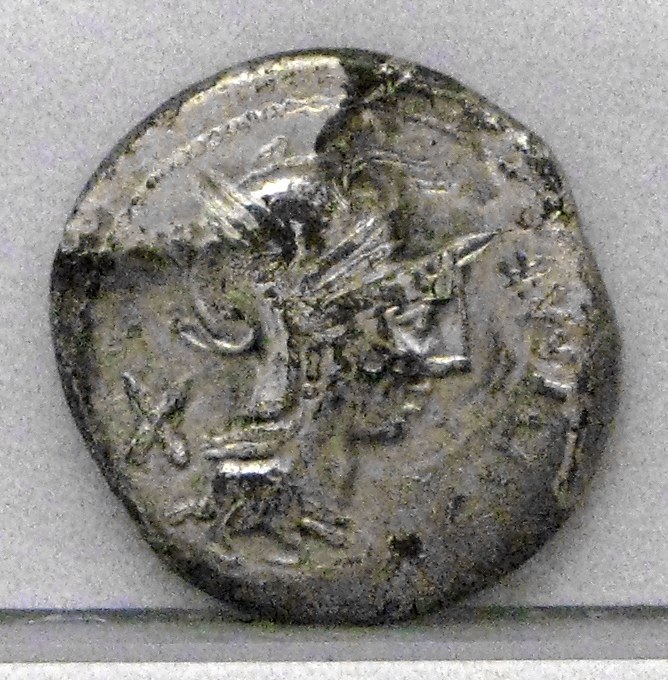
Roman Republican Denarius (Unidentified)
A silver Roman Republican denarius of about 115-114 BC: helmeted Roma on the obverse, Victory driving a two-horse chariot on the reverse.
- Country
- Roman Republic
- Denomination
- Denarius
- Metal
- Silver
Got a coin like this?
Identify any coin from a photo, free.
Overview
This is a silver denarius of the Roman Republic, the workhorse coin of the Roman monetary system. The observed obverse shows the head of Roma facing right in a crested Corinthian-style helmet, her hair falling in curls, exactly the martial personification of the city that dominates Republican coinage. The reverse shows Victory (Victoria) driving a biga, a two-horse chariot, accompanied by additional standing figures. The style and iconography place this piece in the later 2nd century BC, around 115-114 BC.
The coin is catalogued here as "unidentified" because the specific moneyer and catalogue number cannot be fixed from the images alone. Republican denarii were signed by the annually appointed moneyers (the tresviri monetales), whose names or symbols appear in the legends and fields. Reading those marks is what turns a generic "Roma / Victory biga" denarius into a precisely attributed type.
Despite the open attribution, the essentials are secure: a hand-struck silver denarius roughly 3.7-3.9 grams and about 17-20 mm across, issued by the mint of Rome during the middle Republic and used to pay soldiers, taxes, and everyday large transactions.
History & Background
The denarius was introduced during the Second Punic War, traditionally around 211 BC, and quickly became the backbone of Roman coinage for centuries. By the period of this coin, roughly 115-114 BC, the Republic was at the height of its Mediterranean expansion, and its silver flowed to armies and provinces across the ancient world.
Coins of this era were produced by a college of junior magistrates, the moneyers, who oversaw the mint of Rome for a year at a time. Increasingly they used the coinage to advertise their family histories and achievements, which is why reverse types grow varied and personal in the late 2nd and 1st centuries BC. A triumphant Victory in a chariot, as seen here, is a common patriotic and celebratory motif of the period.
Each coin was struck by hand between engraved dies on a prepared silver blank, so no two examples are perfectly identical. That handcraft, combined with the sheer output of the Roman mint, means denarii of this type survive in reasonable numbers today and remain among the most accessible of all genuinely ancient coins.
How to Identify
Confirm the core diagnostics first. The metal should be silver, the weight roughly 3.7-3.9 grams, and the diameter about 17-20 mm, with an irregular, hand-struck flan rather than a perfectly round modern edge. The obverse shows Roma's head right in a crested Corinthian-type helmet with curled hair; on many issues a value mark or the moneyer's symbol sits in the field behind or below the head.
The reverse shows Victory driving a biga to the right, often holding reins and a wreath or palm, with attendant figures alongside the chariot. Look along the exergue (the flat band beneath the ground line) and around the design for the moneyer's name, monogram, or control marks; these letters are the key to a precise attribution and to the standard reference numbers (such as Crawford or Sydenham).
Because the specific legend is not resolved here, treat the attribution as open until the inscriptions are read under good light and magnification. Match the exact wording, symbols, and control marks against a standard Republican catalogue to move from "Roma / Victory biga denarius" to a named type and date.
Value & Collectibility
Value depends on the exact type, the sharpness of the strike, centering, surface quality, and any test cuts, banker's marks, or corrosion. Common Roman Republican denarii in worn but honest condition are among the more affordable ancient silver coins, while sharp, well-centered examples with clear portraits and full reverse detail command a clear premium. Scarcer moneyers or rare varieties can be worth considerably more.
Problem surfaces reduce value: cleaning scratches, tooling, encrustation, or corrosion all detract, as does a coin that has been bent, holed, or mounted. Because the specific type is not yet pinned down, any appraisal should begin by identifying the moneyer and catalogue number, then comparing against recent auction results for that exact issue.
Authenticity is central to value in ancient coins. For a firm figure and peace of mind, weigh and measure the coin, read the legends, and consult a reputable ancient-coin dealer or a recognized authentication service rather than relying on a single online estimate.
Frequently asked questions
What is a denarius?
The denarius was the standard silver coin of the Roman Republic and early Empire, introduced around 211 BC. It was used to pay soldiers and settle large everyday transactions for centuries.
Who is the head on the front?
It is Roma, the personified goddess of the city of Rome, shown in a crested helmet. She is the most common obverse figure on Republican denarii of this era.
What is happening on the reverse?
Victory (Victoria) is driving a biga, a two-horse chariot, with attendant figures alongside. It is a triumphant, celebratory motif typical of late 2nd-century BC coinage.
Why is it called unidentified?
The general type is clear, but the specific moneyer and catalogue number can only be fixed by reading the legends and control marks. Until those are resolved, the exact attribution stays open.
Is a coin like this genuinely ancient?
Genuine Republican denarii are hand-struck silver, roughly 3.7-3.9 grams and 17-20 mm, with an irregular flan. Because convincing forgeries exist, confirm authenticity through weight, style, and a reputable dealer or authentication service.
Roman Republican Denarius (Unidentified) guides
In-depth guides for identifying, valuing, and collecting Roman Republican Denarius (Unidentified).
Other coins you may enjoy
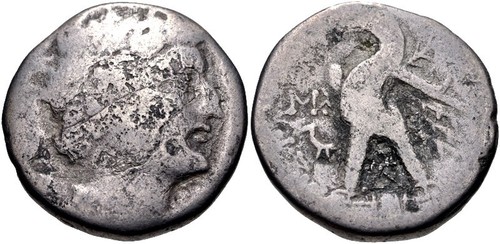
Tetradrachm of Ptolemy XII
80-51 BC
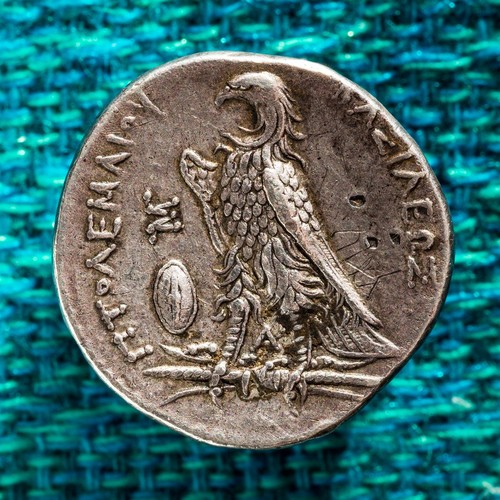
Tetradrachm of Ptolemy I
305-283 BC
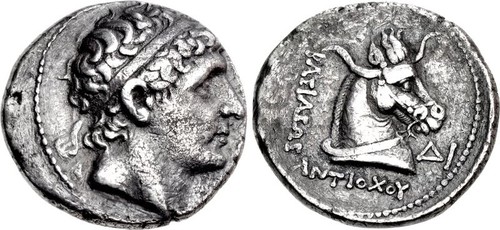
Tetradrachm of Antiochos I Soter
281-261 BC
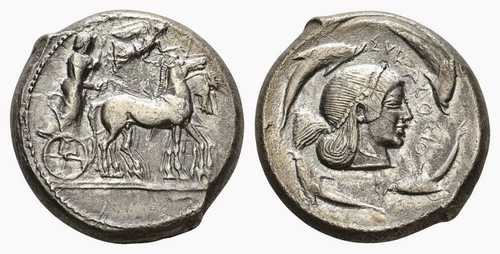
Syracuse Tetradrachm
c. 5th-4th century BC (Classical period)
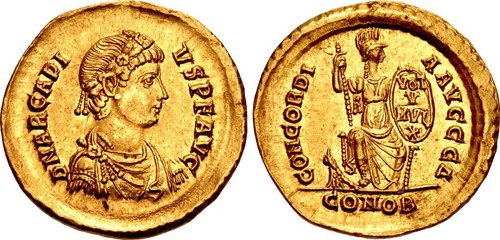
Solidus of Arcadius
AD 395-402
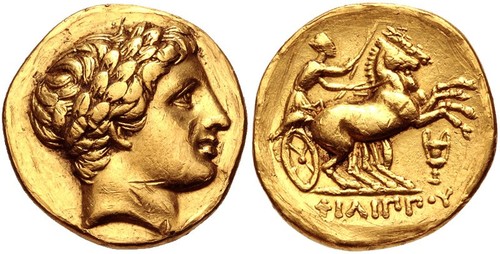
Philip III Gold Stater
323-317 BC
Siliqua of Gratian
AD 367-383
Sestertius of Maximinus Thrax
235-238 AD
Solidus of Valentinian III
AD 425-455
Seleucus I Nicator Tetradrachm
Late 4th-3rd century BC
Nummus of Magnentius
AD 350-353
Follis of Galerius
AD 308-310