
How to Identify the Roman Republican Denarius (Unidentified)
Use the helmeted Roma head, the Victory-in-biga reverse, silver weight, and the moneyer's marks to pin down this Republican denarius.
Read the full Roman Republican Denarius (Unidentified) encyclopedia entry →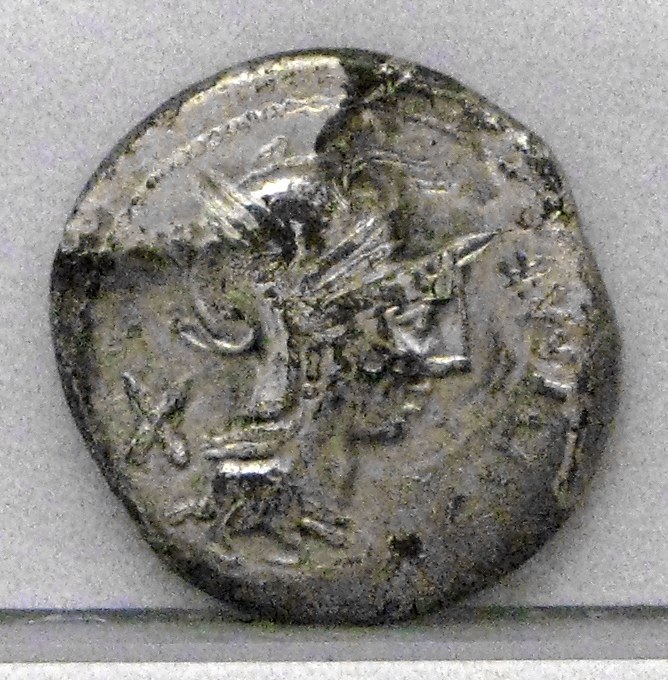
Begin with the obverse portrait. A denarius of this family shows the head of Roma facing right in a crested Corinthian-style helmet, with her hair in curls. Check the field around the head for a value mark or a small symbol, letter, or monogram; on Republican coinage these belong to the moneyer and are among the first clues to a precise attribution. The style of the portrait and the fabric of the flan help confirm a date in the later 2nd century BC, consistent with the observed 115-114 BC range.
Read the reverse carefully. Here Victory drives a biga, a two-horse chariot, usually to the right, with one or more attendant figures beside the team. The most valuable single detail is the inscription: scan the exergue (the flat band under the ground line) and the fields for the moneyer's name, an abbreviation, or control marks. Matching that exact wording and any symbols against a standard reference such as Crawford (RRC) or Sydenham is what turns a generic type into a named, dated issue.
Measure the physical coin. Genuine denarii of this period are silver, roughly 3.7-3.9 grams, about 17-20 mm across, and non-magnetic, struck by hand so the flan is slightly irregular and the design may be off-center. A perfectly round, seamless, or magnetic piece, or one that is markedly over- or under-weight, is a warning sign. Old test cuts and banker's marks are common on genuine coins and are not by themselves a problem.
Watch for look-alikes and traps. Many different Republican moneyers used a Roma head with a Victory-biga reverse, so the type alone does not identify the issue; only the legends and marks do. Cast copies (with a seam or bubbly surface), tourist replicas, and modern struck fakes all circulate. When authenticity or value matters, weigh and measure the coin, examine it under magnification, and consult a reputable ancient-coin dealer or a recognized authentication service rather than relying on a single photograph.
Frequently asked questions
How do I move from the general type to an exact attribution?
Read the reverse legend and any control marks in the exergue and fields, then match the moneyer's name, symbols, and design against a standard catalogue such as Crawford (RRC) or Sydenham.
What weight and size should a genuine example be?
Roman Republican denarii of this era are silver, roughly 3.7-3.9 grams and about 17-20 mm in diameter, non-magnetic, with a hand-struck, slightly irregular flan.
Are test cuts or small punch marks a bad sign?
Not necessarily. Banker's marks and ancient test cuts appear on many genuine denarii; they can lower value slightly but often help confirm the coin is period silver rather than a modern fake.
How can I tell a cast forgery from a struck original?
Struck originals show crisp die detail and sometimes flow lines, while casts often have a soft, grainy surface, tiny bubbles, or a faint seam along the edge. When in doubt, seek professional authentication.