Reis (Peninsular War)
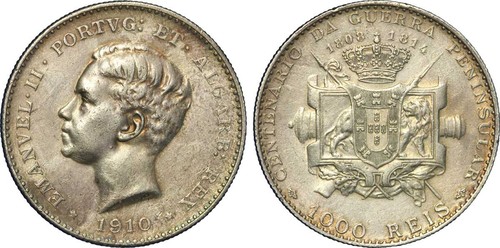
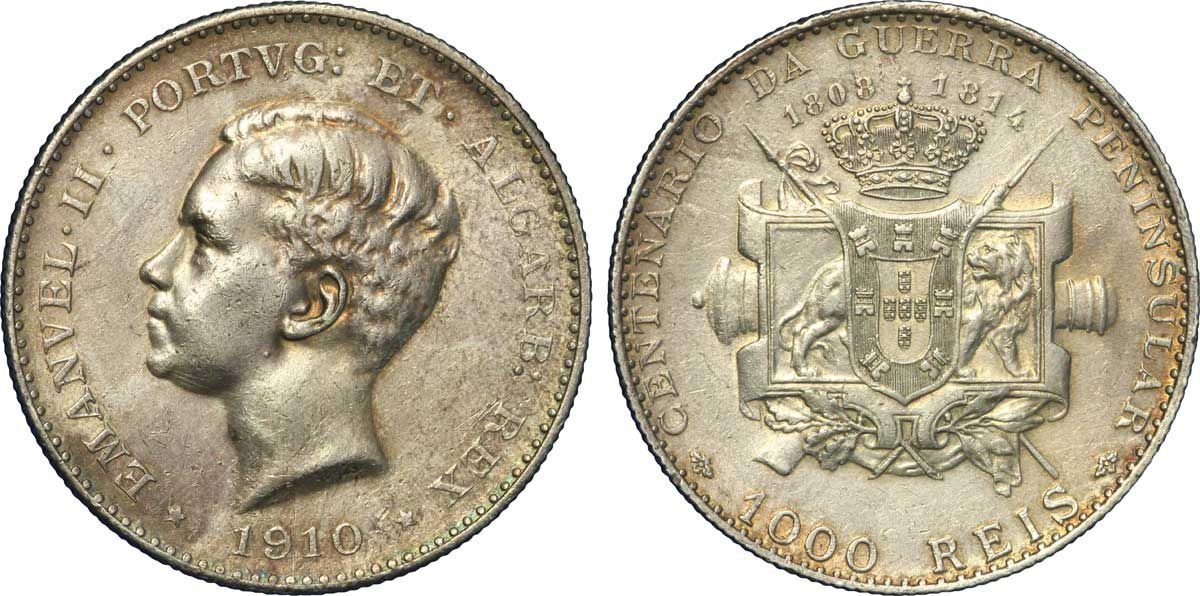
A 1910 Portuguese silver Reis struck under King Manuel II to mark the centenary of the Peninsular War, dated 1808-1814 across the king's bust.
- Country
- Portugal
- Denomination
- Reis
- Metal
- Silver
Got a coin like this?
Identify any coin from a photo, free.
Overview
The Peninsular War Reis is a silver commemorative coin issued by the Kingdom of Portugal in 1910, near the very end of the Portuguese monarchy. It was struck to honor the centenary of the Peninsular War, the campaign of 1808-1814 in which Portuguese, Spanish, and British forces fought Napoleon's armies on the Iberian Peninsula. The coin pairs a portrait of the young King Manuel II with a heraldic reverse.
This piece belongs to a short commemorative series produced in the reign's final months, and its Reis denomination places it among the last royal silver coins Portugal ever made. The photographed example carries the legend MANOEL II PORTUGAL and the war dates 1808-1814 framing the bust, tying the design directly to the centenary theme.
Because the monarchy fell in October 1910, these commemoratives were struck for only a brief window, which makes them popular with collectors of Portuguese royal coinage and of Napoleonic-era commemoratives alike.
History & Background
The Peninsular War (1808-1814) was a defining conflict for Portugal. French forces invaded, the royal court relocated to Brazil, and an Anglo-Portuguese army under Wellington eventually drove the French out. A century later, the Portuguese state marked the anniversary with commemorative silver coinage denominated in Reis, the traditional Portuguese money of account.
The coin was issued under Manuel II, who came to the throne in 1908 as a teenager after his father, King Carlos I, and elder brother were assassinated in Lisbon. His reign was short and turbulent. The 1910 Peninsular War commemoratives were among the last coins struck in his name before the republican revolution of 5 October 1910 ended the monarchy and sent the king into exile.
Because of this timing, the series sits at the close of centuries of Portuguese royal coinage. It was quickly followed by the coinage of the new Portuguese Republic, which replaced royal portraits and the Reis system in the years that followed.
How to Identify
The obverse shows a bust of King Manuel II facing left, draped and cuirassed in military style. The surrounding legend reads MANOEL II PORTUGAL, and the Peninsular War dates 1808-1814 appear as part of the design, directly referencing the centenary being commemorated. The 1910 issue date is present on the coin.
The reverse displays the Portuguese coat of arms beneath a royal crown, flanked or accompanied by crossed palm branches. The heraldic shield carries the traditional Portuguese symbols, the escudos with their castles-and-quinas motif, marking this clearly as a royal, pre-republican issue.
Key identifiers are the paired war dates 1808-1814 alongside the 1910 strike, the Portuguese-language royal legend naming Manoel II, the left-facing youthful bust, and the crowned arms with crossed palms. The coin is silver, so genuine examples show the weight, ring, and tone of a struck silver piece rather than a light base-metal token.
Value & Collectibility
As a short-lived royal commemorative in silver, the Peninsular War Reis carries both collector demand and modest precious-metal content. Values depend heavily on the specific denomination within the series, on grade, and on eye appeal, so figures should be treated as general context rather than fixed quotes. Well-worn examples are accessible to most collectors, while sharp, lightly circulated or uncirculated pieces command a clear premium.
The coin's appeal is driven by its historical position at the fall of the Portuguese monarchy and its Napoleonic centenary theme, which draws interest from more than one collecting audience. Original surfaces, full detail in the bust and arms, and attractive natural toning add value.
Because it is a genuine silver issue, condition and authenticity matter more than bullion weight for pricing. Certified or well-documented examples tend to bring stronger and more consistent results than raw coins of uncertain grade.
Frequently asked questions
Why does the coin show two different dates, 1808-1814 and 1910?
The dates 1808-1814 mark the span of the Peninsular War being commemorated, while 1910 is the year the coin was actually struck. It is a centenary commemorative, so both the event and the issue date appear.
Who is the king shown on the obverse?
The bust is Manuel II, the last King of Portugal, who reigned from 1908 to 1910. The legend spells his name in the Portuguese form, MANOEL II PORTUGAL.
Is this coin made of real silver?
Yes. The Peninsular War Reis is a silver commemorative issue, so genuine examples have the heft, ring, and tone typical of a struck silver coin rather than a light base-metal piece.
What is on the reverse?
The reverse shows the Portuguese coat of arms beneath a royal crown, with crossed palm branches. The shield carries the traditional castles-and-quinas symbols of the Portuguese monarchy.
Why is this coin considered historically significant?
It was issued in 1910, the final year of the Portuguese monarchy. The republican revolution that October ended royal coinage, making these commemoratives among the last coins struck in a Portuguese king's name.
Reis (Peninsular War) guides
In-depth guides for identifying, valuing, and collecting Reis (Peninsular War).