5 Escudos
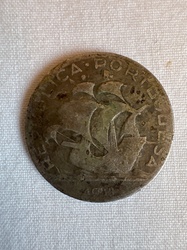
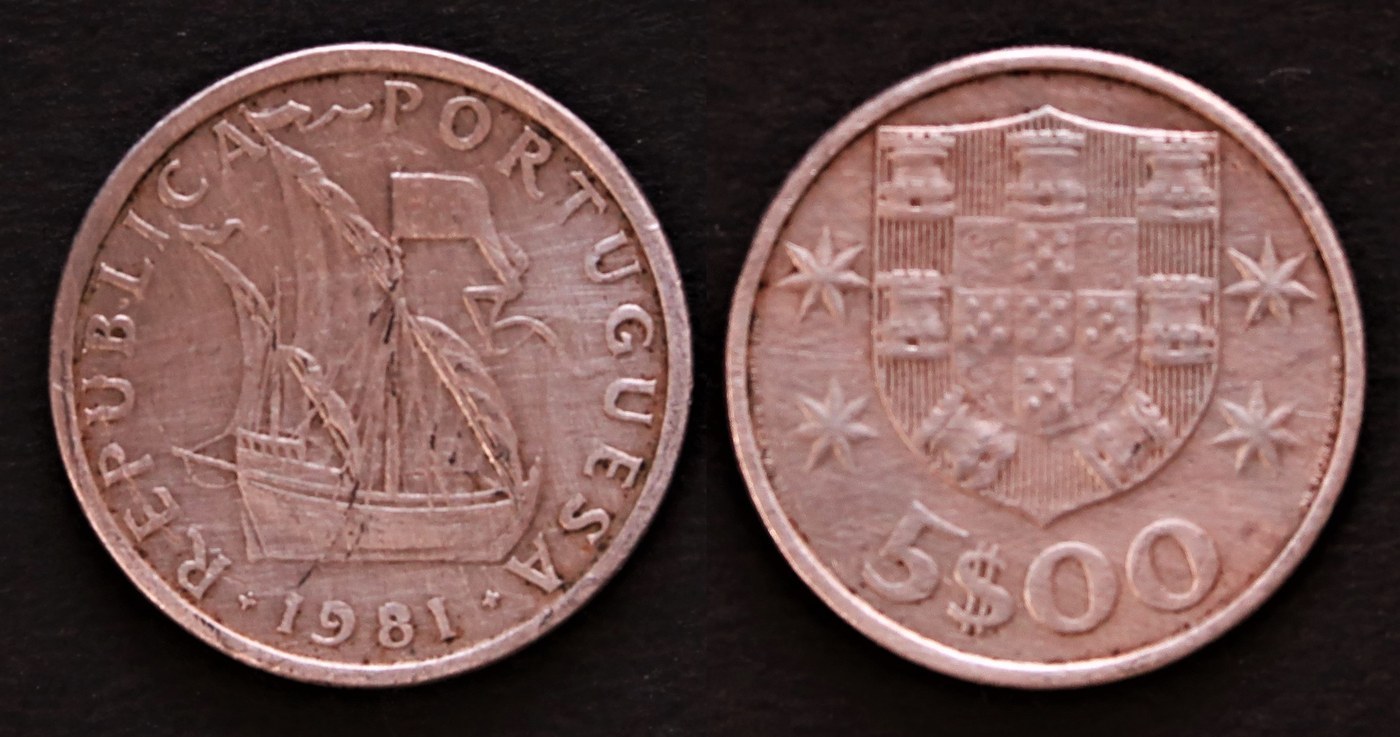
Portugal's copper-nickel 5 Escudos, showing a caravel sailing ship on the obverse and the national shield with the value 5$00 on the reverse.
- Country
- Portugal
- Denomination
- 5 Escudos
- Metal
- Copper-Nickel
Got a coin like this?
Identify any coin from a photo, free.
Overview
The 5 Escudos is a mid-value circulating coin of the Portuguese Republic, and the 1981 example shown here belongs to the long-running copper-nickel series defined by a sailing caravel. The obverse carries the legend REPUBLICA PORTUGUESA around a caravel, the small ocean-going ship tied to Portugal's Age of Discoveries, while the reverse shows the national coat of arms with the value written as 5$00 in escudo notation.
This is an everyday coin rather than a precious-metal issue. It is struck in copper-nickel, giving it a silvery-gray color, a medium size, and a firm, non-magnetic feel. It was made in large numbers for general circulation, so it is common today and turns up frequently in mixed lots of Portuguese and European coins.
The caravel design is the coin's defining feature and a recurring theme across twentieth-century Portuguese coinage, celebrating the maritime voyages of the fifteenth and sixteenth centuries. Collectors usually seek it as part of a Portuguese escudo type set or a date run rather than for any bullion value.
History & Background
The escudo was Portugal's currency from 1911, when it replaced the real after the founding of the Republic, until the country adopted the euro in 2002. Throughout that period the Republic issued coinage inscribed REPUBLICA PORTUGUESA, and the 5 Escudos sat in the middle of the everyday denominations.
The caravel-type copper-nickel 5 Escudos was produced across the 1960s, 1970s, and 1980s, with the 1981 date falling late in that run. The choice of a caravel reflects Portugal's national memory of the Discoveries, the voyages of exploration led by figures such as Henry the Navigator and the crews who opened sea routes around Africa and beyond. Ships and maritime motifs appear widely on Portuguese coins and banknotes of the era.
Escudo coins were struck at the Casa da Moeda, the Portuguese national mint in Lisbon. When Portugal joined the euro, escudo coins were withdrawn from circulation, and pieces like this 1981 5 Escudos passed from daily use into collector hands and household coin jars.
How to Identify
The obverse is the quickest identifier: a caravel, a small square-rigged sailing ship, set within the legend REPUBLICA PORTUGUESA. The reverse shows the Portuguese national shield, an arrangement of small shields (quinas) and a bordure of castles, with the value expressed as 5$00. The dollar-like sign is the cifrao, the escudo symbol placed between the escudo and centavo figures, so 5$00 reads as five escudos.
The coin is copper-nickel, silvery-gray rather than yellow or copper-colored, medium in size (roughly in the low-to-mid 20-millimeter range), and non-magnetic. The date, such as 1981 on this piece, appears in the design and separates one year from another within the same caravel type.
Use the pairing of a caravel obverse and a shield-with-5$00 reverse to confirm the denomination. Portuguese 2$50 and other escudo values from the same era share a similar national style, so read the numeral before the cifrao carefully. A yellow-metal or aluminum-bronze coin of similar design would be a different denomination or a later type, not this copper-nickel 5 Escudos.
Value & Collectibility
This is a common modern circulation coin with little intrinsic value, since copper-nickel carries no precious-metal premium. Well-worn examples are typically worth only a small fraction of a dollar and are often sold in bulk world-coin lots rather than individually.
Condition drives most of the price difference. Fully uncirculated pieces with original luster and no marks bring a modest premium over circulated coins, and certain dates within the caravel series are scarcer than others, which can matter to collectors assembling a complete run. Even so, the 1981 date is generally an available, affordable issue.
Exact prices vary with grade, eye appeal, and where the coin is sold, so figures here are general context rather than fixed quotes. Value comes from condition and set-building interest, not from metal content.
Frequently asked questions
What does the 5$00 on the reverse mean?
It is the value in escudo notation: five escudos and zero centavos. The dollar-like sign is the cifrao, the escudo symbol, placed between the escudo and centavo figures, so 5$00 reads as 5 escudos.
What is the ship on the obverse?
It is a caravel, a small ocean-going sailing ship associated with Portugal's Age of Discoveries. The caravel is a recurring symbol on twentieth-century Portuguese coinage and is the defining motif of this 5 Escudos type.
Is this 5 Escudos made of silver?
No. Despite its silvery-gray color it is struck in copper-nickel, a base-metal alloy with no precious-metal content. The color comes from the nickel in the alloy, not from silver.
Is my 1981 5 Escudos valuable?
It is a common, inexpensive coin. Circulated examples are worth only a small amount, while crisp uncirculated pieces bring a modest premium. Its appeal is as a collectible type or date, not as a bullion or rarity item.
Can I still spend it in Portugal?
No. Portugal replaced the escudo with the euro in 2002, and escudo coins are no longer legal tender. Surviving 5 Escudos coins are now kept by collectors rather than spent.
5 Escudos guides
In-depth guides for identifying, valuing, and collecting 5 Escudos.
5 Escudos identified by the community
Real coins identified with Coin Identifier.