10 Lepta (Phoenix)
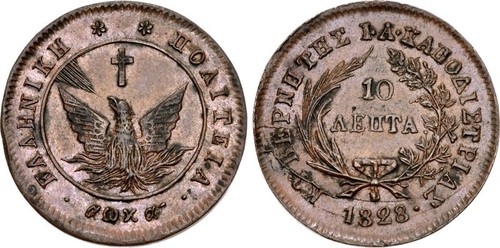
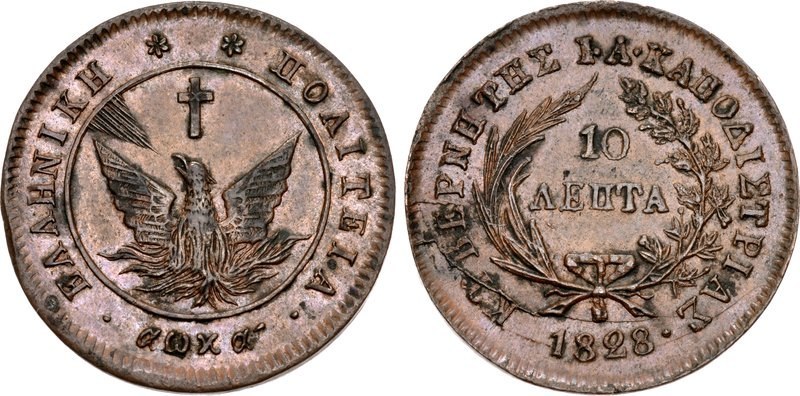
A copper 10 lepta of the first independent Greek state, dated 1828, showing the Phoenix rising from flames beneath a cross against the value within an oak wreath.
- Country
- Greece
- Denomination
- 10 Lepta
- Metal
- Copper
Got a coin like this?
Identify any coin from a photo, free.
Overview
The 10 Lepta dated 1828 is a copper circulation coin from the very first coinage of independent Greece, struck under the Hellenic State led by Governor Ioannis Kapodistrias. It belongs to the short-lived Phoenix coinage that introduced a national currency in the years immediately following the Greek War of Independence.
The obverse shows a Phoenix rising from flames with a small cross above and radiate lines around it, an emblem of the resurrected Greek nation. The reverse states the value 10 ΛΕΠΤΑ within an oak wreath. As a base-metal minor of a brand-new state, it was made for everyday small change rather than as a precious-metal store of value.
Because it comes from the founding moment of the modern Greek state and was produced only briefly with limited equipment, the copper Phoenix 10 lepta is prized more as a historical type than as bullion. It is a tangible relic of Greece's transition from Ottoman rule to nationhood.
History & Background
After nearly a decade of revolution against the Ottoman Empire, Greece emerged as a self-governing state, and in 1828 Ioannis Kapodistrias arrived as its first Governor. One of his early acts was to create a national currency to replace the mix of foreign coins then circulating, establishing the lepton and the phoenix as the units of the new Hellenic State.
This 10 lepta belongs to that first Phoenix series, produced from a mint set up on the island of Aegina, the provisional seat of government. Minting conditions were primitive and output was modest, so the Phoenix coinage was small in scale and short-lived. The design deliberately chose the mythical Phoenix, reborn from its own ashes, as a symbol of a nation rising again after centuries of subjugation, crowned by a cross to signal Orthodox Christian identity.
The Phoenix currency was soon superseded. After Kapodistrias was assassinated in 1831 and the monarchy under King Otto was established in 1832, Greece switched to the drachma and the Phoenix coins were withdrawn. The 1828 copper issues survive today as the earliest coinage of the modern Greek state.
How to Identify
The obverse is the key diagnostic: a Phoenix, a long-necked bird, standing amid flames with rays or a glory around it and a small cross above. This resurrection emblem is unique to the Kapodistrias-era Hellenic State and immediately separates the coin from the later royal drachma coinage that bears a crowned coat of arms or a monarch's portrait. Surrounding Greek lettering names the Hellenic State.
The reverse carries the denomination in Greek, 10 ΛΕΠΤΑ, enclosed within a wreath of oak leaves, with the date 1828 present. The coin is struck in copper, giving it a reddish-brown to chocolate patina rather than the white tone of silver, and it is a chunky, hand-struck minor whose strike is often uneven with visible flan flaws.
Confirm the combination of Phoenix-in-flames obverse, cross above, 10 ΛΕΠΤΑ reverse within an oak wreath, the 1828 date, and copper fabric. Because these were struck on crude equipment, expect somewhat irregular flans, off-center strikes, and variation in exact diameter and weight, all normal for this early issue.
Value & Collectibility
The copper Phoenix 10 lepta is a genuinely historic type as the founding coinage of modern Greece, and it carries a real collector premium above ordinary base-metal coins, though it is not a great rarity. Values are driven strongly by condition, strike quality, and the amount of surviving detail on the Phoenix.
Heavily worn, corroded, or damaged examples, which are common given the soft copper and crude minting, sell for relatively modest sums. Cleaner pieces with a clear Phoenix, even, problem-free surfaces and an attractive natural patina command substantially more, and choice or better-preserved coins can reach into higher collector price levels. Treat any figures as broad context rather than fixed quotes, since condition and market demand cause wide swings.
Because the type is desirable and historically important, it has attracted contemporary and modern counterfeits, so authentication matters more here than for common minors. For any better example, condition, originality of surfaces, and confirmed authenticity are the main things that determine what it is worth.
Frequently asked questions
Why is there a Phoenix on this coin?
The Phoenix, a mythical bird reborn from its own flames, was chosen as the emblem of the newly independent Greek state to symbolize the nation rising again after Ottoman rule. The cross above it signals Greece's Orthodox Christian identity.
How old is the 1828 10 lepta?
It dates to 1828, making it part of the very first coinage of the modern Greek state, struck under Governor Ioannis Kapodistrias shortly after the Greek War of Independence.
Is this coin made of silver?
No. It is struck in copper, so it shows a reddish-brown to chocolate patina rather than the white tone of silver. Its value comes from its history and condition, not precious-metal content.
Is the Phoenix 10 lepta rare or valuable?
It is a sought-after historical type but not extremely rare. Worn or damaged pieces are affordable, while clean, well-struck examples with good surfaces command a solid premium. Because it is desirable, it is also faked, so authentication matters.
What does 10 ΛΕΠΤΑ mean?
It is Greek for 10 lepta, the denomination. The lepton was the small unit of the Phoenix currency introduced by Kapodistrias, later replaced by the drachma system under King Otto.
10 Lepta (Phoenix) guides
In-depth guides for identifying, valuing, and collecting 10 Lepta (Phoenix).