Poltina (½ Rouble)
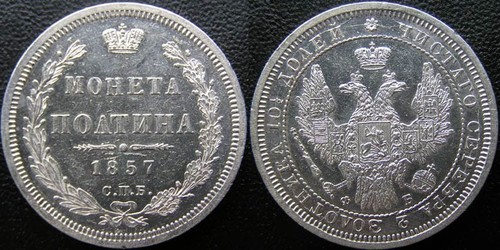
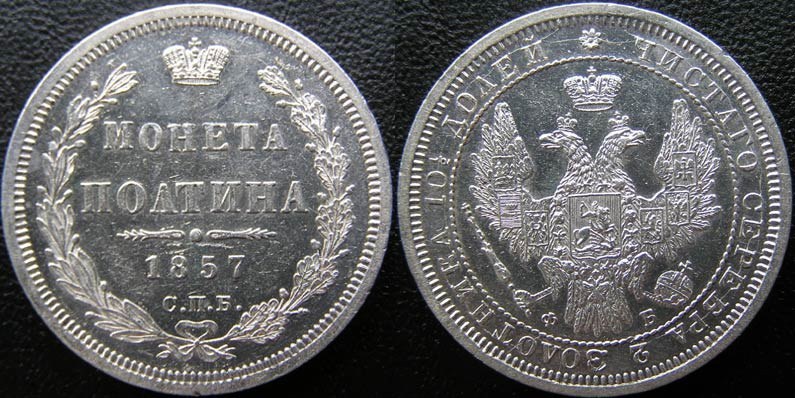
Silver half-rouble of Imperial Russia dated 1857, marked ПОЛТИНА on one side and bearing the crowned double-headed eagle of the Romanov empire.
- Country
- Russia
- Denomination
- Poltina
- Metal
- Silver
Got a coin like this?
Identify any coin from a photo, free.
Overview
The Poltina is the Imperial Russian silver half-rouble, and this example is dated 1857, early in the reign of Tsar Alexander II. One side is dominated by the Cyrillic word ПОЛТИНА (Poltina) together with the date and royal ornament, while the other carries the crowned double-headed eagle that served as the arms of the Russian Empire.
As a half-rouble, the Poltina sat between the smaller silver denominations and the full silver rouble. It is a genuine silver coin, smaller and lighter than the rouble but struck to the same imperial standard, and it circulated as everyday hard money across the empire.
Collectors value the 1857 Poltina both as a dated piece of mid-nineteenth-century Romanov coinage and as an affordable entry into Imperial Russian silver. Its bold Cyrillic denomination and the imperial eagle make it instantly recognizable as a coin of the Tsars.
History & Background
The poltina was a long-established Russian denomination, its name derived from the Old Russian word for a half-rouble. By the mid-nineteenth century it was struck as a milled silver coin within the empire's decimal system, in which one rouble equalled 100 kopecks and the poltina represented half a rouble, or 50 kopecks.
An 1857-dated Poltina belongs to the reign of Alexander II, who came to the throne in 1855 and is remembered for the emancipation of the serfs in 1861 and other reforms. The coin was produced at the imperial mint using the standardized eagle-and-denomination design that ran across Russian silver of this era, changing in detail over the decades but keeping the same essential arrangement.
Imperial Russian silver of this type continued to be struck until the fall of the monarchy in 1917. Surviving Poltinas from the 1850s are relics of the Romanov empire at its territorial height, and they remain popular with collectors of Russian and world silver coinage.
How to Identify
One face carries the large Cyrillic legend ПОЛТИНА, the Russian word for the half-rouble, together with the date 1857 and imperial ornament such as a crown or decorative elements. Reading this Cyrillic denomination is the quickest way to confirm the coin as a Russian poltina rather than a rouble or a smaller kopeck piece.
The other face shows the imperial double-headed eagle, crowned and with spread wings, the coat of arms of the Russian Empire. The eagle typically clutches the orb and sceptre and bears shields on its breast and wings, and surrounding inscriptions in Cyrillic identify the issuing authority and often the silver standard.
The Poltina is a true silver coin, noticeably smaller and lighter than the full silver rouble but larger than the minor silver denominations. Key identifiers are the Cyrillic word ПОЛТИНА, the 1857 date, the crowned double-headed eagle, and Cyrillic legends throughout; there is no Latin lettering or portrait bust on this type.
Value & Collectibility
As a mid-nineteenth-century Imperial Russian silver coin, the 1857 Poltina carries both collector interest and modest bullion value. Circulated examples are generally affordable, trading in the range of ordinary world silver, while sharp, high-grade, and problem-free pieces command clear premiums with collectors of Russian coinage.
Condition drives most of the spread. Wear shows readily on the eagle's detail and on the high points around the denomination, so coins with strong strike, original surfaces, and attractive toning are worth more than heavily worn, cleaned, or damaged pieces. Older Russian silver was often cleaned, which reduces value.
Exact prices depend on grade, eye appeal, market demand, and silver spot, so treat these as general ranges rather than fixed quotes. Because Imperial Russian silver is widely collected and sometimes faked, certified or carefully authenticated examples bring the strongest and most reliable prices.
Frequently asked questions
What does ПОЛТИНА mean?
ПОЛТИНА is the Cyrillic spelling of Poltina, the Russian name for a half-rouble. The word appears prominently on the coin to state its denomination of fifty kopecks.
Is the 1857 Poltina real silver?
Yes. The Imperial Russian Poltina is a genuine silver half-rouble struck to the empire's silver standard, which gives it weight and a bright silver appearance.
What is the bird on the reverse?
It is the imperial double-headed eagle, the coat of arms of the Russian Empire, shown crowned with spread wings and usually holding an orb and sceptre.
How does a Poltina relate to a rouble?
A poltina is half a rouble, equal to 50 kopecks in Russia's system of 100 kopecks to the rouble. It is smaller and lighter than the full silver rouble.
Is this coin valuable?
It is a collectible silver type. Worn examples are affordable, while high-grade, original pieces bring notable premiums. Value depends on grade, eye appeal, authenticity, and silver price.
Poltina (½ Rouble) guides
In-depth guides for identifying, valuing, and collecting Poltina (½ Rouble).