1 Franc (Leopold II)
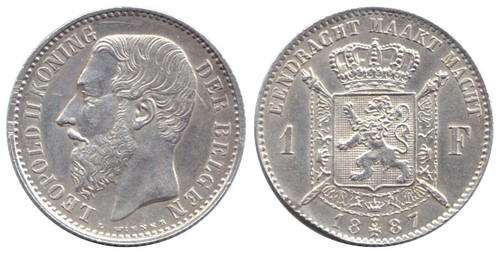
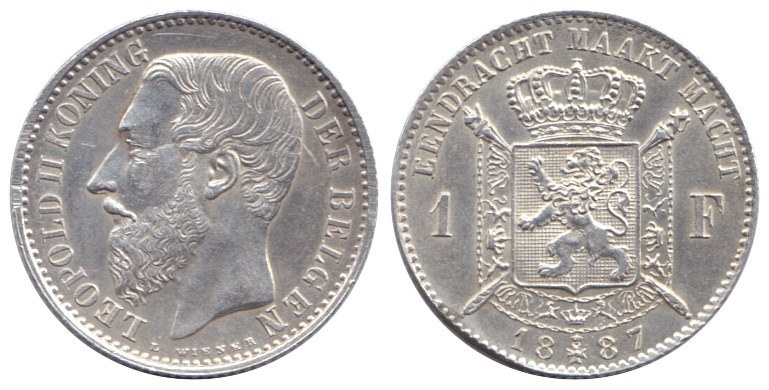
A late-19th-century Belgian silver franc of King Leopold II, with his left-facing profile on the obverse and a crowned coat of arms on the reverse.
- Country
- Belgium
- Denomination
- 1 Franc
- Metal
- Silver
Got a coin like this?
Identify any coin from a photo, free.
Overview
The 1 Franc of Leopold II is a small silver coin of the Kingdom of Belgium struck during the long reign of its second king. The example shown, dated 1887, carries the bare left-facing portrait of Leopold II on the obverse and a crowned Belgian coat of arms on the reverse, the classic pairing used for the country's franc denominations of the period.
As a franc, the coin was made to the silver standard of the Latin Monetary Union, the 19th-century currency bloc that harmonized the weight and fineness of French, Belgian, Swiss, Italian and other francs so they could circulate across borders. That heritage is why the piece is close in size and metal to a French franc of the same era.
Collectors pursue it both as a portrait type of Leopold II and as a small, affordable silver coin. Because Belgium issued its inscriptions in two languages, the same year can be found with either a French or a Flemish legend, a detail that adds interest to type sets.
History & Background
Leopold II ruled Belgium from 1865 to 1909, a period of rapid industrial growth and colonial expansion. His coinage replaced the earlier issues of his father, Leopold I, and the mature portrait used on this franc reflects the king in later middle age.
Belgium was a founding member of the Latin Monetary Union, formed in 1865, which fixed the 1 franc as a small silver coin shared in standard with several neighboring nations. Under this system Belgium struck francs, half francs and larger silver pieces to a common specification, allowing them to pass at par abroad.
Because Belgium is officially bilingual, coin legends were issued in both French (LEOPOLD II ROI DES BELGES) and Dutch/Flemish (LEOPOLD II KONING DER BELGEN). The two legend variants of a given date were struck to serve the country's French- and Dutch-speaking populations, and both circulated together.
How to Identify
The obverse shows the bare (uncrowned) head of Leopold II facing left, with a full beard, surrounded by the royal legend and the engraver's name below the neck. The wording is either LEOPOLD II ROI DES BELGES (French) or LEOPOLD II KONING DER BELGEN (Flemish), which is the quickest way to tell the two language variants apart.
The reverse displays the crowned coat of arms of Belgium, a mantled shield topped by a royal crown, with the value 1 FRANC (or 1 FRANK on the Flemish issue) and the date, here 1887. The design is a heraldic composition rather than a figure or allegory.
The coin is struck in silver to the Latin Monetary Union franc standard, giving a small piece of roughly 23 mm diameter and about 5 grams weight in a fineness near .835. Its modest size, silver tone, portrait-and-arms layout, and bilingual legend options are the core identifiers of the type.
Value & Collectibility
The Leopold II silver franc is a common and generally affordable coin. In well-worn condition it trades for a small premium over its silver content, while cleaner examples in higher grades command more, and truly uncirculated pieces with full detail are the most sought after.
Value depends heavily on grade, eye appeal, and which legend variant and date are present, since some year-and-language combinations were struck in smaller quantities than others. Because the coin contains only a few grams of silver, its bullion floor is low and most of the price for collectible examples reflects condition and demand.
Ranges here are general context rather than fixed quotes; actual prices vary with the market and the specific coin. Original, uncleaned surfaces and sharp detail in the portrait and crown add the most value.
Frequently asked questions
Is the Leopold II 1 Franc real silver?
Yes. It was struck in silver to the Latin Monetary Union franc standard, a small coin of roughly 5 grams at a fineness near .835. The silver content is modest but genuine.
Why do some examples have French text and others Dutch?
Belgium is bilingual, so the franc was issued with either a French legend (LEOPOLD II ROI DES BELGES) or a Flemish one (LEOPOLD II KONING DER BELGEN). Both circulated together; the Flemish reverse reads 1 FRANK.
What is shown on the reverse?
The reverse shows the crowned coat of arms of Belgium, a mantled shield beneath a royal crown, together with the value 1 FRANC (or 1 FRANK) and the date.
Who was Leopold II?
Leopold II was King of the Belgians from 1865 to 1909. His left-facing bearded portrait appears on the obverse of this franc.
Is the 1887 date rare?
The type is common overall, though individual date-and-language combinations vary in scarcity. Value is driven mainly by condition rather than the year alone.
1 Franc (Leopold II) guides
In-depth guides for identifying, valuing, and collecting 1 Franc (Leopold II).