
How to Identify the 1 Franc (Leopold II)
A collector's guide to confirming a Belgian silver 1 Franc of Leopold II by its portrait, crowned arms, bilingual legend, size and metal.
Read the full 1 Franc (Leopold II) encyclopedia entry →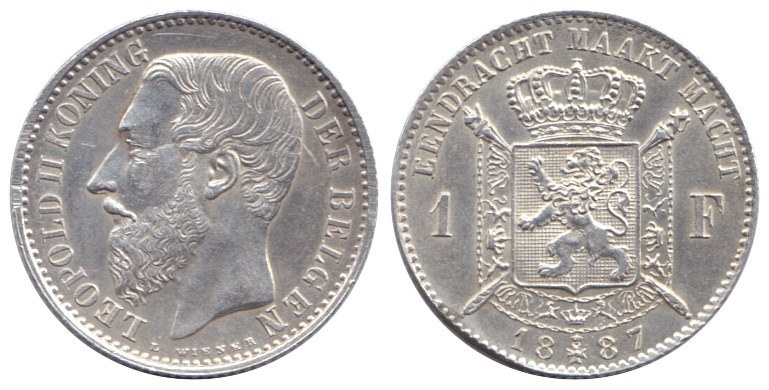
Start With the Portrait and Legend
The obverse should show the bare left-facing head of a bearded man, Leopold II, ringed by a royal legend. Read that legend to pin down the variant: LEOPOLD II ROI DES BELGES marks the French issue, while LEOPOLD II KONING DER BELGEN marks the Flemish one. The engraver's name usually appears in small letters below the neck. A crowned bust, a facing head, or a different name means you have a different coin or ruler.
Check the Reverse Arms and Value
Turn the coin over and confirm a crowned coat of arms: a mantled heraldic shield topped by a royal crown, not a standing figure, wreath, or plain numeral. The value should read 1 FRANC on French coins or 1 FRANK on Flemish coins, with the date beside or below the arms. On the pictured example that date is 1887.
Verify Size and Metal
This is a small silver coin made to the Latin Monetary Union franc standard, so expect a diameter of about 23 mm, a weight near 5 grams, and a fineness around .835. It should be non-magnetic and show the soft gray luster of silver rather than the brighter, lighter feel of a base-metal or later franc. A coin that is markedly heavier, lighter, or magnetic is not this type.
Separate It From Look-Alikes
France, Switzerland and other union members struck francs of nearly identical size and metal in the same era, so always confirm the Belgian legend and the crowned Belgian arms rather than relying on size alone. Watch also for the larger Belgian 2 francs and 5 francs of Leopold II, which share the portrait style but carry different values and diameters. Leopold I francs use an older portrait and different legends and should not be confused with his son's issues.
Authentication Cautions
Weigh and measure suspect pieces, since underweight or off-diameter examples can betray a cast or plated fake. Be wary of harshly cleaned or re-engraved surfaces that inflate apparent grade, and of tooled dates. When the portrait, crowned arms, bilingual value, correct silver weight and 23 mm size all agree, the attribution to a Leopold II 1 Franc is secure.
Frequently asked questions
How do I tell a Belgian franc from a French franc of the same period?
Read the legend and check the arms. The Belgian coin names LEOPOLD II and shows the crowned Belgian coat of arms, while French francs of the era carry French inscriptions and their own designs, even though both share the same size and silver standard.
What weight and size should it be?
Expect a small silver coin of roughly 23 mm diameter and about 5 grams, struck to the Latin Monetary Union standard at a fineness near .835. Large deviations suggest a different coin or a fake.
Does the language on the coin affect what it is?
No, both are the same denomination. French (ROI DES BELGES / 1 FRANC) and Flemish (KONING DER BELGEN / 1 FRANK) legends are two official-language variants of the same franc; they simply help identify which version you hold.
How can I spot a counterfeit?
Confirm the coin is non-magnetic, weighs about 5 grams, and measures near 23 mm, and look for crisp, untooled detail in the portrait and crown. Wrong weight, magnetism, or soft cast-looking surfaces are warning signs.