1 Escudo
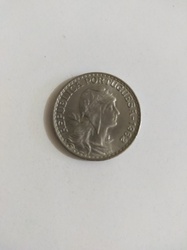
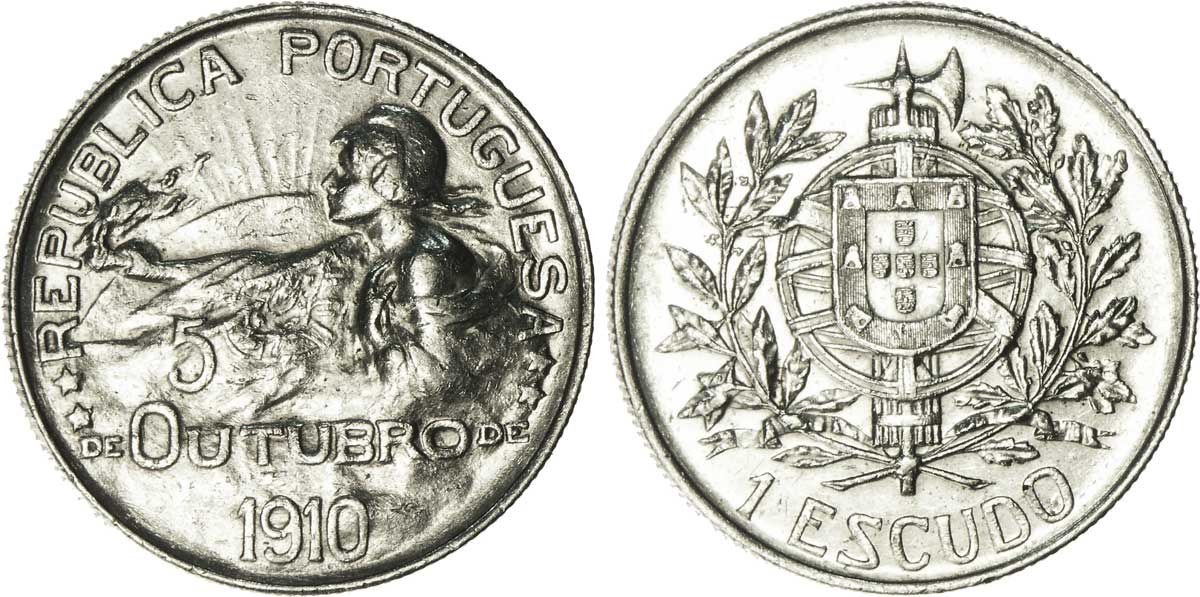
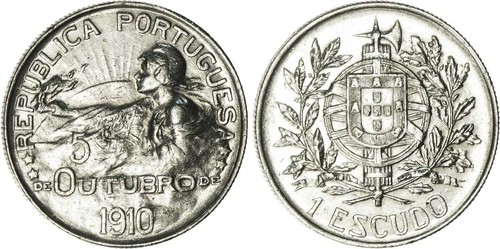
Portugal's first silver escudo, struck in 1910 to mark the founding of the Republic, with an allegorical female head and the crowned national shield.
- Country
- Portugal
- Denomination
- 1 Escudo
- Metal
- Silver
Got a coin like this?
Identify any coin from a photo, free.
Overview
The 1 Escudo of 1910 is a silver coin of the newly proclaimed Portuguese Republic and effectively the flagship piece of the country's first republican coinage. It pairs an allegorical female profile on the obverse with the national arms on the reverse, and its legends explicitly tie it to the October 1910 revolution that ended the monarchy.
This is a genuine precious-metal issue: a substantial crown-sized silver coin roughly 37 mm across, meant to represent the new unit of account, the escudo, which replaced the old real system. Because of its size, silver content, and historic role as the Republic's inaugural escudo, it is one of the most sought-after Portuguese coins of the twentieth century.
Collectors value it both as a one-year type and as a tangible relic of Portugal's transition from kingdom to republic. Well-struck, high-grade examples are prized, and the coin frequently anchors type sets of modern Portuguese silver.
History & Background
On 5 October 1910 a revolution in Lisbon overthrew the Portuguese monarchy and proclaimed the Republic, ending centuries of rule by the House of Braganza. The new state moved quickly to reform the currency, replacing the real with the escudo, divided into 100 centavos, as its monetary unit.
The 1910-dated 1 Escudo was issued in this founding period as the standard-bearer of the republican coinage. Its imagery abandoned the royal portrait used on monarchy-era coins in favor of an allegorical figure symbolizing the Republic, and its inscriptions reference the October date of the revolution, making the coin both money and political statement.
The escudo remained Portugal's currency until the country adopted the euro in 2002. The 1910 silver escudo stands at the very start of that long escudo era, which is a large part of why it is remembered and collected today.
How to Identify
The obverse shows a female head in profile facing right, an allegory of the Republic, encircled by the legend REPUBLICA PORTUGUESA together with wording referring to the fifth of October (DE OUTUBRO) and the date 1910. The female figure, not a named monarch, is a key marker that this is a republican rather than a royal issue.
The reverse carries the Portuguese national shield, bearing the cross-like arrangement of castles and the small quinas (shields), set beneath a crown, with the value written plainly as 1 ESCUDO. The coin is a large silver crown, on the order of 37 mm in diameter and around 25 grams, so it feels heavy and substantial in hand.
Key identifiers are the republican legend REPUBLICA PORTUGUESA, the allegorical female head rather than a king's bust, the October 1910 reference, the crowned national arms, and the clear 1 ESCUDO denomination. The metal is true silver of high fineness, which gives the coin its weight and ring and distinguishes it from later base-metal escudos.
Value & Collectibility
As a large historic silver coin, the 1910 1 Escudo carries both collector and precious-metal value. Circulated examples generally trade in the low-to-mid tens of dollars, driven partly by silver content, while sharp, high-grade, and lustrous pieces command higher premiums as a desirable one-year republican type.
Condition and eye appeal drive most of the price spread. Because the coin is a broad silver crown, wear shows readily on the high points of the allegorical head and the shield, so problem-free examples with strong detail are worth clearly more than heavily circulated or cleaned coins. Attractively toned, original-surface pieces are especially prized.
Exact prices vary with grade, market conditions, and silver spot, so treat these as general ranges rather than fixed quotes. Cleaned, damaged, or counterfeit pieces trade well below genuine problem-free coins, and higher-end certified examples can bring substantially more.
Frequently asked questions
Is the 1910 Portugal 1 Escudo real silver?
Yes. It is a genuine silver crown of high fineness, which is why it is large and heavy for its size and rings when struck. Its silver content contributes to its collector value.
Who is the woman on the obverse?
She is an allegorical figure representing the Portuguese Republic, not a specific monarch. Using an allegory instead of a royal portrait signals the coin's republican, post-monarchy identity.
Why does it mention October 1910?
The inscription referencing the fifth of October and the date 1910 commemorates the revolution of 5 October 1910 that overthrew the monarchy and established the Portuguese Republic.
What is on the reverse?
The reverse shows the Portuguese national shield with its castles and quinas beneath a crown, alongside the value written as 1 ESCUDO.
Is this coin valuable?
It is a desirable historic silver type. Circulated pieces are affordable, while high-grade, original examples bring notable premiums. Value depends on grade, eye appeal, and silver price.
1 Escudo guides
In-depth guides for identifying, valuing, and collecting 1 Escudo.
1 Escudo identified by the community
Real coins identified with Coin Identifier.