1000 Reis (Discovery of India)
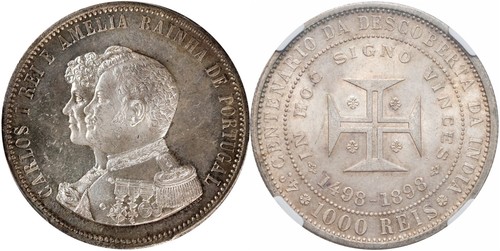
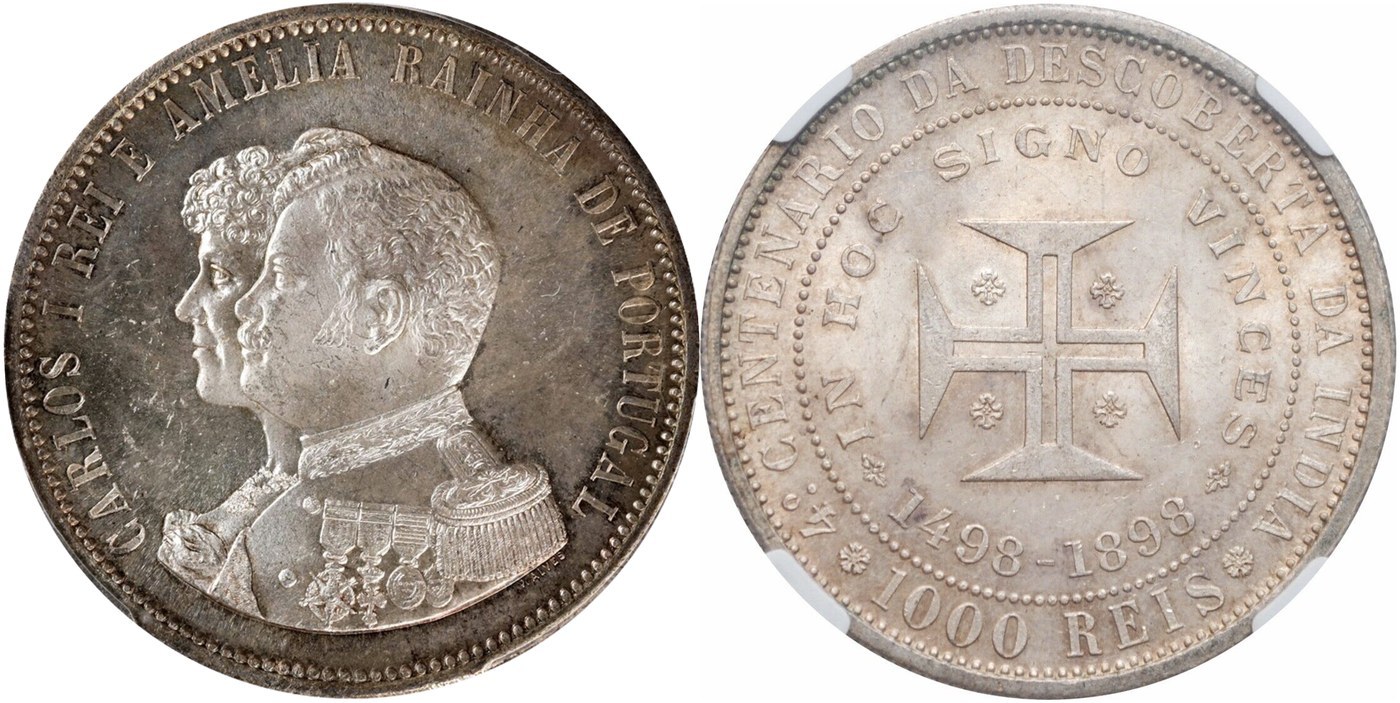
A late Kingdom of Portugal 1000 Reis of the Carlos I period, showing a king's right-facing profile and the crowned Portuguese royal arms on the reverse.
- Country
- Portugal
- Denomination
- 1000 Reis
- Metal
- Gold
Got a coin like this?
Identify any coin from a photo, free.
Overview
This coin is a 1000 Reis piece from the Kingdom of Portugal, dating to the reign of King Carlos I in the first decade of the 1900s. The obverse carries a male royal portrait in profile facing right, ringed by an inscription with the king's titles, while the reverse displays the Portuguese royal coat of arms, a crowned shield built from the cross-shaped arrangement of castles and the five smaller shields (quinas) that define Portuguese heraldry.
The reis (plural of real) was the historic unit of Portuguese money, and 1000 reis, often written as a mil reis, was one of its larger everyday denominations. The example seen here presents as a gold or gold-toned coin; collectors should note that Portuguese 1000 Reis of this era were also struck in silver, so verifying the actual metal is part of attributing any given piece.
The "Discovery of India" name reflects Portugal's tradition of commemorating the 1498 opening of the sea route to India by Vasco da Gama, a theme that appears on Portuguese commemorative coinage. Whether a specific 1000 Reis carries that commemorative design or is a standard type is determined by the inscriptions and the reverse motif, so close reading of the coin is essential.
History & Background
Portugal used the real and its multiples as the basis of its money for centuries, and by the late 1800s the mil reis (1000 reis) had become a standard higher-value denomination of the constitutional monarchy. Coins of this system were struck at the Lisbon mint and carried the reigning monarch's portrait and titles.
King Carlos I ruled Portugal from 1889 until his assassination in 1908, after which his son Manuel II reigned as the last king of Portugal until the monarchy fell in the republican revolution of 1910. Coins of this final monarchical period therefore span a politically turbulent era, and the 1906-1910 window places this type near the very end of the Portuguese kingdom.
Portugal marked the 400th anniversary of Vasco da Gama's 1498 voyage to India with commemorative issues, cementing the discovery-of-India theme in its numismatic tradition. The reis system itself was retired in 1911, when the new republic replaced it with the escudo, making late-monarchy reis coins the closing chapter of a very old currency.
How to Identify
Start with the obverse portrait: a male profile facing right, surrounded by a Portuguese-language legend giving the king's name and titles (for the Carlos I period, look for CARLOS I and references to Portugal). The date sits within the design and should fall in the late-monarchy range.
The reverse is the strongest identifier. It shows the Portuguese royal arms: a central shield topped by a royal crown, with the shield composed of a cross-like grouping of the small quina shields set within a border of castles. This distinctive cross-and-shields heraldry is characteristic of Portugal and separates it from other national arms. The denomination 1000 REIS should appear in the reverse legend or field.
Confirm the denomination text, the Portuguese royal arms, and the king's name together rather than relying on any single feature. Because the piece presents as gold-colored, check whether it is genuinely gold or a silver coin with toning or gilding; the true metal, diameter, and weight are decisive for pinning down the exact type and whether it is a commemorative or a standard issue.
Value & Collectibility
Value for a late Kingdom of Portugal 1000 Reis depends heavily on the actual metal, the specific date and type, and the grade. A genuine gold piece would carry meaningful bullion value on top of any collector premium, while a silver 1000 Reis of the same denomination trades chiefly on its numismatic and condition merits. Establishing the real metal is therefore the first step before estimating worth.
Commemorative and scarcer-date monarchy coins generally command higher premiums than common circulating dates, and well-struck, lightly worn examples are worth considerably more than heavily circulated ones. Original surfaces, sharp heraldic detail on the reverse arms, and a clear portrait all add to desirability.
Because prices swing with metal content, date rarity, grade, and market conditions, treat any figure as general context rather than a fixed quote. For a coin of this value bracket, a professional appraisal or third-party authentication is worthwhile before buying or selling.
Frequently asked questions
What is a reis, and what does 1000 Reis mean?
The real (plural reis) was Portugal's historic money unit. 1000 reis, often written mil reis, was a larger denomination of the Portuguese monarchy before the escudo replaced the reis system in 1911.
Who is on the obverse?
The obverse shows a Portuguese king in right-facing profile with his titles in the legend. For the 1906-1910 window this corresponds to the reign of Carlos I and the final years of the Portuguese monarchy.
What is the coat of arms on the reverse?
It is the Portuguese royal arms: a crowned shield formed from the cross-like arrangement of small quina shields within a border of castles, a heraldic device unique to Portugal.
Is this coin really gold?
The example presents as gold-colored, but Portuguese 1000 Reis were also struck in silver, and toning or gilding can mislead. Verifying the true metal by weight, diameter, and testing is essential before valuing it.
What is the Discovery of India connection?
Portugal commemorated the 400th anniversary of Vasco da Gama's 1498 sea route to India on its coinage. Whether a given 1000 Reis is that commemorative or a standard type depends on its exact design and inscriptions.
1000 Reis (Discovery of India) guides
In-depth guides for identifying, valuing, and collecting 1000 Reis (Discovery of India).