
How to Identify the Poltina (½ Rouble)
A collector's guide to confirming the Imperial Russian Poltina by its Cyrillic ПОЛТИНА denomination, 1857 date, double-headed eagle, and silver format.
Read the full Poltina (½ Rouble) encyclopedia entry →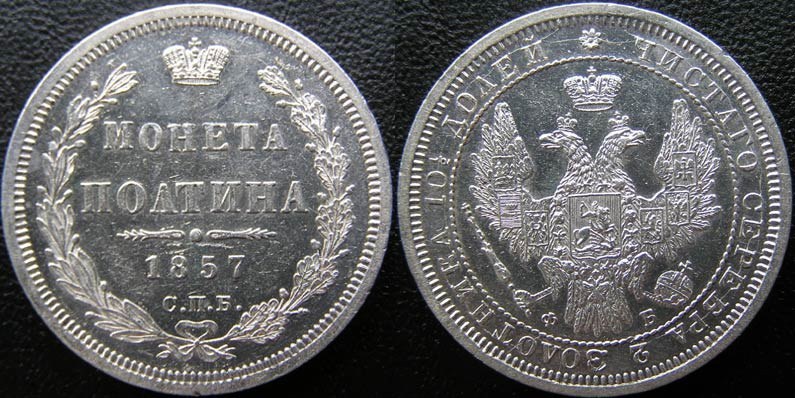
Read the Cyrillic Denomination
Start with the side bearing the large word ПОЛТИНА. This Cyrillic legend is the single most decisive marker: it names the coin as a half-rouble and separates it from the full rouble (РУБЛЬ) and from smaller kopeck pieces. Confirm the date beside it reads 1857, and note any crown or ornament that frames the denomination on this type.
Confirm the Imperial Eagle
Turn to the other face and check for the crowned double-headed eagle of the Russian Empire, wings spread, typically holding an orb and sceptre and carrying shields on its breast and wings. The surrounding text should be Cyrillic, identifying the issuing authority and often the silver standard. If the reverse lacks this two-headed eagle, the coin is not an Imperial Russian poltina of this type.
Check Size, Weight, and Metal
The Poltina is a genuine silver coin, distinctly smaller and lighter than the crown-sized silver rouble but larger than the minor silver kopeck denominations. It should feel dense for its size and show the bright tone or gray patina of struck silver, and it must be non-magnetic. A lightweight, thin, or magnetic piece of this design is a warning sign.
Rule Out Look-Alikes and Related Denominations
Imperial Russia struck a family of similar eagle-and-Cyrillic silver coins, including the full rouble and fractional pieces such as 25, 20, 15, 10 and 5 kopecks. They share the eagle and Cyrillic style but differ in size and stated value, so always read the denomination word and any kopeck figure. Matching the ПОЛТИНА legend, the 1857 date, and the imperial eagle together is what pins down this exact type.
Authentication Cautions
Because Imperial Russian silver is widely collected, it attracts counterfeits, altered dates, and cast copies. Weigh and measure the coin, compare the eagle and lettering to trusted references, and watch for soft mushy detail, wrong weight, seams, or an off color that suggest a fake or a plated piece. Cleaning is common on old Russian silver and lowers value, so favor original surfaces, and for higher-value examples consider third-party authentication.
Frequently asked questions
How do I tell a Poltina from a full rouble?
Read the denomination word. A poltina is marked ПОЛТИНА (half-rouble) and is smaller and lighter, while the full rouble is marked РУБЛЬ and is a larger, heavier crown-sized silver coin.
The coin has no portrait. Is that correct?
Yes. This Poltina type shows the crowned double-headed eagle and the Cyrillic denomination rather than a tsar's portrait bust, so the absence of a portrait is normal for the design.
How can I rule out a kopeck piece?
Kopeck denominations state a number of kopecks in Cyrillic (for example 25 or 20 КОПѢЕКЪ) and are generally smaller. The Poltina instead spells out ПОЛТИНА for the half-rouble value.
Is it worth authenticating?
For anything beyond a well-worn common example, yes. Imperial Russian silver is faked, so verifying weight, diameter, and design detail, or using third-party certification, guards against counterfeits and altered dates.