
How to Identify the Reis (Peninsular War)
A collector's guide to confirming the 1910 Portuguese Peninsular War silver Reis by its Manuel II bust, 1808-1814 dates, and crowned arms.
Read the full Reis (Peninsular War) encyclopedia entry →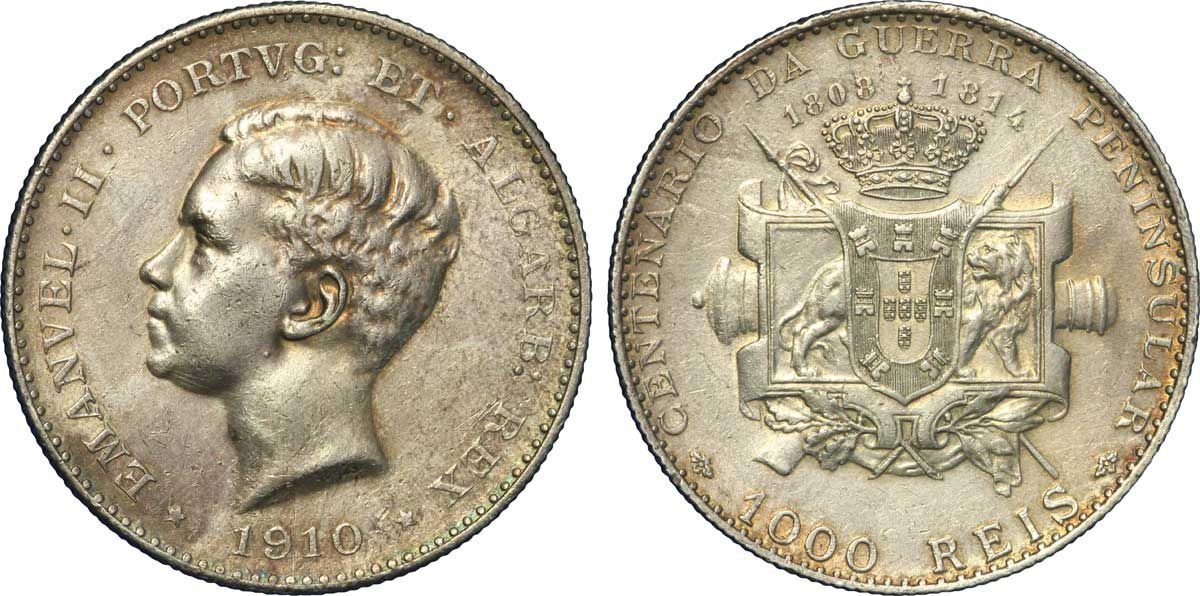
Start With the Dual Dates
The fastest confirmation is the date pairing. Look for the Peninsular War span 1808-1814 framing the royal bust, combined with the 1910 strike date on the coin. This dual-date combination is specific to the centenary commemorative and separates it from ordinary circulating Reis of the period, which carry only a single date.
Verify the Obverse Portrait and Legend
The obverse must show a youthful bust of King Manuel II facing left, draped and cuirassed. The legend should read MANOEL II PORTUGAL in the older Portuguese spelling. A bust facing right, a different name such as CARLOS or LUIZ, or a republican legend (REPUBLICA PORTUGUESA) all indicate a different coin. The young, military-style portrait is a key cue, since Manuel reigned only briefly as a teenager.
Check the Reverse Heraldry
Turn to the reverse and confirm the Portuguese coat of arms beneath a royal crown, accompanied by crossed palm branches. The shield should carry the traditional castles-and-quinas symbols. The presence of a crown and full royal arms marks this as a pre-republican monarchy issue; later republican coins drop the crown in favor of a Liberty head or the republican shield.
Confirm Metal, Size, and Weight
This is a silver commemorative, so a genuine piece should feel dense, ring clearly, and show silver's characteristic tone and wear. Weigh and measure the coin against published specifications for the specific denomination in the series before drawing conclusions; a piece that is light, dull, or magnetic is a warning sign. Do not assume the value from appearance alone, as the series includes more than one denomination struck to different standards.
Watch for Look-Alikes and Fakes
Because these are short-lived royal commemoratives with collector value, be alert to cast copies, tooled surfaces, and altered dates. Compare the sharpness of the bust, crown, and heraldic detail to trusted reference images, and be cautious of examples where the 1808-1814 dates or the 1910 strike look re-engraved. When value or authenticity is in doubt, third-party grading and attribution give the most reliable answer.
Frequently asked questions
How do I know this is a commemorative and not a regular Reis coin?
The giveaway is the presence of two dates: the Peninsular War span 1808-1814 with the bust, plus the 1910 strike date. Standard circulating Reis carry only a single date and lack the centenary war theme.
How can I tell a royal issue from a later republican Portuguese coin?
Look for the crowned royal arms and the legend naming MANOEL II PORTUGAL. Republican coins from 1910 onward drop the royal crown and portrait and instead read REPUBLICA PORTUGUESA with republican designs.
What should I check to confirm it is silver?
A genuine example should have the weight, ring, and tone of struck silver, and should not be attracted to a magnet. Compare its measured weight and diameter to published figures for the specific denomination rather than judging by color alone.
What are the main red flags for a fake?
Watch for soft, blurry detail suggesting a cast copy, re-engraved or altered dates, and incorrect weight or size. For valuable examples, third-party grading is the safest way to confirm both authenticity and the exact denomination.