
Quincunx of Capua
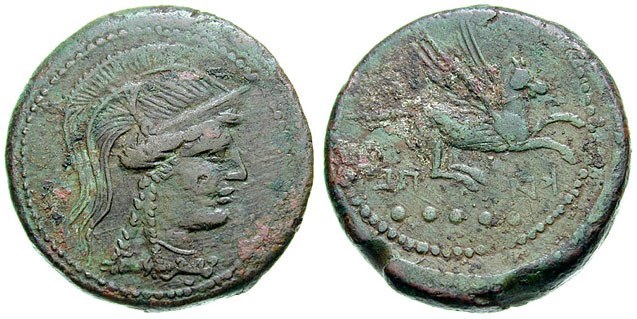
Bronze quincunx (5 unciae) struck by Capua in Campania in the 3rd century BC, pairing a diademed female head with a lion or griffin and five value pellets.
- Country
- Capua (Italic)
- Denomination
- Quincunx
- Metal
- Bronze
Got a coin like this?
Identify any coin from a photo, free.
Overview
This is a bronze quincunx of Capua, the leading city of ancient Campania in southern Italy, struck in the 3rd century BC. The quincunx was a denomination worth five unciae, that is five-twelfths of an as, and its name comes directly from that value. The defining feature of the type is its mark of value: five pellets, or a quincunx pattern of dots, indicating the five unciae.
The obverse of this issue shows a female head facing right wearing a diadem, while the reverse carries an animal design, described on this example as a lion or griffin, together with the five-pellet value mark. As a hand-struck ancient bronze, each surviving coin differs slightly in centering, flan shape, patina, and wear, and the piece shown here is one such individually struck survivor from more than two thousand years ago.
History & Background
Capua was the wealthy chief city of Campania and one of the most important urban centers of ancient Italy. During the 3rd century BC it produced its own bronze coinage on the Italic uncial system, in which denominations were counted in unciae and marked with pellets. The quincunx, at five unciae, sat between the smaller fractional bronzes and the larger multiples of the as.
The best-known phase of Capua's independent coinage falls during the Second Punic War. After the Roman defeat at Cannae in 216 BC, Capua broke with Rome and allied with Hannibal, and in this period the city struck bronze in its own name. When Rome recaptured Capua in 211 BC it punished the city harshly and stripped away its autonomy, bringing this local coinage to an end. That historical window helps explain why these coins are firmly dated to the 3rd century BC.
Coins like this circulated as everyday small change within Campania rather than as far-traveling international money. Many survive today because bronze coinage was produced in quantity, and specimens turn up in the collections and hoards associated with the region.
How to Identify
Look for a fairly substantial cast-flan or hand-struck bronze coin, larger and heavier than a small fractional piece, with a green, brown, or mixed earthen patina typical of ancient bronze. The single most diagnostic feature is the mark of value: five pellets arranged as a quincunx, confirming the five-uncia denomination.
The obverse shows a female head facing right wearing a diadem. The reverse displays an animal, identified on this example as a lion or griffin, moving or standing, accompanied by the five value pellets and sometimes traces of a legend or symbol in the field. The combination of the diademed female head with the animal reverse and five pellets is the key that identifies the piece as a Capuan quincunx rather than another Campanian bronze denomination.
Because each coin was made by hand in antiquity, expect variation in strike sharpness, centering, and flan outline, which is often slightly irregular. Genuine examples show the surface texture, patina, and honest wear of ancient bronze rather than the crisp uniformity of a modern machine-struck coin.
Value & Collectibility
Values for a Capuan quincunx depend heavily on condition, surviving detail, and the quality of the patina. Worn, corroded, or off-center examples generally trade in the modest tens of dollars, while attractive pieces with a clear portrait, a legible animal reverse, and a pleasing even patina bring meaningfully more, often into the low or mid hundreds of dollars.
Strong, well-centered coins with sharp detail and good surfaces, especially with documented provenance, can sell for higher sums at specialist ancient-coin auctions. Damaged, tooled, cleaned down to bare metal, or heavily encrusted coins sell for much less. Because each ancient bronze is unique and the market shifts over time, treat any single figure as a reference point rather than a fixed price.
Provenance and authentication add value: coins with a documented collection history and, where relevant, appropriate export documentation are more desirable than anonymous pieces of equal grade.
Frequently asked questions
What is a quincunx?
A quincunx is an ancient Italic bronze denomination worth five unciae, or five-twelfths of an as. Its name reflects that value, and coins of this denomination are marked with five pellets, arranged in the quincunx pattern, as the mark of value.
Why do five pellets appear on the coin?
The five pellets are the mark of value. On the Italic uncial system a coin's worth in unciae was shown by a row or cluster of pellets, so five pellets identify the piece as a quincunx, that is five unciae.
When and where was it made?
It was struck at Capua, the chief city of ancient Campania in southern Italy, during the 3rd century BC. The most famous phase of Capua's own coinage falls in the Second Punic War, when the city allied with Hannibal before Rome recaptured it in 211 BC.
Is the coin made of bronze?
Yes. This is a base-metal bronze coin, not silver or gold. Capua's fractional denominations like the quincunx were struck in bronze for everyday local circulation, and genuine examples show the patina and wear typical of ancient bronze.
Is the reverse animal a lion or a griffin?
On this example the reverse animal is described as a lion or griffin. Capuan and Campanian bronzes use several animal reverse types, so the precise creature is read from the individual coin's surviving detail alongside the five value pellets.
Quincunx of Capua guides
In-depth guides for identifying, valuing, and collecting Quincunx of Capua.
Other coins you may enjoy
Tetradrachm of Ptolemy XII
80-51 BC
Tetradrachm of Ptolemy I
305-283 BC
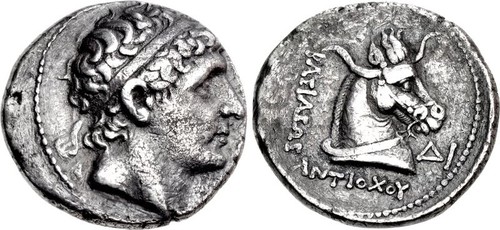
Tetradrachm of Antiochos I Soter
281-261 BC
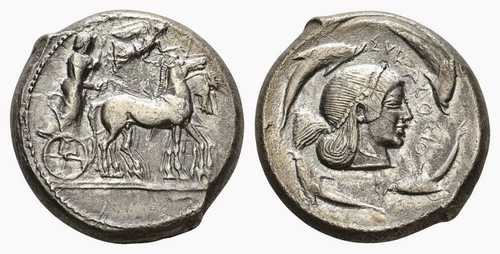
Syracuse Tetradrachm
c. 5th-4th century BC (Classical period)
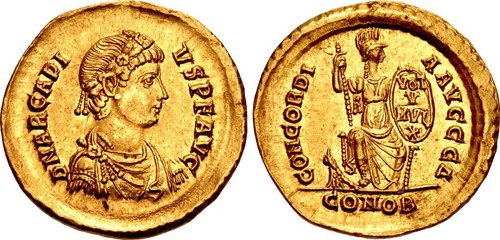
Solidus of Arcadius
AD 395-402
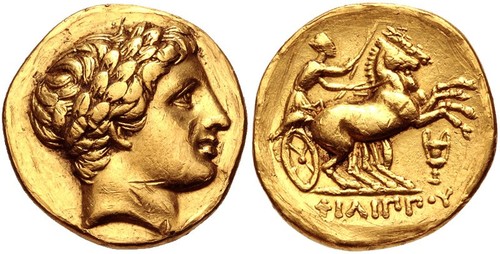
Philip III Gold Stater
323-317 BC
Siliqua of Gratian
AD 367-383
Sestertius of Maximinus Thrax
235-238 AD
Solidus of Valentinian III
AD 425-455
Seleucus I Nicator Tetradrachm
Late 4th-3rd century BC
Nummus of Magnentius
AD 350-353
Follis of Galerius
AD 308-310