
How to Identify the Quincunx of Capua
A collector's guide to recognizing the 3rd century BC bronze quincunx of Capua by its diademed head, animal reverse, five value pellets, and ancient bronze surfaces.
Read the full Quincunx of Capua encyclopedia entry →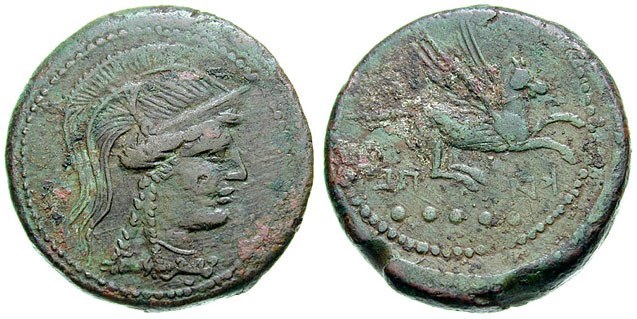
Start with the denomination mark, because it is the most reliable single clue. A quincunx is worth five unciae, and that value is shown by five pellets arranged in the quincunx pattern. Locate those five dots on the coin: they confirm the denomination and separate this piece from other Campanian bronzes marked with different numbers of pellets, such as a sextans (two), a quadrans (three), or a semis (six).
Read the obverse. A genuine example of this type shows a female head facing right wearing a diadem. Note the direction the head faces and the presence of the diadem, since Campanian bronzes use a range of divine and personified heads, and matching the specific portrait helps confirm the attribution rather than relying on general resemblance.
Check the reverse for the animal type. On this coin the reverse carries a lion or griffin, accompanied by the five value pellets and sometimes a symbol or legend traces in the field. The pairing of the diademed head with an animal reverse and five pellets, on a bronze flan, is the combination that points to a Capuan quincunx of the 3rd century BC.
Confirm format, metal, and size. This is a base-metal bronze, generally a substantial coin rather than a tiny fraction, with the earthy green-to-brown patina and slightly irregular flan of ancient hammered or cast-blank coinage. A perfectly round, glossy, uniform piece with a fresh metallic look is a warning sign. Genuine ancient bronze shows honest wear, patina that grows out of the surface, and hand-made variation in centering and strike.
Be cautious with look-alikes and fakes. Many Italic and Campanian cities struck similar bronzes with heads and animals, so match the specific portrait, reverse animal, and pellet count rather than the overall style. Watch for cast reproductions with a soft grainy surface or a faint mold seam around the edge, artificially applied green paint imitating patina, and tooled or re-engraved detail. When value is at stake, weigh and measure the coin, examine it under magnification, and rely on reputable dealers or third-party authentication.
Frequently asked questions
What single feature best confirms this is a quincunx?
The five pellets, arranged in the quincunx pattern, are the mark of value for five unciae. Counting exactly five pellets, alongside the diademed head and animal reverse, is the clearest confirmation of the denomination.
How do I tell a quincunx from other Capuan bronzes?
Count the value pellets. Different denominations carry different pellet counts, so a coin with five pellets is a quincunx, while other numbers indicate a sextans, quadrans, semis, or another fraction of the as.
How can I tell a genuine ancient bronze from a cast copy?
Genuine coins show a hard patina that grows from the metal, honest wear on the high points, and slight hand-made irregularity. Cast fakes often have a soft grainy surface, rounded detail, a faint seam around the edge, or green paint sitting on top of the metal.
Does the reverse have to be a lion?
Not necessarily. This example shows a lion or griffin, but Campanian bronzes use several animal reverses. Identify the coin from the combination of the diademed head, the animal actually present, and the five value pellets rather than assuming one fixed creature.