
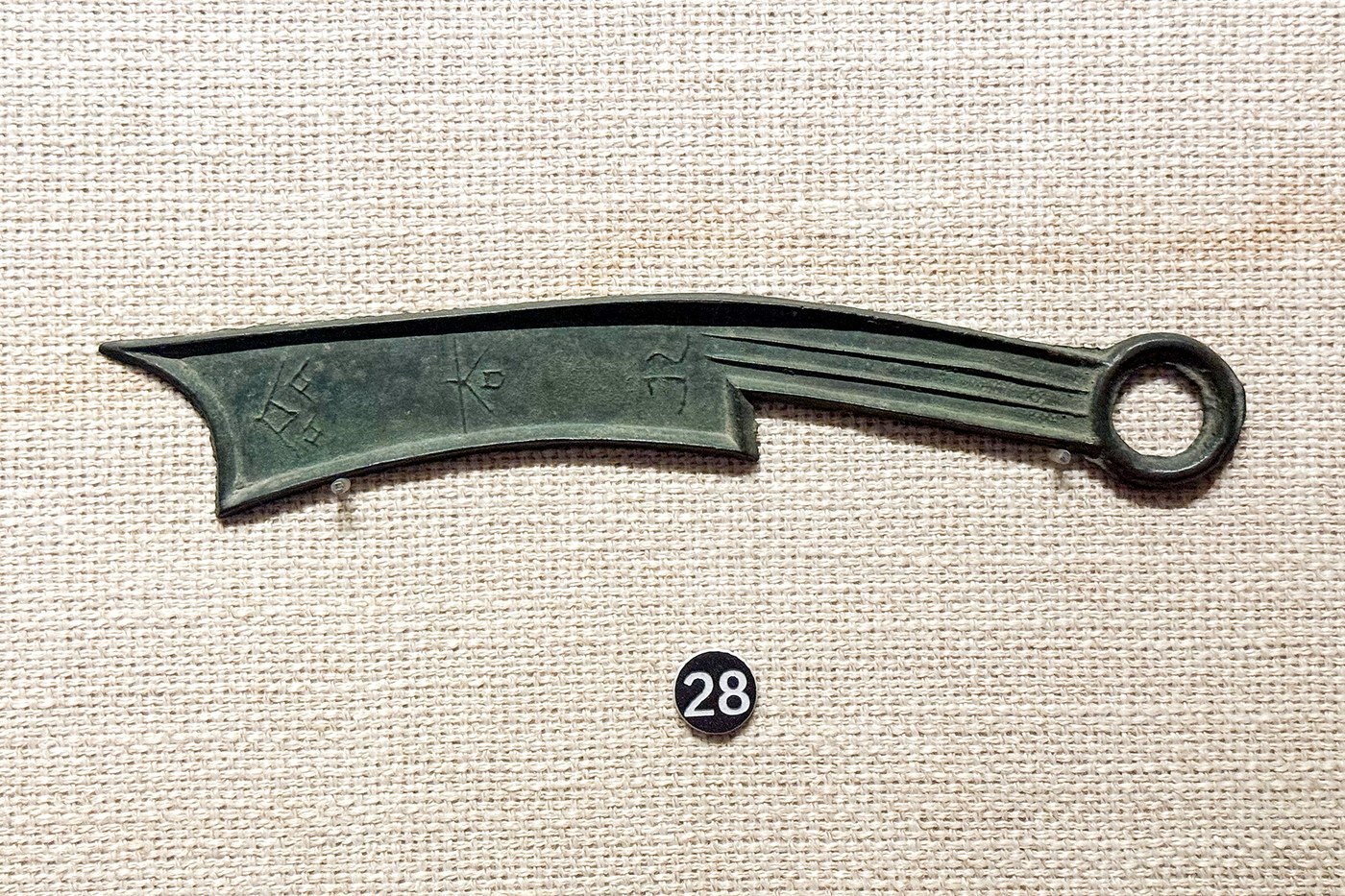
Qi State Knife Coin
A cast bronze knife-shaped coin of the ancient state of Qi, with Chinese characters running down the curved blade and a ringed handle terminal.
- Country
- China
- Denomination
- Knife Money
- Metal
- Bronze
Got a coin like this?
Identify any coin from a photo, free.
Overview
The Qi State knife coin is a form of early Chinese knife money (dao): a cast bronze coin shaped like a full-size cutting knife, with a curved blade, a raised handle, and a rounded ring at the end of the grip. It was produced by the powerful state of Qi in the region of modern Shandong during the Warring States period, when several Chinese states each issued their own distinctive metal money rather than a single unified coinage.
On this example, Chinese characters run in a vertical line down one face of the blade, the inscription that names or authorizes the money. The handle is a narrower rectangular strip carrying raised lines and a ring terminal, the decorative and structural markings typical of the form. The whole object is bronze and was cast in a mould rather than struck, so its shape and lettering are integral to the casting.
Knife money like this is one of the iconic "non-round" coinages of ancient China, alongside spade money and cowrie-derived pieces. Its knife form is thought to descend from the practice of using actual tools and implements as a medium of exchange, later abstracted into a standardized cast currency.
History & Background
During the Warring States period, the fragmented Chinese states experimented with several families of metal money. The eastern state of Qi became especially associated with knife money, casting large, handsome bronze knives that are among the most recognizable of all ancient Chinese coins. These circulated as legal currency within Qi and its sphere of influence.
The inscriptions on Qi knives typically identify them as the money of Qi and include a term often read in the sense of "legal" or "authorized" currency. Different varieties are known, distinguished chiefly by the number and content of the characters on the blade, ranging from shorter inscriptions to longer, more elaborate legends. Because each was cast from moulds, coins were produced in quantity, yet individual pieces vary in the crispness of the characters and the finish of the blade and handle.
The knife coinage of Qi came to an end with the broader unification of China. When the Qin state conquered the rival states and established a unified empire, it standardized the currency on the round bronze coin with a central square hole, and the older regional forms, including Qi knife money, ceased to be issued. This places the type firmly within the pre-imperial Warring States era.
How to Identify
The defining feature is the overall knife shape: a long, gently curved bronze blade that widens toward the tip, joined to a straighter handle that ends in a ring. On this coin the handle is a narrow rectangular strip bearing raised parallel lines, and a rounded terminal closes the grip, matching the "circular head" and "decorative markings" seen on the piece.
Examine the blade for the vertical line of Chinese characters. On Qi knives these run down one face and identify the coin as Qi money; the number of characters is a key diagnostic between varieties. The opposite face and the handle may carry additional marks, lines, or symbols. The metal is bronze, typically with an aged brown-to-green patina, and the coin is a cast object, so look for the smooth, slightly soft detail of casting rather than the sharp relief of a struck coin.
Because the form is so distinctive, a genuine Qi knife is hard to confuse with round Chinese cash. The main identification tasks are confirming the knife shape, reading the blade inscription, and noting the ringed handle. Precise attribution to a specific Qi variety depends on the exact characters and their arrangement, which are best matched against specialist references on early Chinese knife and spade money.
Value & Collectibility
Genuine Qi knife coins are historically important and collectible, and well-preserved authentic examples can be valuable, often ranging from the low hundreds to several thousand dollars or more depending on variety and condition. Varieties with longer, rarer inscriptions and coins with crisp characters, complete blades, and attractive patina sit at the upper end, while damaged, corroded, or repaired pieces are worth considerably less.
Because these coins are ancient, large, and iconic, they have been extensively reproduced and forged. A great many knife-shaped pieces offered as Qi money are modern castings, tourist replicas, or outright fakes, so provenance and expert authentication matter enormously to value; an unattributed knife of uncertain origin should be treated cautiously.
Rather than any fixed figure, value is best established by comparing a specific, authenticated variety and grade against recent sales of genuine examples, ideally with an opinion from a specialist in early Chinese coinage. Condition, completeness of the blade and ring, legibility of the inscription, and above all authenticity are the main drivers of price.
Frequently asked questions
Is this really a coin, even though it is shaped like a knife?
Yes. Knife money is a form of early Chinese cast-bronze currency shaped like a full-size knife. It functioned as money in the state of Qi during the Warring States period, before China adopted the round coin with a square hole. The knife form, not a round disc, is the coin.
What do the Chinese characters on the blade say?
The vertical inscription running down the blade identifies the piece as the money of Qi and includes a term commonly read in the sense of legal or authorized currency. The exact characters vary between types and are the main way to distinguish one Qi knife variety from another.
When and where was it made?
It was cast by the state of Qi, in the area of modern Shandong in eastern China, during the Warring States period (roughly 475-221 BCE). Production of regional knife money ended when China was unified and a standardized round coinage was introduced.
What is it made of?
It is bronze, cast in a mould rather than struck. Genuine ancient examples usually show an aged brown-to-green patina and the soft, integral detail characteristic of casting.
Are Qi knife coins valuable?
Authentic examples can be valuable, from the low hundreds to several thousand dollars or more depending on variety and condition. However, the type is heavily reproduced and forged, so authentication is essential before assuming any knife is a genuine antique.
Qi State Knife Coin guides
In-depth guides for identifying, valuing, and collecting Qi State Knife Coin.
Other coins you may enjoy
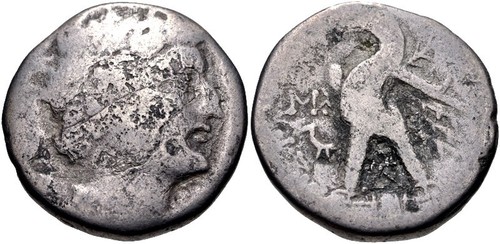
Tetradrachm of Ptolemy XII
80-51 BC
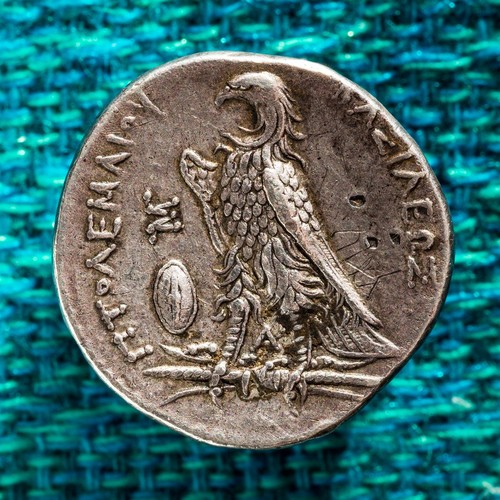
Tetradrachm of Ptolemy I
305-283 BC
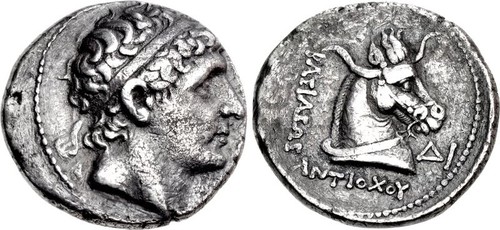
Tetradrachm of Antiochos I Soter
281-261 BC
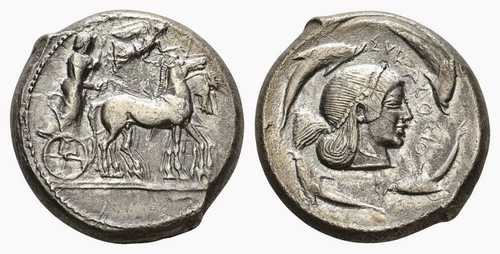
Syracuse Tetradrachm
c. 5th-4th century BC (Classical period)
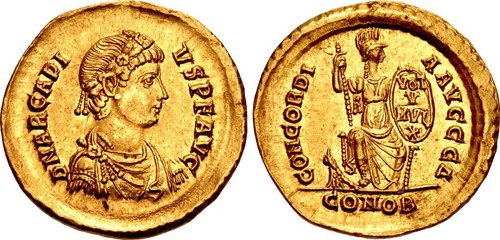
Solidus of Arcadius
AD 395-402
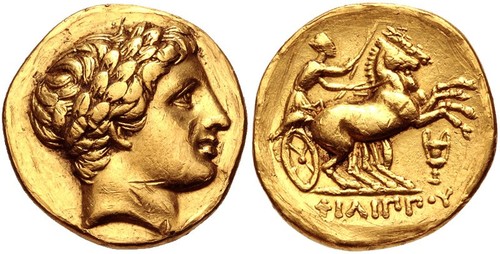
Philip III Gold Stater
323-317 BC
Siliqua of Gratian
AD 367-383
Sestertius of Maximinus Thrax
235-238 AD
Solidus of Valentinian III
AD 425-455
Seleucus I Nicator Tetradrachm
Late 4th-3rd century BC
Nummus of Magnentius
AD 350-353
Follis of Galerius
AD 308-310