
How to Identify the Qi State Knife Coin
A collector's checklist for the bronze Qi knife coin: its knife shape, blade inscription, ringed handle, cast bronze surfaces, and the many fakes to watch for.
Read the full Qi State Knife Coin encyclopedia entry →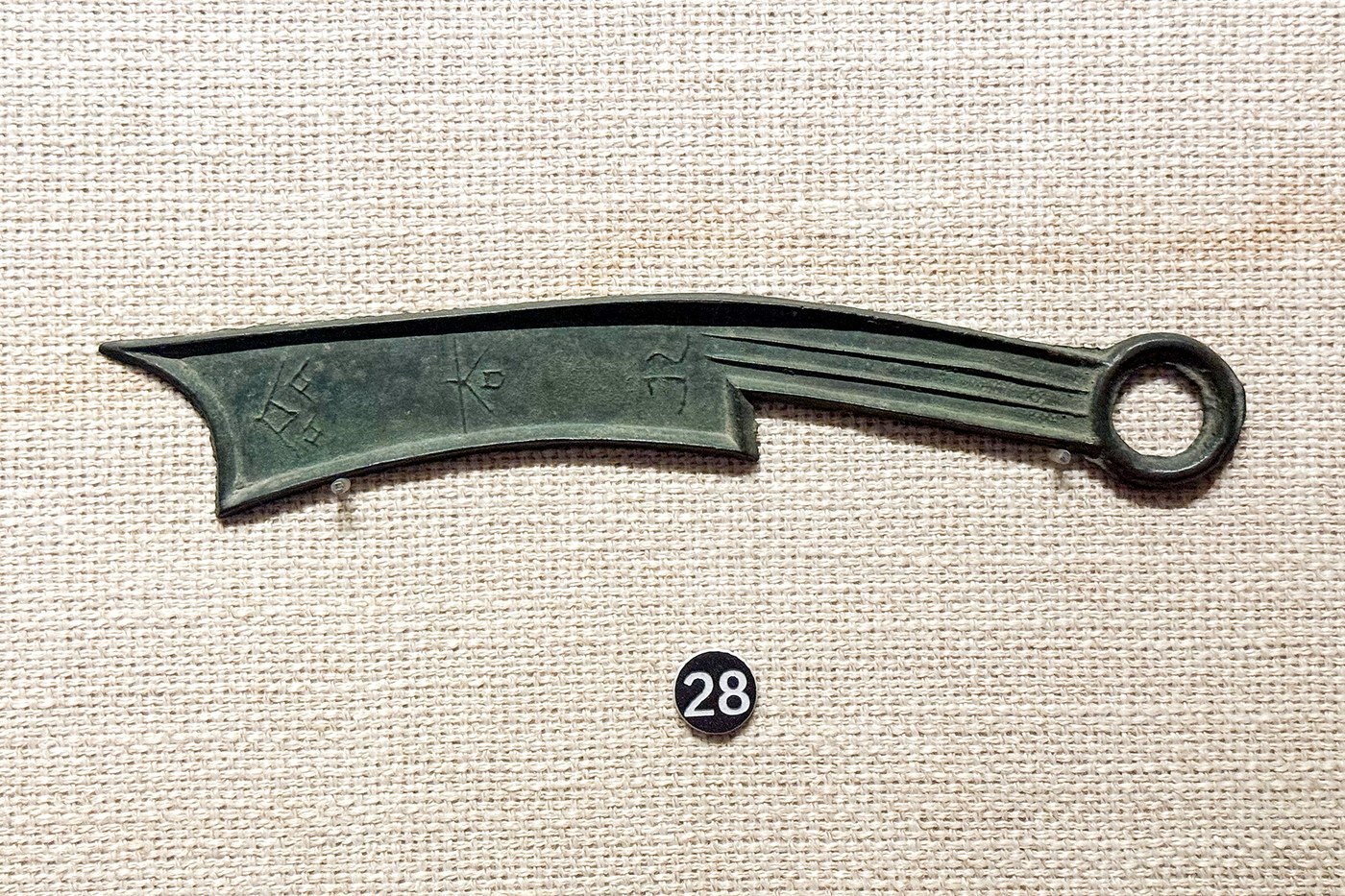
Start with the silhouette, because the knife shape is the single most telling feature. A Qi knife coin is a cast bronze object formed like a real knife: a long, gently curved blade that broadens toward the point, running into a straighter handle that terminates in a small ring. If a Chinese bronze piece has this blade-and-ring outline rather than a round disc, you are in the right family of coinage.
Next, read the blade. Qi knives carry a vertical column of Chinese characters down one face; this inscription marks the coin as money of Qi and distinguishes varieties by the number and content of the characters. Note how many characters there are and how they are arranged, then compare them against a specialist reference on early Chinese knife money, since the precise legend, not just the shape, determines the exact type.
Inspect the handle and terminal. The handle is a narrower strip bearing raised parallel lines, and it closes in a rounded ring at the end. These raised lines and the ring are structural and decorative features of the genuine form; a handle that is featureless, crudely finished, or lacking the ring is a warning sign. Confirm the material is bronze with a plausible aged patina, and remember these are cast, not struck, so genuine detail is smoothly integral to the metal rather than sharply pressed in.
Beware of look-alikes and fakes above all else. Qi knives are among the most heavily reproduced of ancient Chinese coins, and the market is full of modern castings, souvenir replicas, and deliberate forgeries. Suspect pieces that feel too light or too clean, that show a bright artificial green paint-like "patina," that have grainy or bubbled cast surfaces, file marks, or mould seams, or whose characters are blurry, wrongly proportioned, or nonsensical. Do not confuse Qi knives with knife money of other states or with unrelated round Chinese cash.
Given the shape's fame and the prevalence of forgeries, treat authentication as part of identification. Because value and legitimacy hinge on it, an unprovenanced knife should be verified by a specialist in early Chinese coinage or a reputable grading service before it is accepted as a genuine Warring States Qi knife.
Frequently asked questions
What is the quickest way to recognize a Qi knife coin?
Look for the knife silhouette: a curved bronze blade widening toward the tip, joined to a handle that ends in a ring, with a vertical line of Chinese characters down the blade. That blade-and-ring shape with a Qi inscription is the signature of the type.
How do I tell one Qi knife variety from another?
The main differences are in the blade inscription, chiefly the number and content of the characters. Count and read the characters and match them to a specialist reference on Qi knife money, since varieties with longer or rarer legends differ in scarcity and value.
How can I spot a fake or replica?
Watch for coins that are too light or too clean, that have bright fake-looking green surfaces, grainy or bubbly cast texture, mould seams or file marks, or blurry, mis-shaped, or meaningless characters. Because Qi knives are heavily reproduced, verify uncertain pieces with a specialist.
Is it easy to confuse with ordinary round Chinese coins?
No. Qi knife money is knife-shaped, not a round disc with a central square hole. Round square-holed cash belongs to the later unified coinage, so the knife form itself rules that out; the task is instead to confirm authenticity and the specific Qi variety.