
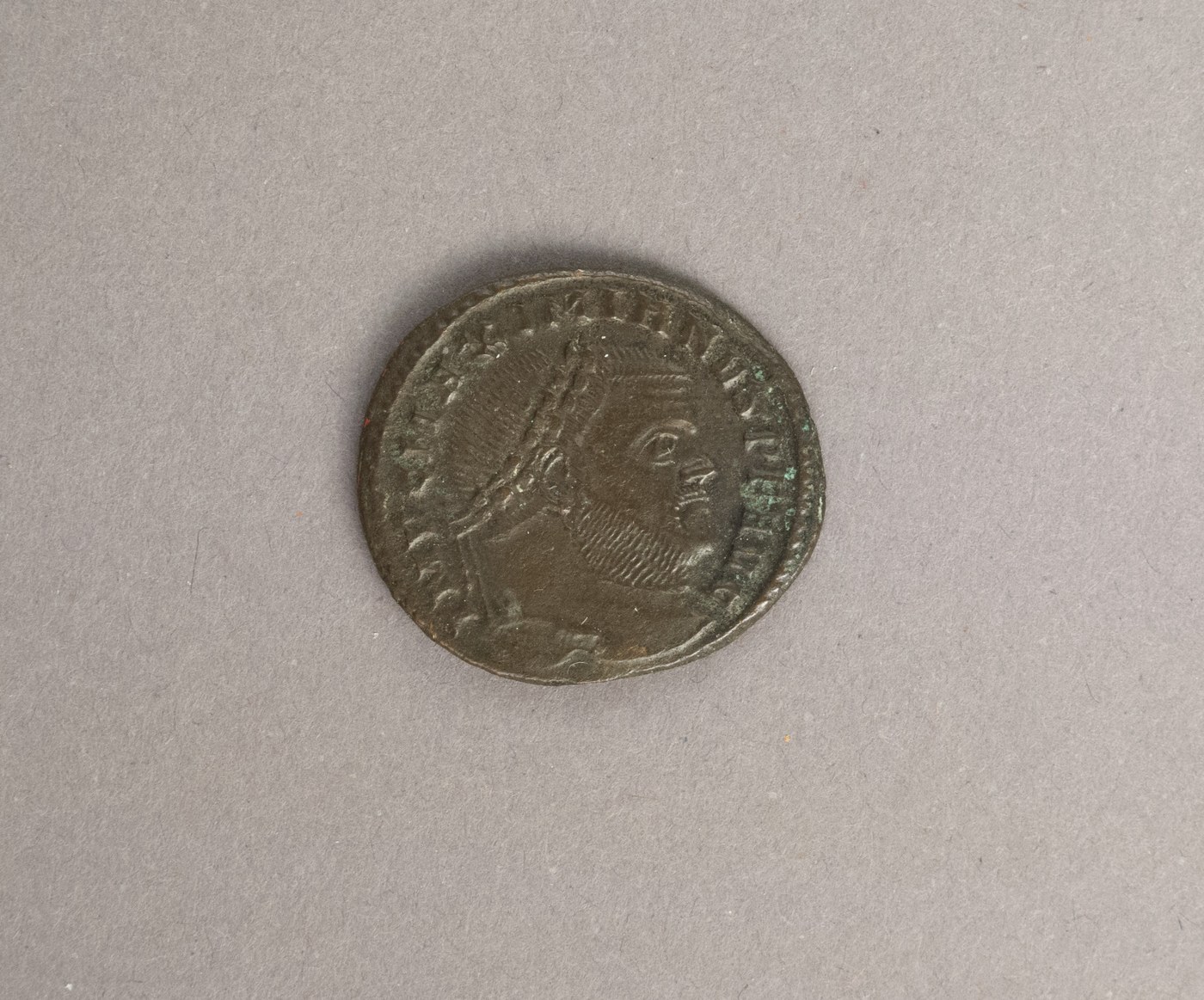
Nummus of Maximianus
A late-Roman bronze nummus (follis) of the emperor Maximianus, with his right-facing laureate portrait and a standing deity on the reverse.
- Country
- Roman Empire
- Denomination
- Nummus
- Metal
- Bronze
Got a coin like this?
Identify any coin from a photo, free.
Overview
This is a Roman bronze nummus, the large silvered-bronze coin often called a follis, struck for the emperor Maximianus (Marcus Aurelius Valerius Maximianus, known as Herculius). The obverse carries his right-facing portrait, usually laureate and cuirassed, ringed by a Latin imperial legend; the reverse shows a standing figure of a deity or personification holding attributes such as a cornucopia, patera, or scales.
Maximianus was co-emperor under the Tetrarchy, the four-ruler system organized by Diocletian, and his nummi were produced in enormous quantity across mints throughout the empire. As a base-metal denomination struck for everyday circulation, the coin survives today in large numbers and is one of the most accessible of all imperial Roman bronzes.
Because the type was issued over roughly 286 to 310 CE and copied at many mints, the exact reverse deity, legend, and mint marks vary from piece to piece. Reading those details is what separates one issue from another within the broad "nummus of Maximianus" family.
History & Background
Maximianus was raised to the rank of Augustus by Diocletian in 286 CE and given charge of the western half of the empire. Around 294 CE Diocletian reformed the debased Roman coinage, introducing a large bronze coin with a thin silver wash, modern scholars call it the nummus or follis, to restore confidence in the currency. Maximianus features prominently on this new coinage alongside his fellow tetrarchs.
He abdicated with Diocletian in 305 CE but repeatedly returned to politics, supporting his son Maxentius and later allying with Constantine, before his death in 310 CE. Coins were struck in his name throughout this turbulent period, and posthumous or commemorative issues also exist, which is why the type spans roughly 286 to 310 CE.
The reverse deities reflect Tetrarchic ideology. The most common type, GENIO POPVLI ROMANI, shows the Genius of the Roman People; issues invoking Jupiter, Hercules (Maximian's patron), Sol, or personifications like Providentia and Moneta also appear. These standardized reverses were struck at mints from Britain and Gaul to the eastern provinces.
How to Identify
Confirm the ruler from the obverse legend. Coins of this emperor read some form of IMP C M A MAXIMIANVS P F AVG or MAXIMIANVS NOB CAES, wrapped around a right-facing laureate head. The name MAXIMIANVS is the key diagnostic; do not confuse it with GALERIVS VAL MAXIMIANVS (Galerius), a different tetrarch whose coins look very similar.
The reverse names the deity in its legend. GENIO POPVLI ROMANI (the Genius of the Roman People, a standing male figure holding a cornucopia and patera) is by far the most common; others include IOVI CONSERVATORI (Jupiter), HERCVLI (Hercules), and SAC MON VRB (the Sacred Mint). A line of letters in the exergue below the figure is the mint mark and identifies the city and workshop.
The metal is bronze, originally coated with a thin silver wash that is usually worn away, leaving a brown or green patina; traces of silvering sometimes survive in the recesses. Early reform nummi are large and heavy, roughly 26 to 28 mm and 8 to 10 grams, shrinking over time to smaller, lighter coins by around 310 CE. Weight and diameter therefore help date the piece within the series.
Value & Collectibility
As one of the most abundantly produced Roman bronzes, the nummus of Maximianus is affordable and widely available. Worn or common examples typically trade in the low tens of dollars, while sharp, well-centered coins with clear legends, attractive patina, or surviving silvering command higher figures. Scarcer mints, unusual reverse types, and exceptional condition drive the premium end.
Condition and eye appeal dominate value. A full, legible obverse legend, a complete reverse figure, and a clear mint mark matter far more than the coin's age. Green or brown patina is normal and desirable; harsh cleaning, corrosion pits, or smoothing reduce value.
Because fakes and tourist replicas exist, and because attribution depends on mint marks and legends, have higher-value or uncertain pieces confirmed by a specialist in ancient coins or a reputable third-party grading service before buying or selling. Treat single online prices as rough guidance rather than firm valuations.
Frequently asked questions
What is a nummus or follis?
It is a large silvered-bronze coin introduced by Diocletian's currency reform around 294 CE. "Nummus" and "follis" are modern names for the same denomination; ancient sources do not give it a single agreed term.
Who was Maximianus?
Maximianus Herculius was a Roman co-emperor (Augustus) of the West from 286 CE under the Tetrarchy organized by Diocletian. He abdicated in 305, returned to power, and died in 310 CE.
What deity is on the reverse?
Most often the Genius of the Roman People (GENIO POPVLI ROMANI), a standing male figure with a cornucopia and patera. Jupiter, Hercules, Sol, and personifications such as Providentia also appear on other issues.
Is the coin silver or bronze?
It is bronze that originally carried a thin silver wash. The silvering usually wears off, leaving a brown or green patina, though traces sometimes survive in protected areas of the design.
Are these coins rare or valuable?
They were struck in huge numbers and are common and affordable. Value depends on condition, mint, reverse type, and surviving silvering rather than rarity of the emperor himself.
Nummus of Maximianus guides
In-depth guides for identifying, valuing, and collecting Nummus of Maximianus.
Other coins you may enjoy
Tetradrachm of Ptolemy XII
80-51 BC
Tetradrachm of Ptolemy I
305-283 BC
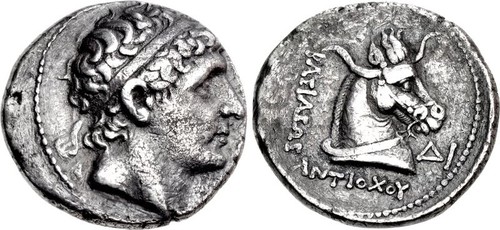
Tetradrachm of Antiochos I Soter
281-261 BC
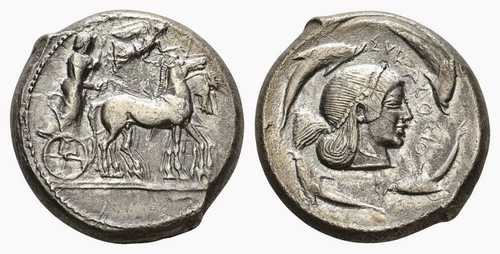
Syracuse Tetradrachm
c. 5th-4th century BC (Classical period)
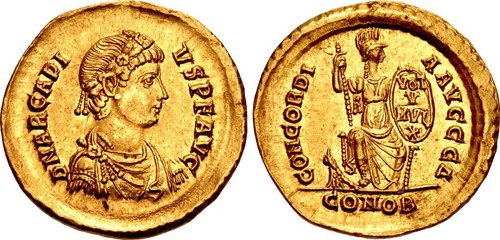
Solidus of Arcadius
AD 395-402
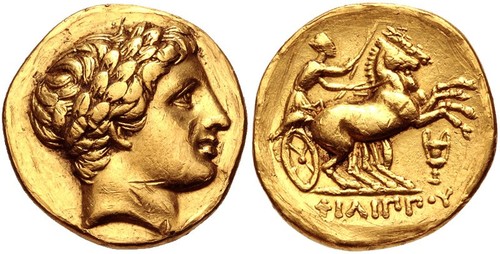
Philip III Gold Stater
323-317 BC
Siliqua of Gratian
AD 367-383
Sestertius of Maximinus Thrax
235-238 AD
Solidus of Valentinian III
AD 425-455
Seleucus I Nicator Tetradrachm
Late 4th-3rd century BC
Nummus of Magnentius
AD 350-353
Follis of Galerius
AD 308-310