
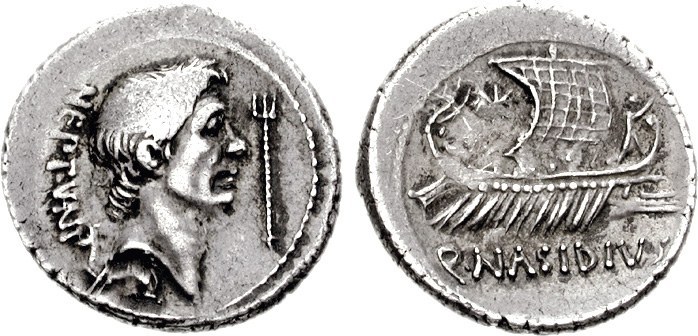
Nasidius Denarius
Roman Republican silver denarius struck for Sextus Pompey's admiral Q. Nasidius, showing Pompey the Great's head and a galley marked NASIDIVS.
- Country
- Roman Republic
- Denomination
- Denarius
- Metal
- Silver
Got a coin like this?
Identify any coin from a photo, free.
Overview
The Nasidius Denarius is a Roman Republican silver coin struck in the naval camp of Sextus Pompeius and signed by his fleet commander Quintus Nasidius. The obverse carries the head of Pompey the Great (Cn. Pompeius Magnus) facing right, and the reverse shows a galley under sail with the name NASIDIVS as the moneyer's signature.
It is a denarius, the standard silver unit of the late Republic, but a distinctly political and military one: the portrait honors a dead general revered by his sons, and the warship advertises the sea power on which Sextus Pompey built his cause. The type is catalogued in the standard reference as Crawford 483/2 and is prized as one of the most evocative naval issues of the Roman civil wars.
History & Background
The coin belongs to the turbulent decade after the assassination of Julius Caesar in 44 BC. Sextus Pompeius, younger son of Pompey the Great, held out against the Caesarian leadership by commanding a powerful fleet based around Sicily, controlling the sea lanes and grain supply to Rome. Coins like this were struck at a traveling military mint to pay his sailors and soldiers, generally dated to roughly 44-38 BC.
By placing his father's portrait on the obverse, Sextus turned coinage into propaganda, keeping the memory and legitimacy of the Pompeian name alive. Related issues add maritime and Neptunian imagery — trident, dolphin, and references to Neptune — because Sextus styled himself a son of the sea-god and master of the waves.
Quintus Nasidius was the admiral who signed this issue; ancient sources record a Nasidius active as a naval commander in the period's civil wars. The galley on the reverse is a direct emblem of that command. Sextus Pompey's resistance was finally broken at the naval battle of Naulochus in 36 BC, after which such coinage ceased, making these pieces a snapshot of a lost cause.
How to Identify
Identify this type from its two signature elements: a right-facing male portrait of Pompey the Great on the obverse, and a single galley (warship) on the reverse bearing the name NASIDIVS. That combination of Pompey's head with a named galley is the defining marker and separates it from other Republican denarii.
The obverse portrait is often accompanied by naval attributes such as a trident before the face and a small dolphin below, with a legend referencing Neptune. The reverse galley usually sails right and may show a star in the field above the ship, with the moneyer's name in the field or exergue.
As a Republican denarius, expect a small silver coin roughly 17-20 mm in diameter and about 3.5-4.0 grams, hand-struck on a slightly irregular flan with the uneven surfaces typical of ancient coinage. The metal should read as toned silver, not bright modern white or a yellow base-metal cast.
Value & Collectibility
The Nasidius Denarius is a genuinely scarce and historically charged type, and it commands a strong premium over ordinary late-Republican denarii. Even well-worn authentic examples typically trade in the mid hundreds of dollars, while sharp, well-centered coins with a clear Pompey portrait and crisp galley can reach the low-to-mid thousands, and exceptional specimens considerably more.
Value turns on strike, centering, surfaces, and portrait clarity. Ancient coins are frequently off-center, so a well-centered galley and a full, expressive Pompey head are worth a real premium. Corrosion, tooling, smoothing, or harsh cleaning sharply reduce desirability.
Because this is a famous and often-faked type, prices should be checked against recent auction results for comparable grade, and high-value purchases are safest when accompanied by a reputable dealer attribution or third-party authentication.
Frequently asked questions
Whose portrait is on the Nasidius denarius?
The obverse shows the head of Pompey the Great (Cn. Pompeius Magnus) facing right. The coin was struck by his son Sextus Pompey's faction, honoring the dead general to reinforce the Pompeian cause.
Who was Nasidius?
Quintus Nasidius was a naval commander (admiral) serving Sextus Pompeius. His name NASIDIVS appears on the reverse beside the galley, marking him as the official responsible for the issue.
What does the galley on the reverse represent?
It is a Roman warship (galley), an emblem of the sea power that Sextus Pompey and his admiral Nasidius wielded against their rivals during the civil wars following Caesar's assassination.
When and where was it made?
It was struck at a traveling military mint associated with Sextus Pompey's fleet, most likely in or around Sicily, generally dated to roughly 44-38 BC in the 1st century BC.
Is it valuable?
Yes, relatively. It is a scarce and popular naval type, so genuine examples carry a solid premium; worn coins run into the hundreds of dollars and well-preserved ones into the thousands, with authentication strongly advised.
Nasidius Denarius guides
In-depth guides for identifying, valuing, and collecting Nasidius Denarius.
Other coins you may enjoy
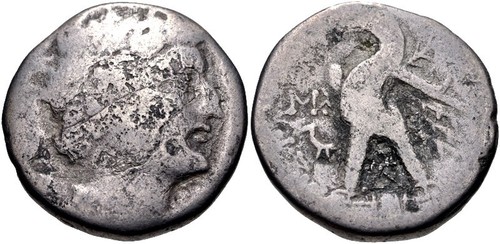
Tetradrachm of Ptolemy XII
80-51 BC
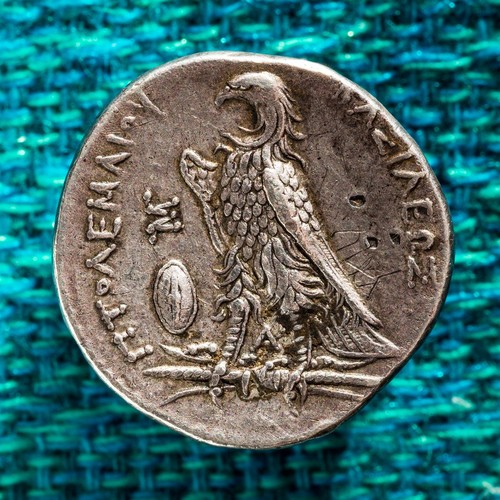
Tetradrachm of Ptolemy I
305-283 BC
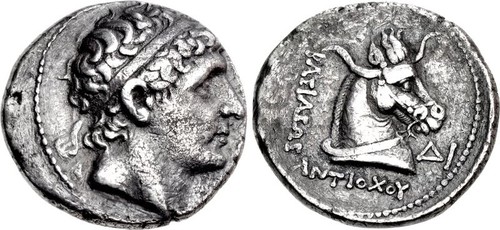
Tetradrachm of Antiochos I Soter
281-261 BC
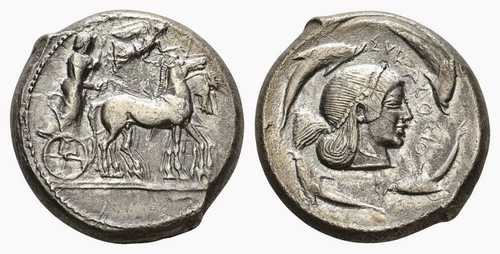
Syracuse Tetradrachm
c. 5th-4th century BC (Classical period)
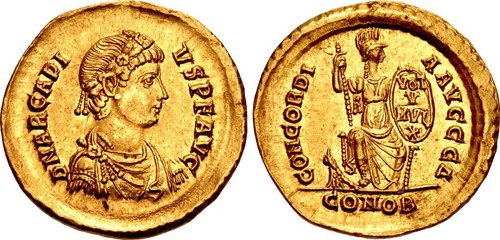
Solidus of Arcadius
AD 395-402
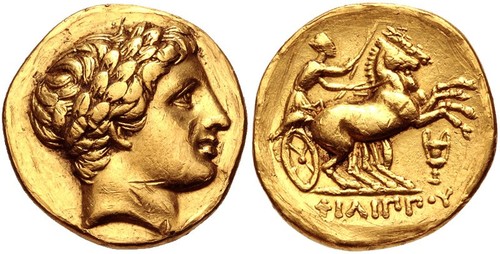
Philip III Gold Stater
323-317 BC
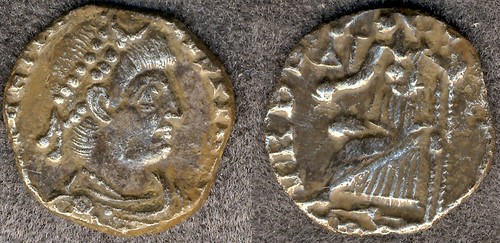
Siliqua of Gratian
AD 367-383
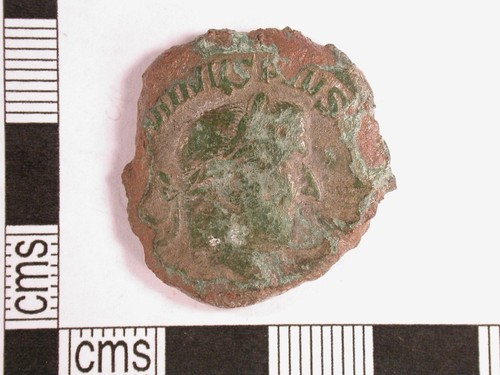
Sestertius of Maximinus Thrax
235-238 AD
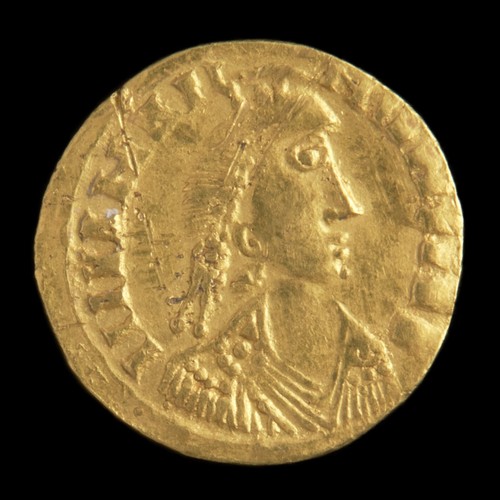
Solidus of Valentinian III
AD 425-455
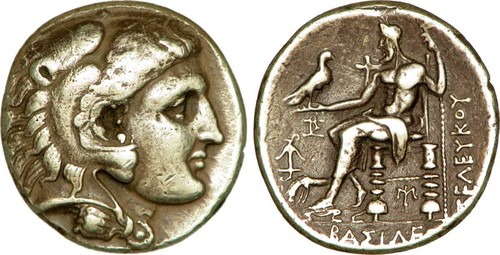
Seleucus I Nicator Tetradrachm
Late 4th-3rd century BC
Nummus of Magnentius
AD 350-353
Follis of Galerius
AD 308-310