
How to Identify the Nasidius Denarius
A collector's guide to confirming the Pompey-and-galley denarius of Q. Nasidius by its portrait, reverse ship, size, and telltale look-alikes.
Read the full Nasidius Denarius encyclopedia entry →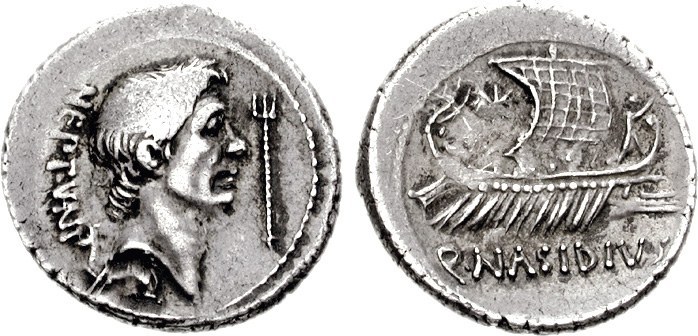
Begin with the obverse portrait. This type shows a right-facing head of Pompey the Great, and genuine examples usually surround it with naval attributes — a trident in front of the face and a small dolphin below the chin — plus a legend referencing Neptune. If the head faces the wrong way, lacks the maritime symbols entirely, or is paired with an unrelated legend, you are probably looking at a different Republican portrait denarius.
Turn to the reverse, which is the clinching feature: a single galley (warship), generally under sail and moving right, with the moneyer's name NASIDIVS in the field or exergue and often a star above the ship. The combination of Pompey's head with a named galley is unique enough to confirm the attribution (Crawford 483/2). Read the letters carefully — the name should be legible and correctly formed, not a mushy approximation.
Check the physical spec. A real example is a hand-struck silver denarius, roughly 17-20 mm across and about 3.5-4.0 grams, on an irregular ancient flan. Weigh and measure it: a coin that is markedly heavy, oversized, perfectly round with sharp modern edges, or magnetic is a red flag. The surfaces should show toned silver with the natural wear and minor flan flaws of an ancient strike.
Beware look-alikes and reproductions. Sextus Pompey issued several related naval and Neptunian types, and modern replicas and cast forgeries of this famous coin are common. Cast fakes betray themselves with soft, blurry detail, seams on the edge, air bubbles, and a repeated "grainy" surface; tooled genuine coins show scratchy re-cut lines in the fields and hair.
For anything beyond a modest, clearly worn piece, seek authentication. Compare your coin against verified auction images of Crawford 483/2, weigh the risk of forgery given the type's value, and rely on a reputable ancient-coin dealer or a third-party grading service before paying a premium.
Frequently asked questions
What single feature confirms this is the Nasidius denarius?
The reverse galley signed NASIDIVS, paired with a right-facing head of Pompey the Great on the obverse. That specific portrait-plus-named-ship combination is the defining diagnostic (Crawford 483/2).
What size and weight should it be?
Expect a hand-struck silver denarius roughly 17-20 mm in diameter and about 3.5-4.0 grams, on a slightly irregular ancient flan. A heavy, oversized, perfectly regular, or magnetic piece is suspect.
How do I spot a fake?
Watch for soft, blurry detail, an edge seam or casting bubbles (typical of cast copies), overly sharp modern rims, and unnatural surfaces. Compare against verified images and, for valuable coins, get third-party authentication.
Could I confuse it with another Sextus Pompey coin?
Yes. Sextus issued related naval and Neptune types with tridents, dolphins, and ships. Confirm the reverse shows a galley with the NASIDIVS signature specifically, rather than a different design or moneyer name.