
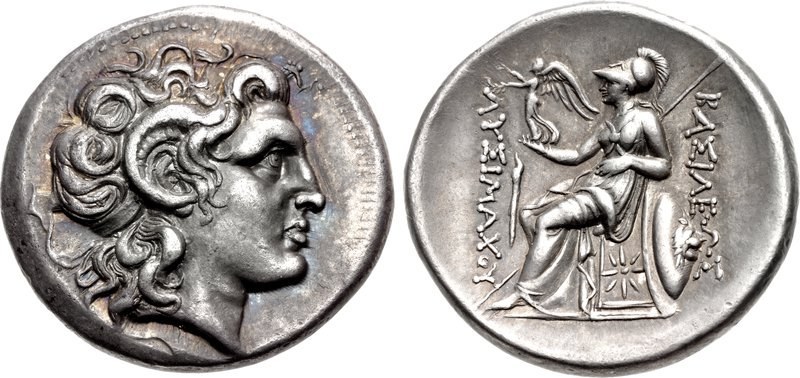
Lysimachos Tetradrachm
Silver tetradrachm of Lysimachos of Thrace, c. 297-282 BC, showing the deified head of Alexander the Great and Athena seated with a shield and spear.
- Country
- Thrace (Ancient)
- Denomination
- Tetradrachm
- Metal
- Silver
Got a coin like this?
Identify any coin from a photo, free.
Overview
The Lysimachos tetradrachm is a large silver coin struck for Lysimachos, one of the successors (Diadochi) who divided the empire of Alexander the Great and ruled as king of Thrace. The example here belongs to his royal coinage of roughly 297-282 BC and pairs a portrait of the deified Alexander on the obverse with the goddess Athena enthroned on the reverse.
The obverse shows the head of Alexander facing right, with thick curly Macedonian hair, a royal diadem, and the curling ram's horn of the god Ammon at the temple. The reverse shows Athena seated to the left on a throne, resting one arm on a round shield and holding a spear, beside the king's name in Greek.
Struck on the Attic weight standard used across the Greek world, the coin is a broad, heavy piece of good silver. It is one of the most recognizable and widely admired of all Hellenistic portrait coinages, prized for its idealized image of Alexander.
History & Background
Lysimachos was one of Alexander the Great's bodyguards and generals. After Alexander's death in 323 BC his empire was carved up among his marshals, and Lysimachos took Thrace, later extending his power over parts of Asia Minor and Macedonia and taking the royal title of king (basileus) around 306-305 BC.
Early in his reign Lysimachos struck coins in the name and types of Alexander, as several of the successors did. From about 297 BC he introduced his own distinctive royal coinage, replacing the Herakles head of the Alexander series with the deified portrait of Alexander himself, marked as a god by the horn of Ammon. The seated Athena holding a small figure of Nike (Victory), who crowns the king's name, advertised his claim to Alexander's legacy and to victory.
Lysimachos was killed at the Battle of Corupedium in 281 BC, and his kingdom did not long survive him. His tetradrachms, however, remained a trusted trade coinage, and several Greek cities continued to strike coins in his name and types for many decades after his death, so the design far outlasted the king.
How to Identify
The obverse shows the head of Alexander the Great facing right, with full curly hair, a plain royal diadem tied around the head, and the distinctive curled horn of Ammon curving around the ear. This ram's horn, marking Alexander as divine, is the single most important identifier and separates the type from ordinary Alexander-head coinages that use the lion-skin of Herakles.
The reverse shows Athena seated to the left on a throne, her body turned slightly, holding a spear and resting an arm on a round shield set at her side; in many dies she also holds a small figure of Nike in her outstretched hand. The Greek legend reads BASILEOS LYSIMACHOU ("of King Lysimachos"), typically arranged with the king's title to the right and his name to the left of the seated goddess, with small mint symbols and monograms in the field.
In hand the coin is a broad, heavy tetradrachm on the Attic standard, weighing on the order of about 17 grams and measuring roughly 28-32 mm across, struck in good silver that usually tones grey. Styles and mint marks vary from one mint to another, so genuine examples differ in the fineness of the portrait and in the symbols beside Athena.
Value & Collectibility
Lysimachos tetradrachms are genuine Hellenistic royal silver of a famous type, and they enjoy a strong and steady collector market. Worn or roughly struck examples with a clear Alexander portrait and readable reverse commonly trade in the mid hundreds of dollars, while sharply struck coins of fine style with a bold, high-relief head can reach well into the four figures.
Value is driven above all by the quality and artistry of the Alexander portrait, along with strike, centering, surface preservation, toning, mint, and eye appeal. Coins from mints known for especially beautiful engraving, and lifetime issues struck under Lysimachos himself, tend to bring premiums over the many later posthumous imitations struck in his name.
These figures are general context rather than appraisals. Any individual coin's price depends heavily on condition, style, mint, and authenticity, and high-grade Hellenistic silver of this kind is frequently sold with specialist attribution or third-party certification.
Frequently asked questions
Whose portrait is on the coin?
It is the deified Alexander the Great, not Lysimachos himself. Alexander is shown with a royal diadem and the ram's horn of the god Ammon, marking him as divine, while the coin was issued by King Lysimachos of Thrace.
What is the horn on the head?
It is the horn of Ammon, an Egyptian-Greek god. Alexander was associated with Ammon after visiting the god's oracle, and the horn became a standard symbol identifying his deified portrait on this coinage.
Who is the figure on the reverse?
It is the goddess Athena, seated on a throne with a spear and a round shield. On many dies she also holds a small winged Nike (Victory) who crowns the king's name in the Greek legend.
What does the Greek writing say?
The legend reads BASILEOS LYSIMACHOU, meaning "of King Lysimachos." It names the ruler who issued the coin and appears on either side of the seated Athena.
How big and heavy is it?
It is a tetradrachm on the Attic standard, weighing on the order of about 17 grams and roughly 28-32 mm across. It is a broad, substantial silver coin.
Lysimachos Tetradrachm guides
In-depth guides for identifying, valuing, and collecting Lysimachos Tetradrachm.
Other coins you may enjoy
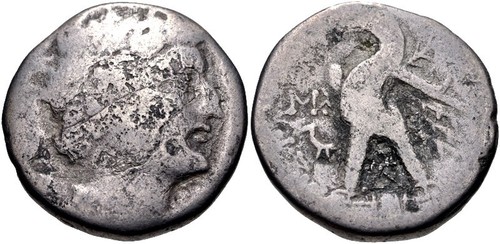
Tetradrachm of Ptolemy XII
80-51 BC
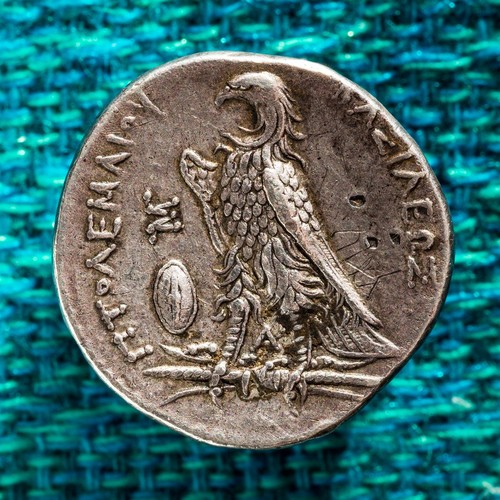
Tetradrachm of Ptolemy I
305-283 BC
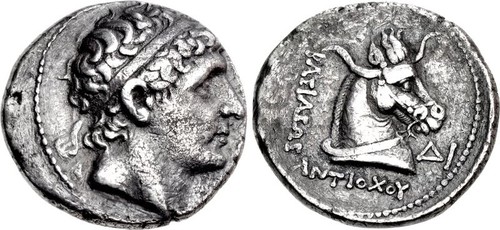
Tetradrachm of Antiochos I Soter
281-261 BC
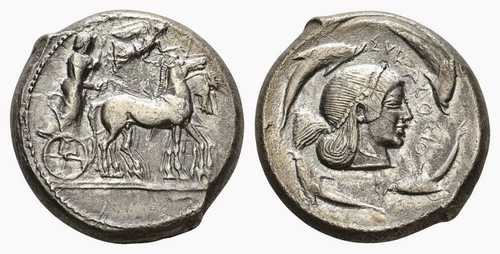
Syracuse Tetradrachm
c. 5th-4th century BC (Classical period)
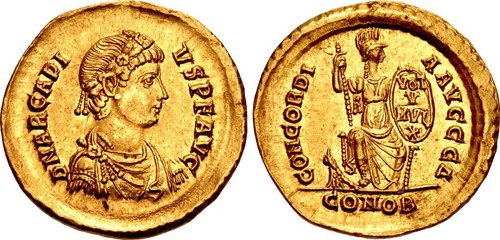
Solidus of Arcadius
AD 395-402
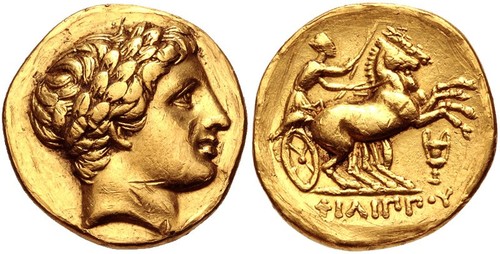
Philip III Gold Stater
323-317 BC
Siliqua of Gratian
AD 367-383
Sestertius of Maximinus Thrax
235-238 AD
Solidus of Valentinian III
AD 425-455
Seleucus I Nicator Tetradrachm
Late 4th-3rd century BC
Nummus of Magnentius
AD 350-353
Follis of Galerius
AD 308-310