
How to Identify the Lysimachos Tetradrachm
A collector's guide to recognizing the Lysimachos tetradrachm by its horned Alexander portrait, seated Athena reverse, Attic weight, and Greek legend.
Read the full Lysimachos Tetradrachm encyclopedia entry →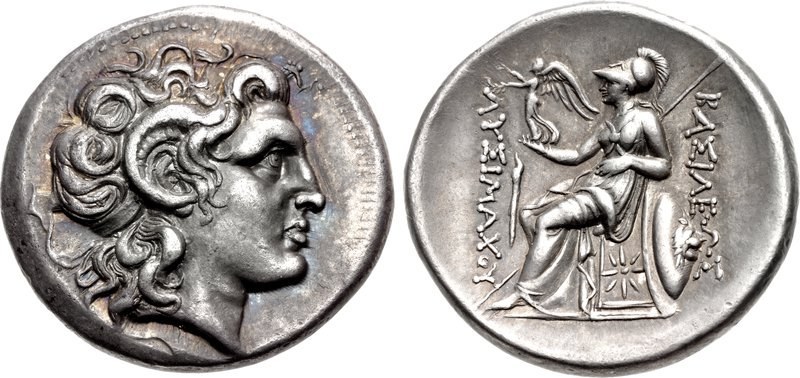
Start with the obverse portrait. A Lysimachos tetradrachm shows the head of Alexander the Great facing right with abundant curly hair and a plain diadem, but the decisive detail is the curled horn of Ammon wrapping around the ear. If the head instead wears a lion-skin headdress, it is an Alexander-type coin with Herakles, not a Lysimachos issue. The horned, diademed head is the type's signature and should be the first thing you check.
Turn to the reverse and read the design. You should see Athena seated to the left on a throne, holding a spear and resting an arm on a round shield, frequently with a small Nike in her hand. The Greek legend BASILEOS LYSIMACHOU runs vertically on either side, naming the king; look also for small monograms, symbols, or a mint mark in the field or under the throne, which identify the mint and help attribute the coin. A different seated deity, a standing figure, or a legend naming another ruler means it is a different type.
Check size, weight, and metal together. The coin is a broad silver tetradrachm on the Attic standard, on the order of about 17 grams and roughly 28-32 mm across, so it should feel heavy and substantial with a metallic ring and grey toning. A markedly lighter or smaller coin of similar design may be a drachm or a fraction, and a suspiciously light, greasy, or dull piece deserves scrutiny before anything else.
Be aware of posthumous and later issues. Many Greek cities kept striking tetradrachms in Lysimachos's name and types for decades after his death in 281 BC, and later still some issues have broader flans and a coarser, more stylized portrait. These are collectible in their own right but differ in style and value from lifetime coins, so style and mint marks matter when placing a given piece.
Finally, watch for authenticity problems. Cast forgeries show a seam at the edge, soft mushy detail, and bubbles or porosity in the fields; modern struck fakes and tooled coins add unnaturally sharp, scratchy detail to the hair or drapery. Because fine-style Lysimachos tetradrachms are valuable, be cautious with bargain offers and, for a significant purchase, rely on specialist attribution or third-party certification and, where possible, documented provenance.
Frequently asked questions
What is the fastest way to confirm the type?
Look for the ram's horn of Ammon curling around the ear on the right-facing Alexander portrait, then check the reverse for a seated Athena and the Greek legend naming King Lysimachos. Those two features together define the type.
How do I tell a lifetime coin from a later imitation?
Style, mint marks, and fabric are the guide. Lifetime issues tend to have finer portraits and specific mint monograms, while many posthumous coins have broader flans and coarser engraving. Precise attribution usually needs a specialist reference or expert.
The head wears a lion skin instead of a horn. Is it still a Lysimachos coin?
No. A head in a lion-skin headdress is Herakles on an Alexander-type coin. The Lysimachos tetradrachm shows a diademed Alexander with the horn of Ammon, not the lion skin.
What are the main warning signs of a fake?
An edge seam, soft or bubbly surfaces, and a dull non-metallic tone suggest a cast copy, while unnaturally sharp scratchy detail on a worn coin suggests tooling. For valuable examples seek specialist attribution or certification.