
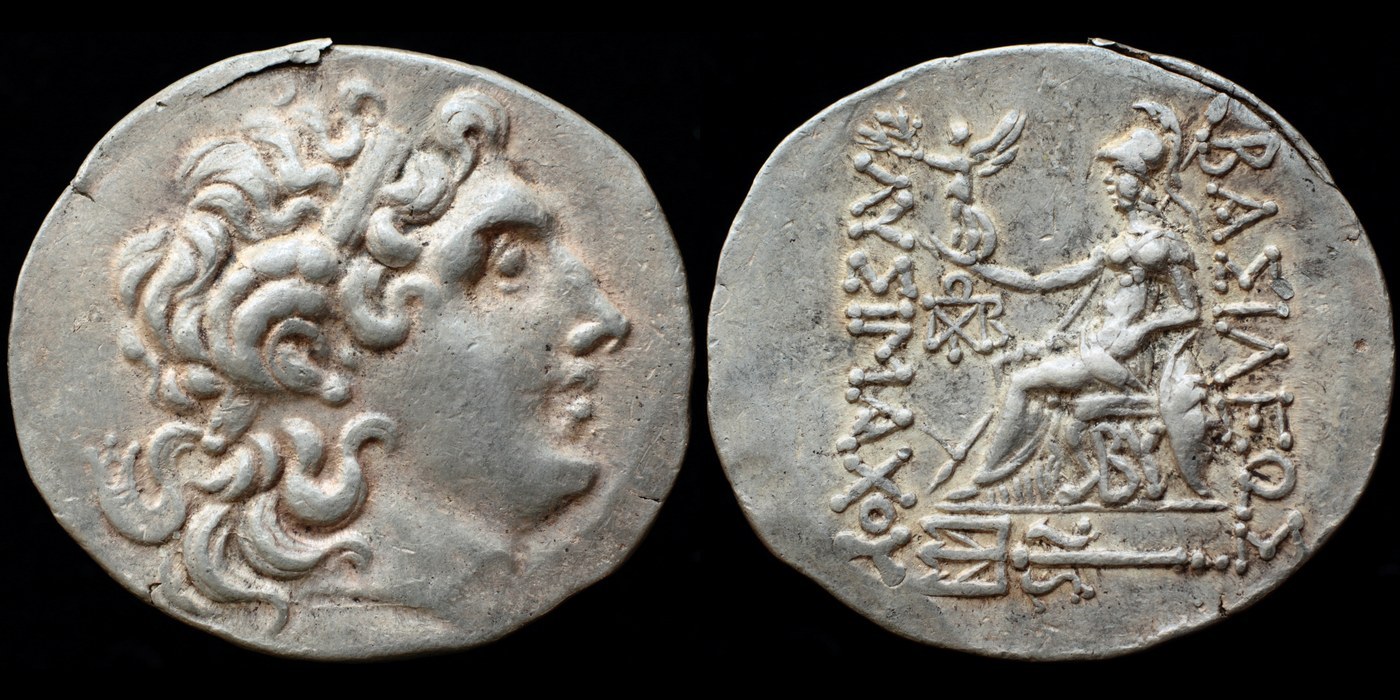
Lysimachos Gold Stater
Gold stater of Lysimachos, king in Thrace and Macedon c. 305-281 BC, with a deified head of Alexander the Great and an enthroned Athena reverse.
- Country
- Ancient Macedon
- Denomination
- Stater
- Metal
- Gold
Got a coin like this?
Identify any coin from a photo, free.
Overview
The Lysimachos gold stater is an ancient Greek gold coin struck under Lysimachos, one of the successors (Diadochi) of Alexander the Great who ruled as king over Thrace, western Asia Minor, and eventually Macedon. The example here belongs to his royal coinage of roughly 305-281 BC and pairs an idealized head of the deified Alexander on the obverse with a seated figure of Athena on the reverse.
Struck in high-purity gold on the Attic weight standard, the stater is a small but heavy coin carrying one of the most admired portraits of the Hellenistic age. The obverse head is Alexander shown as a god, rendered with heroic, almost divine features, so the powerful youthful face is sometimes read as a Heracles-like hero. The reverse shows Athena enthroned, holding a small figure of Nike (Victory), alongside the royal legend of Lysimachos.
Because it names a specific king and carries a distinctive portrait, the type is readily identified once the design is understood. Lysimachos staters were struck at several mints during his reign, and the same portrait types continued to be copied at Greek cities for generations after his death.
History & Background
Lysimachos was a Macedonian officer and bodyguard of Alexander the Great who, after Alexander's death in 323 BC, took control of Thrace and gradually built a kingdom spanning both sides of the Aegean. He assumed the title of king around 305 BC, joining the other Diadochi in carving successor states out of Alexander's empire, and his coinage in gold and silver dates chiefly to the two decades that followed.
The stater's imagery makes a deliberate political statement. Rather than showing his own likeness, Lysimachos placed the deified Alexander on the obverse, wearing the horn of the god Ammon, asserting himself as Alexander's true heir. The enthroned Athena of the reverse, a goddess of both wisdom and war, holds Victory and reinforces the message of legitimate, triumphant kingship under the name BASILEOS LYSIMACHOU, "of King Lysimachos."
Lysimachos died in battle at Corupedium in 281 BC, and his kingdom quickly fell apart. His coin types, however, proved remarkably durable: Greek cities such as Byzantion and others continued to strike "Lysimachos-type" gold and silver for well over a century afterward, so the design long outlived the king himself.
How to Identify
The obverse shows the head of the deified Alexander the Great facing right, youthful and idealized, with flowing hair and the curling horn of Ammon curving around the ear. The heroic, god-like treatment of the face is why the portrait is sometimes described as Alexander in the guise of a hero such as Heracles. There is no obverse legend; the portrait itself carries the message.
The reverse shows Athena seated on a throne, usually facing left, holding a small winged figure of Nike (Victory) in her outstretched hand and resting an arm on a shield, often with a spear behind. The royal inscription reads BASILEOS LYSIMACHOU (of King Lysimachos) in Greek letters, arranged in the field and beside the figure, and small mint symbols or monograms typically appear in the field or under the throne.
In hand the stater is a thick, lustrous gold coin on the Attic standard, weighing on the order of about 8.5 grams and measuring roughly 18-20 mm across. The high gold content gives it a warm, bright color that resists tarnish, so genuine examples look markedly different from silver or bronze coins of the same era. The combination of the horned Alexander head and the enthroned, Victory-bearing Athena is the coin's decisive identifier.
Value & Collectibility
Lysimachos gold staters are genuine ancient Greek gold from a celebrated Hellenistic dynasty, and they sit at the higher end of the ancient-coin market. Worn but clearly identifiable lifetime examples generally trade in the low-to-mid four figures, while sharply struck, well-centered coins in fine style can reach well into five figures, especially for pieces with a bold, artistic Alexander portrait.
Value is driven by the quality of the portrait, the sharpness and centering of both sides, the completeness of the legend, the mint and whether the issue is a lifetime striking or a later posthumous copy, and overall eye appeal. Because the type was imitated for generations, careful attribution to a particular mint and period can significantly affect price.
The figures here are general context, not appraisals. Any specific coin's value depends heavily on condition, style, attribution, and authenticity, and gold of this importance is very often sold with specialist cataloguing or third-party certification.
Frequently asked questions
Whose portrait is on the coin if it was struck by Lysimachos?
The obverse shows Alexander the Great, not Lysimachos himself. Lysimachos honored his former commander by placing the deified Alexander, wearing the horn of Ammon, on his coins to present himself as Alexander's rightful heir.
Why is the head sometimes called Heracles?
The deified Alexander is rendered with heroic, god-like features, and Alexander's family claimed descent from Heracles, so the powerful youthful face can look Heracles-like. The defining detail is the ram's horn of Ammon curling by the ear.
What is on the reverse?
The reverse shows the goddess Athena seated on a throne, holding a small figure of Nike (Victory), with the Greek legend naming King Lysimachos. Mint symbols or monograms usually appear in the field.
How much gold does the stater contain?
It is struck in high-purity gold on the Attic standard and weighs on the order of about 8.5 grams. The metal is bright and warm in color and does not tarnish like silver.
Were these coins made only during Lysimachos's lifetime?
No. Although the king reigned until 281 BC, several Greek cities continued to strike Lysimachos-type gold and silver long after his death, so many surviving coins are later posthumous issues in his name and types.
Lysimachos Gold Stater guides
In-depth guides for identifying, valuing, and collecting Lysimachos Gold Stater.
Other coins you may enjoy
Tetradrachm of Ptolemy XII
80-51 BC
Tetradrachm of Ptolemy I
305-283 BC
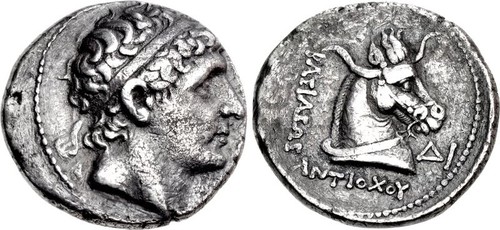
Tetradrachm of Antiochos I Soter
281-261 BC
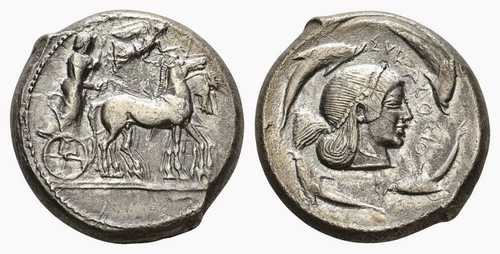
Syracuse Tetradrachm
c. 5th-4th century BC (Classical period)
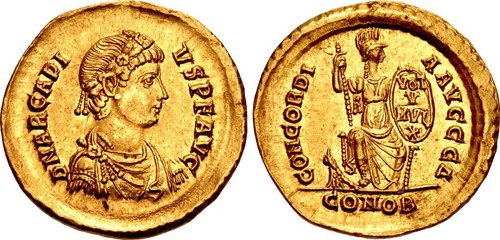
Solidus of Arcadius
AD 395-402
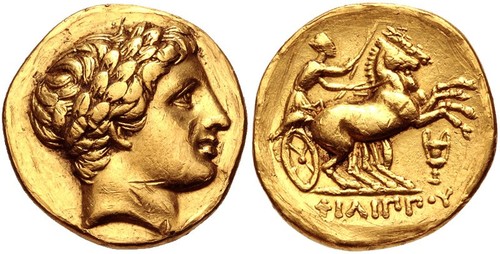
Philip III Gold Stater
323-317 BC
Siliqua of Gratian
AD 367-383
Sestertius of Maximinus Thrax
235-238 AD
Solidus of Valentinian III
AD 425-455
Seleucus I Nicator Tetradrachm
Late 4th-3rd century BC
Nummus of Magnentius
AD 350-353
Follis of Galerius
AD 308-310