
How to Identify the Lysimachos Gold Stater
A collector's guide to recognizing the Lysimachos gold stater by its horned Alexander portrait, enthroned Athena reverse, royal legend, and gold fabric.
Read the full Lysimachos Gold Stater encyclopedia entry →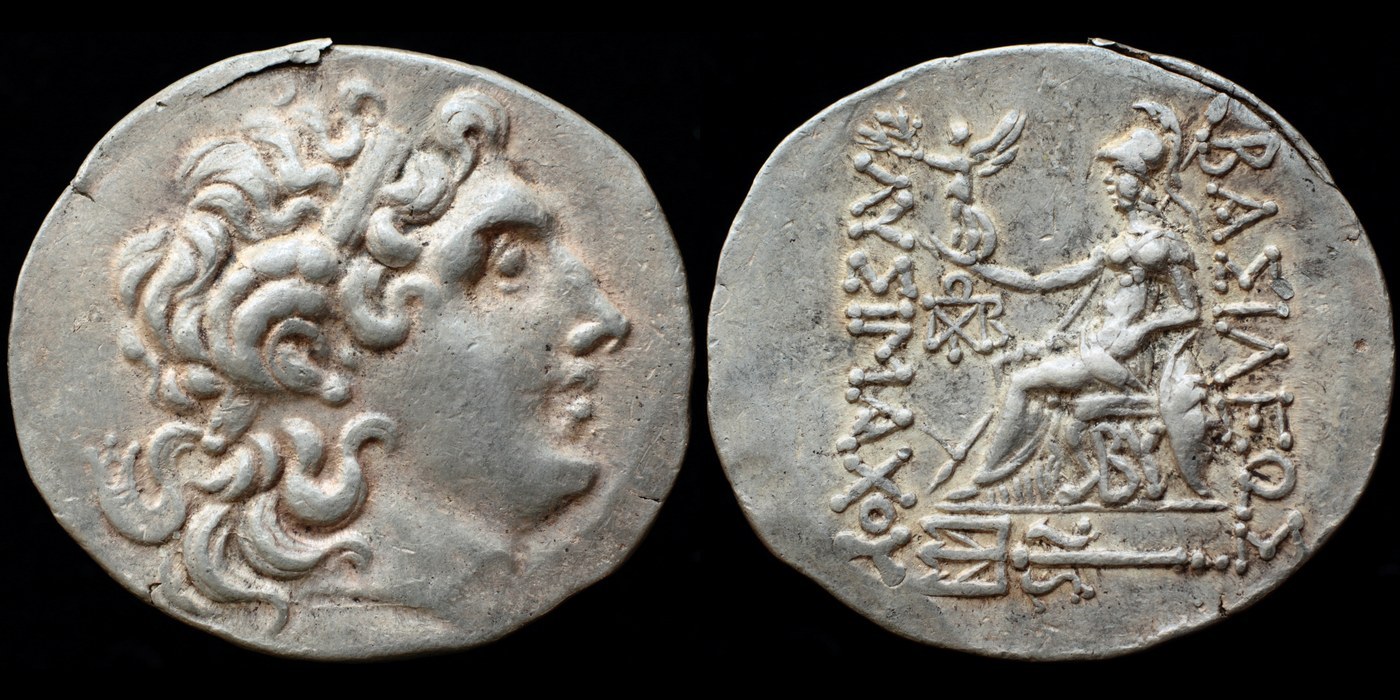
Start with the obverse portrait. A Lysimachos stater shows a youthful, idealized male head facing right, and the single most important detail is the horn of Ammon, a curling ram's horn wrapped around the ear beneath the flowing hair. This marks the head as the deified Alexander the Great. The heroic treatment can make the face look like Heracles, but there is no lion-skin headdress here; the horn, not a lion scalp, is the diagnostic feature that separates this type from ordinary Heracles heads on other Greek coins.
Turn to the reverse, which should show Athena seated on a throne, generally facing left, holding a small winged Nike in her extended hand with a shield at her side and often a spear behind. Read the Greek legend: it names BASILEOS LYSIMACHOU, "of King Lysimachos." The arrangement of the letters, plus any monograms or small symbols in the field or under the throne, identifies the mint and helps distinguish lifetime strikings from the many later posthumous copies of the same design.
Check metal, size, and weight together. A genuine gold stater is a dense, bright, untarnished gold coin on the Attic standard, weighing on the order of about 8.5 grams and roughly 18-20 mm across. The color should be a warm, even gold throughout, including on any edge nicks; a coppery or silvery tone under wear, or a coin that is too light or too heavy for a stater, is a warning sign that it may be gilt, a fraction, or a modern fake.
Beware of look-alikes and later imitations. Lysimachos types were struck for well over a century after his death by cities such as Byzantion, so a Lysimachos-type stater is not automatically a lifetime coin of the king; attribution depends on style, mint marks, and fabric. Silver tetradrachms of Lysimachos share the same two designs at larger size and lighter-looking metal, so confirm you are looking at small, heavy gold before calling a piece a gold stater.
Finally, treat authentication seriously. Because these staters are valuable, they are frequently forged, whether as cast copies with a soft surface and a telltale edge seam, gold-plated base-metal fakes, or modern struck reproductions. Genuine ancient strikes show hand-made irregularities, crisp high-relief detail in the hair and drapery, and correct weight and gold color. For any significant purchase, rely on specialist attribution, documented provenance, or third-party certification rather than the portrait alone.
Frequently asked questions
How do I tell the deified Alexander from a plain Heracles head?
Look for the ram's horn of Ammon curling around the ear. A Heracles head instead wears a lion-skin headdress with the paws knotted at the neck. The Lysimachos obverse has the horn and flowing hair, not a lion scalp.
How can I distinguish a gold stater from the silver tetradrachm?
Both use the same Alexander and Athena designs, but the gold stater is small and heavy, about 8.5 grams and 18-20 mm, with a warm gold color, while the tetradrachm is a larger, broader silver coin that tones grey. Metal and size settle it.
Is a Lysimachos-type coin always from his reign?
No. Greek cities struck coins in his types for generations after 281 BC. Only careful study of style, mint monograms, and fabric can place a coin as a lifetime issue rather than a later posthumous striking.
What are the main warning signs of a fake?
A seam around the edge, a soft or bubbly surface, and a color that turns coppery or silvery under wear point to a cast or plated forgery, while the wrong weight is a red flag. For valuable gold, insist on specialist attribution or certification.