
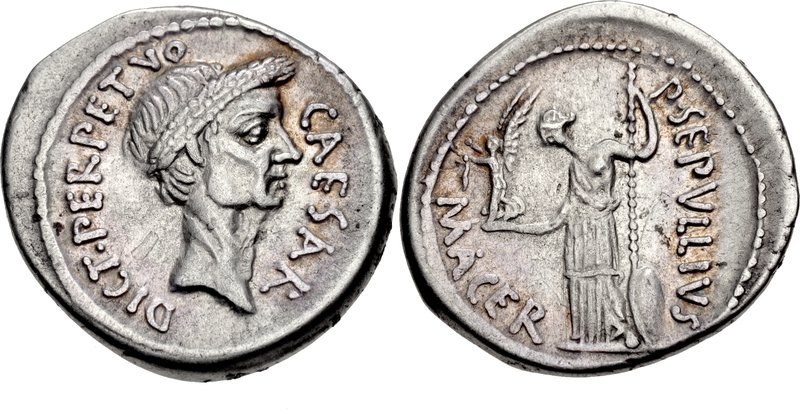
Julius Caesar Denarius
Silver Roman denarius of 44 BC bearing the bareheaded portrait of Julius Caesar, among the first Roman coins to show a living statesman's likeness.
- Country
- Roman Republic
- Denomination
- Denarius
- Metal
- Silver
Got a coin like this?
Identify any coin from a photo, free.
Overview
The Julius Caesar denarius is a silver Roman Republican coin struck in 44 BC, the year of Caesar's dictatorship and assassination. The example shown carries a bareheaded portrait of Caesar facing right with the legend CAESAR, paired with a standing female figure on the reverse holding attributes and usually read as a personification such as Clemency (Clementia) or Victory. It is one of the most historically significant of all ancient coins because it broke a long Roman taboo against depicting a living person on the currency.
Struck at the mint of Rome under officials called moneyers, these denarii were the everyday high-value silver coin of the late Republic. Today the type is prized less for rarity of the denomination than for its portrait: this is a contemporary likeness of Caesar himself, issued while he still held power. Genuine examples are widely collected, heavily studied, and just as heavily imitated, so the type carries both great appeal and real authentication risk.
History & Background
For centuries the Roman Republic pointedly avoided placing living people on its coins, reserving that honor for gods, personifications, and long-dead ancestors. In early 44 BC the Senate granted Caesar the right to have his portrait struck on the coinage, and a series of denarii bearing his likeness followed, produced under several moneyers including Marcus Mettius, Publius Sepullius Macer, and Lucius Aemilius Buca. The move was a striking assertion of personal power and helped fuel the resentment that culminated in Caesar's murder on the Ides of March, 15 March 44 BC.
The legends on these coins track Caesar's escalating titles, with variants reading CAESAR, CAESAR DICT PERPETVO (dictator for life), and related forms. Reverse designs vary by moneyer and include standing deities and personifications such as Venus, Juno, Clemency, and Victory, often with symbols of the goddess or of Caesar's claimed divine descent.
After Caesar's death the precedent he set endured: his heir Octavian and later emperors placed their own portraits on the coinage as a matter of course, making the imperial portrait coin the norm for the next several centuries. The 44 BC denarii thus mark a genuine turning point between Republican and Imperial Rome.
How to Identify
The defining feature is a realistic portrait head of an older man facing right, bareheaded (sometimes veiled or wreathed on other dies), accompanied by the name CAESAR or a longer titled legend. The portrait is individualized rather than idealized: a lined face, prominent neck, and often a wreath or veil distinguish it from the generic deity heads on most Republican denarii. The reverse of the pictured coin shows a draped female figure standing with attributes, of the kind used for personifications such as Clemency or Victory, frequently with a moneyer's name in the field.
As a denarius, the coin is small silver, roughly 17 to 20 mm across and about 3.5 to 4 grams, hand-struck so that flans are slightly irregular and the strike is often off-center. Expect some die wear, porosity, or toning consistent with a 2,000-year-old coin. The style, fabric, and lettering should all read as late-Republican rather than modern.
Because many different moneyers issued Caesar portrait denarii, the exact reverse type, legend, and symbols vary from coin to coin. Attributing a specific piece means matching the obverse legend and portrait style together with the reverse figure and the moneyer's name to a standard reference such as Crawford's Roman Republican Coinage.
Value & Collectibility
Genuine Julius Caesar lifetime portrait denarii are sought-after and command strong prices, well above ordinary Republican silver, because they combine a famous historical figure with a contemporary likeness. Worn but authentic examples typically trade in the mid hundreds of dollars, while attractive, well-centered, and well-preserved coins routinely reach the low-to-mid four figures. Exceptional pieces, rare moneyers, and choice mint-state examples can sell for much more at specialist auction.
Condition, centering, portrait quality, and the specific legend and moneyer all affect value, as does clear, documented authenticity. Because the type is so desirable, provenance and expert certification add meaningfully to price and to buyer confidence.
A critical caution: this is one of the most widely forged and reproduced of all ancient coins, and modern replicas, tourist copies, and cast fakes are extremely common. Any Caesar denarius offered cheaply should be treated as a copy until proven otherwise, and significant purchases should be authenticated by a reputable dealer or grading service before money changes hands.
Frequently asked questions
Is a Julius Caesar denarius real silver?
Yes. Authentic examples are struck in Republican-standard silver, weighing roughly 3.5 to 4 grams and measuring about 17 to 20 mm across. Many pieces sold as Caesar denarii, however, are modern base-metal or silver-plated reproductions.
Was this really made during Caesar's lifetime?
The portrait denarii were struck in 44 BC, the year Caesar was assassinated, after the Senate granted him the right to place his likeness on the coinage. They were among the first Roman coins to depict a living Roman.
Who is the figure on the reverse?
It varies by moneyer. The pictured coin shows a standing female personification, of the kind read as Clemency (Clementia) or Victory; other Caesar denarii show Venus, Juno, or related deities, usually with the moneyer's name.
How much is a genuine Caesar denarius worth?
Authenticated examples generally range from the mid hundreds of dollars for worn coins to several thousand for choice pieces, with rare varieties selling higher. Because forgeries are common, value depends heavily on proven authenticity.
Why are there so many fake Caesar denarii?
Its fame makes it one of the most reproduced ancient coins. Museum replicas, tourist souvenirs, and deceptive cast forgeries all exist in large numbers, so any inexpensive example should be assumed to be a copy until authenticated.
Julius Caesar Denarius guides
In-depth guides for identifying, valuing, and collecting Julius Caesar Denarius.
Other coins you may enjoy
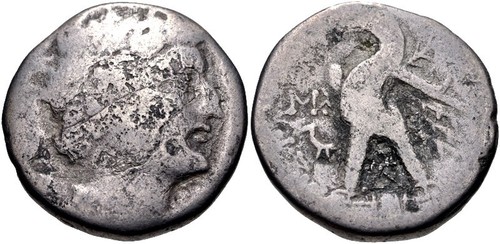
Tetradrachm of Ptolemy XII
80-51 BC
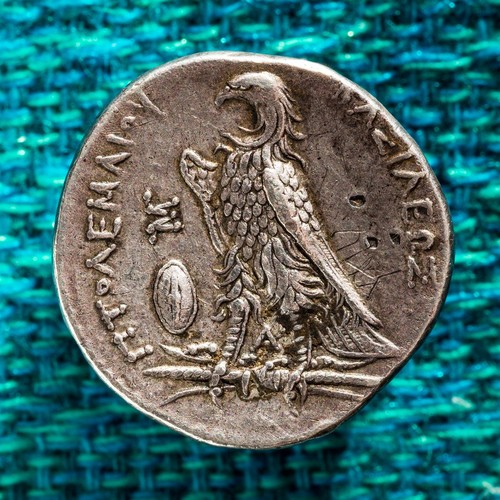
Tetradrachm of Ptolemy I
305-283 BC
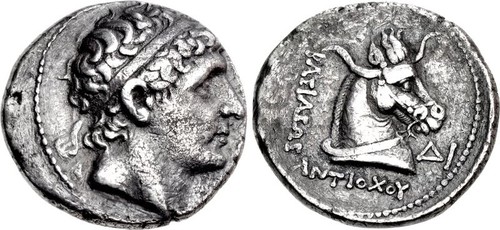
Tetradrachm of Antiochos I Soter
281-261 BC
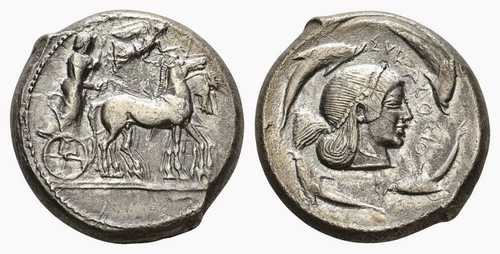
Syracuse Tetradrachm
c. 5th-4th century BC (Classical period)
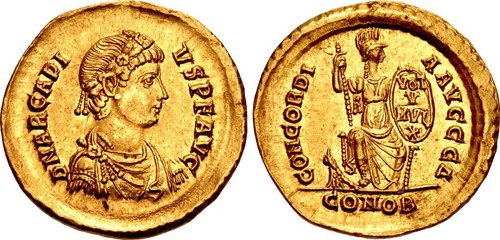
Solidus of Arcadius
AD 395-402
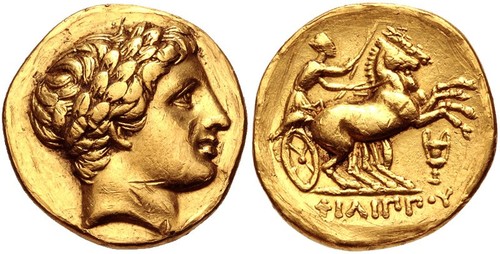
Philip III Gold Stater
323-317 BC
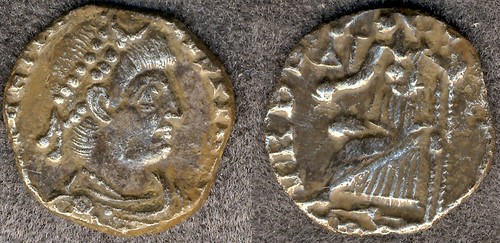
Siliqua of Gratian
AD 367-383
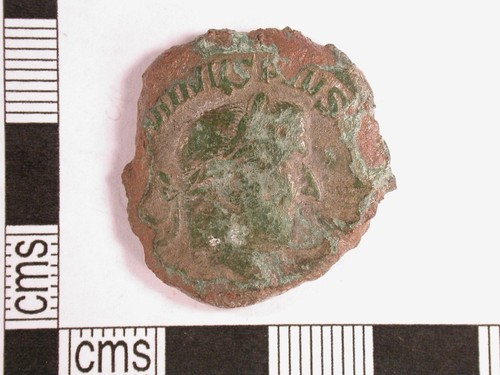
Sestertius of Maximinus Thrax
235-238 AD
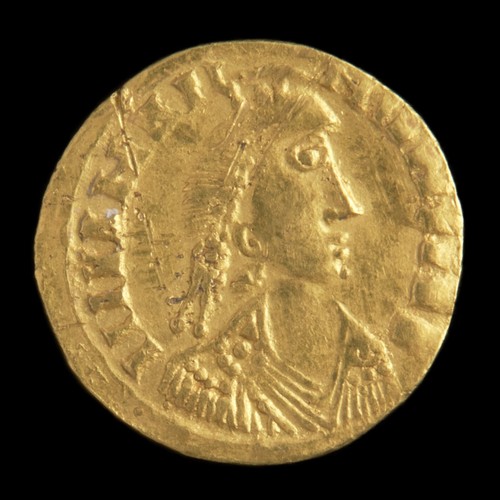
Solidus of Valentinian III
AD 425-455
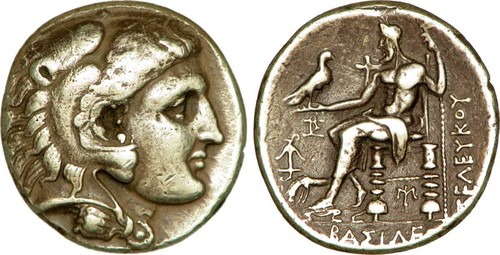
Seleucus I Nicator Tetradrachm
Late 4th-3rd century BC
Nummus of Magnentius
AD 350-353
Follis of Galerius
AD 308-310