
How to Identify the Julius Caesar Denarius
A collector's guide to recognizing the 44 BC silver denarius of Julius Caesar by its portrait, legend, fabric, and the many fakes that imitate it.
Read the full Julius Caesar Denarius encyclopedia entry →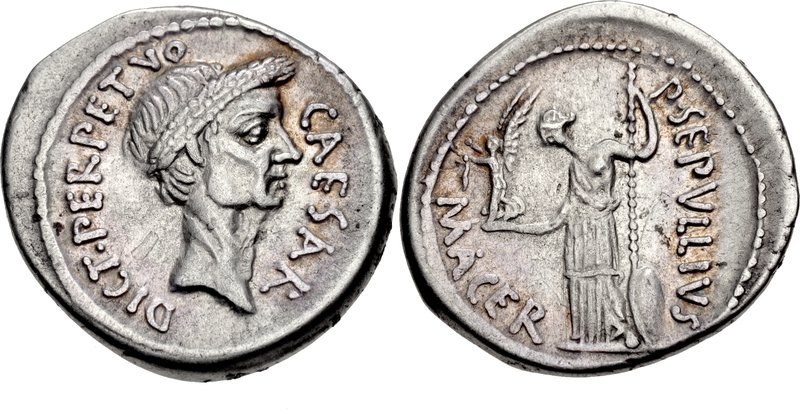
Begin with the portrait. A genuine Caesar denarius shows an individualized older man's head in profile facing right, with the name CAESAR or a longer titled legend such as CAESAR DICT PERPETVO running along the edge. The face is realistic rather than idealized, often with a visible wreath or veil and a lined, aged look, unlike the smooth generic deity heads on most other Republican denarii. Read the legend carefully: the presence of the personal name CAESAR, not a god's name, is the primary diagnostic.
Turn to the reverse and match the figure. The pictured coin has a draped female personification standing with attributes, consistent with Clemency or Victory; other dies show Venus, Juno, or similar deities. Look for a moneyer's name in the field, since these coins were issued under officials such as Mettius, Sepullius Macer, and Buca, and the specific reverse plus moneyer is how a piece is attributed to a catalogue entry like Crawford's Roman Republican Coinage.
Check the physical coin. A real denarius is small silver, about 17 to 20 mm and 3.5 to 4 grams, hand-struck on a slightly irregular flan. Expect off-center strikes, minor edge splits, honest wear, and old toning. A coin that is unnaturally uniform, seamed around the rim, too heavy or too light, magnetic, or coppery under the surface is almost certainly a cast or plated reproduction.
Be especially alert to forgeries, because this is among the most copied of all ancient coins. Cast fakes show soft detail, surface bubbles, and a telltale mold seam; tooled coins have recut, over-sharp lines; and countless souvenir replicas circulate as genuine. Compare style and fabric against published authentic specimens, weigh and measure the coin, and for any significant purchase insist on expert authentication or third-party certification with clear provenance rather than relying on the seller's word.
Finally, do not assume that damage or crudeness means a coin is fake, or that sharpness means it is genuine. Ancient production was hand-work, so irregularity is normal, while the best modern forgeries are deliberately made to look worn. Sound identification rests on the combination of correct portrait style, correct legend, correct reverse type and moneyer, and correct metal, size, and weight taken together.
Frequently asked questions
What is the single clearest sign it is a Caesar denarius?
The personal name CAESAR (or a titled form like CAESAR DICT PERPETVO) next to a realistic, individualized portrait head facing right. A named living Roman rather than a god is the key identifier for this 44 BC type.
How can I spot a fake?
Watch for a rim seam, surface bubbles or pitting from casting, over-sharp recut detail, wrong weight or diameter, magnetism, or a coppery core showing through. Any of these points to a modern copy rather than a genuine hand-struck denarius.
How do I know which moneyer struck my coin?
Read the reverse for a moneyer's name and match the reverse figure and obverse legend to a reference such as Crawford's Roman Republican Coinage. Different moneyers used different deities and legend forms in 44 BC.
Should I clean an old-looking Caesar denarius?
No. Cleaning ancient silver can strip original toning and surfaces and sharply reduce both value and the ability to authenticate the coin. Leave it as found and consult a specialist before doing anything to it.