
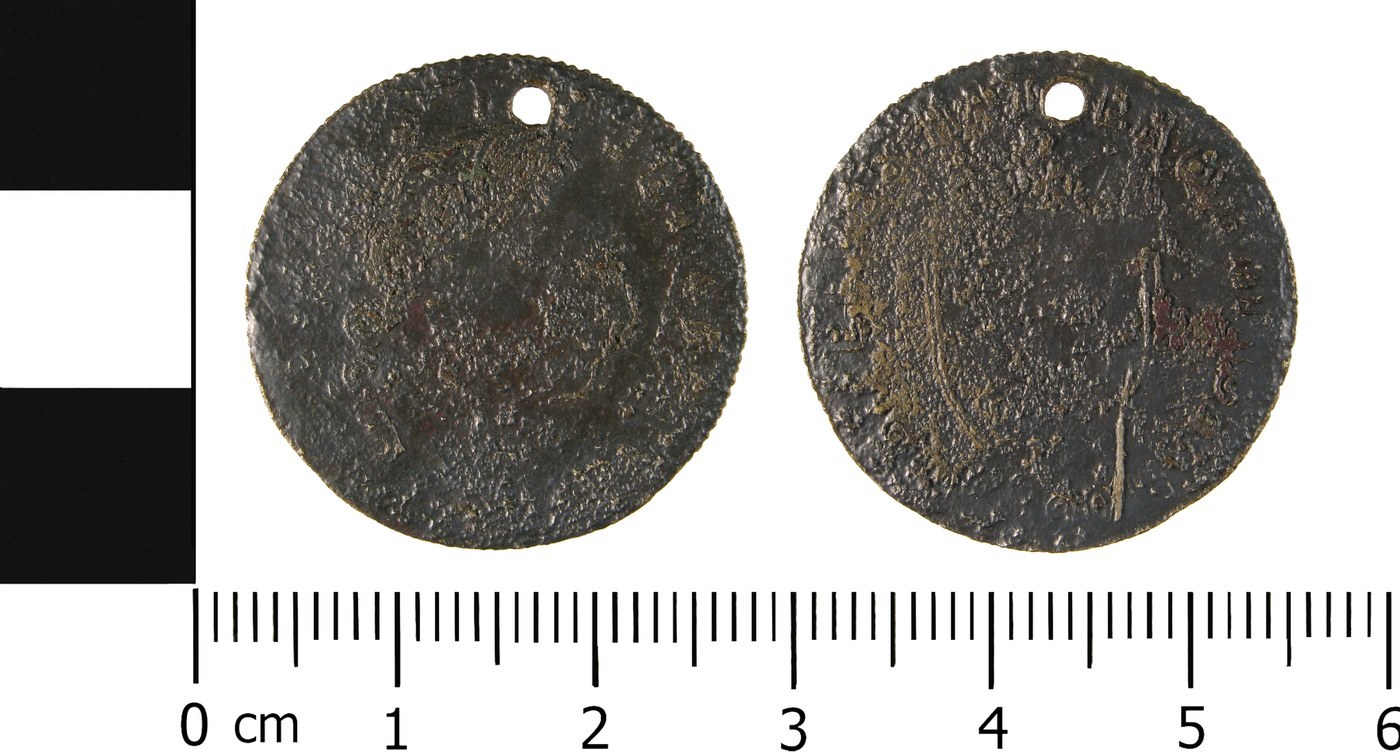
Imitation Guinea Gaming Piece
A brass or bronze token imitating a George III spade guinea, made for card games and gaming tables rather than as legal-tender money.
- Country
- United Kingdom
- Denomination
- Guinea
- Metal
- Bronze
Got a coin like this?
Identify any coin from a photo, free.
Overview
The Imitation Guinea Gaming Piece is a base-metal token, usually brass or bronze, made to resemble a George III guinea of the "spade" type. It was never money. Instead it served as a card counter, gaming chip, or novelty medalet, and pieces like it were produced in large numbers through the nineteenth century.
The example shown here carries the familiar imitation-guinea look: a right-facing bust of King George III on the obverse and a crowned coat of arms on a spade-shaped shield on the reverse. Because it is a gaming piece, it bears no true date, denomination value, or Royal Mint authority, and the legends often differ from those on a genuine guinea.
These counters are common survivors today. They are collected as social-history curiosities from the age of whist and card-table play rather than as official British coinage.
History & Background
The genuine gold guinea, and especially the spade guinea of George III (struck 1787-1799), was one of the most recognisable coins in Georgian Britain. Its distinctive shield shaped like a spade made it an easy template to copy, and once real guineas left circulation many people still remembered the design fondly.
Brass and bronze imitations were produced by button-makers and token manufacturers, many in Birmingham, from the late 1700s onward and in great quantity during the Victorian era. They were sold cheaply as whist counters and card markers, as toys, and as advertising or novelty pieces. Some carry mock legends such as IN MEMORY OF THE GOOD OLD DAYS or a maker's slogan in place of the royal titles.
Because they mimic a gold coin so closely, such tokens were occasionally passed off on the unwary as real guineas, and later collectors sometimes label them "gaming" or "gambling" pieces for that reason. They were never issued by the Royal Mint and had no monetary value.
How to Identify
Look first at the metal and colour. A genuine guinea is gold; this piece is base brass or bronze, so it shows a yellow, brown, or worn coppery tone rather than the rich colour of gold, and it feels lighter for its size. Any "guinea" that is clearly not gold is an imitation.
Check the legends and design. The obverse shows George III facing right, but the surrounding inscription is frequently altered, garbled, or replaced with a motto or maker's name, rather than the correct Latin royal titles. The reverse coat of arms sits on the characteristic spade-shaped shield, but again the lettering may be non-standard and there is no genuine date or value.
Confirm it is undated and non-denominational. Real George III spade guineas are dated 1787-1799; a piece with no date, an impossible date, or slogans in place of the legend is a gaming counter. Many also have a slightly different diameter and a plain or lightly milled edge compared with a struck gold guinea.
Value & Collectibility
Imitation guinea gaming pieces are common and inexpensive. As mass-produced brass and bronze tokens they typically trade in the low single-digit to low double-digit range in modest condition, and they are valued as historical curiosities rather than for precious-metal content.
Condition, sharpness of the design, and any unusual or legible motto or maker's name drive most of the premium. Well-preserved examples with crisp detail, or scarcer legend varieties, can bring somewhat more, while worn or damaged pieces are worth very little.
Because they superficially resemble a gold coin, be cautious of anything sold as a real guinea. These figures are indicative only; for a specific piece, compare it with catalogued token varieties or ask a dealer familiar with jetons and counters.
Frequently asked questions
Is an imitation guinea gaming piece worth anything?
Only modestly. They are common brass or bronze tokens usually worth a few pounds or dollars, valued as historical card-game curiosities rather than for metal content.
Is it real gold?
No. Despite imitating a gold guinea, these pieces are struck in base brass or bronze. If a "guinea" is clearly not gold, it is an imitation gaming counter.
Why does it look like a coin if it isn't one?
It was deliberately modelled on the popular George III spade guinea to serve as a card counter or gaming chip. It was never issued as money and has no legal-tender value.
What are the mottoes on some of these pieces?
Many replace the royal Latin titles with slogans such as "IN MEMORY OF THE GOOD OLD DAYS" or a maker's name, which is a clear sign the piece is a token rather than a genuine guinea.
How old is my gaming piece?
Most were made between roughly the 1790s and 1900, with large numbers produced in the Victorian era. They are undated, so an exact year usually cannot be assigned.
Imitation Guinea Gaming Piece guides
In-depth guides for identifying, valuing, and collecting Imitation Guinea Gaming Piece.
Other coins you may enjoy
Medieval Penny of Edward III
1327–1377
Medieval Silver Cut Farthing
1272-1509
Quarter Farthing
1839-1868
Medieval Halfgroat of Henry VII
1485-1509
Godless Florin
1849
Victoria Maundy Twopence
1838–1901 (Young Head example shown: 1845)
British Silver Threepence
1838-1944
Victoria Maundy Fourpence
1838–1901 (Jubilee Head type shown: 1888–1892)
British Crown
1927–1936 (George V wreath crown; example dated 1934)
British Decimal Half Penny
1971–1984
British Brass Threepence
1937-1967
British Half Crown
1928 (George V type; series ran 1816–1946 in silver)