
How to Identify the Imitation Guinea Gaming Piece
Practical checks to tell a brass or bronze imitation guinea counter from a real George III gold guinea: metal, legends, date, and edge.
Read the full Imitation Guinea Gaming Piece encyclopedia entry →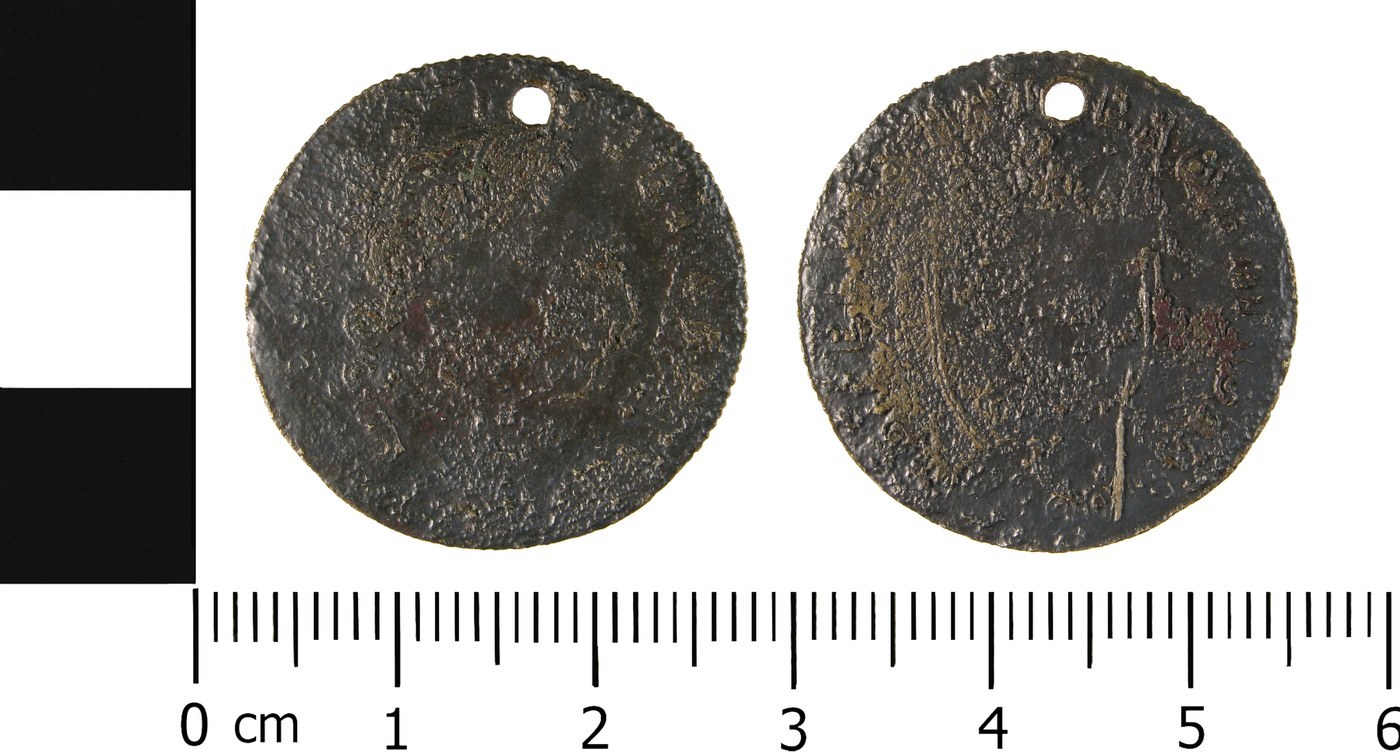
Begin with the metal test, which settles most cases instantly. A genuine guinea is 22-carat gold with a warm yellow colour and real heft. An imitation gaming piece is brass or bronze: it looks yellow-brass, brown, or coppery, often shows wear to a duller tone, and feels lighter than a gold coin of the same size. If it is plainly not gold, it is a token.
Read the obverse legend closely. The bust of George III faces right as on a real spade guinea, but on gaming pieces the surrounding inscription is commonly wrong, blundered, abbreviated oddly, or replaced altogether with a motto or maker's name. Genuine guineas carry correct Latin royal titles; a slogan such as IN MEMORY OF THE GOOD OLD DAYS is a dead giveaway that the piece is a counter.
Turn to the reverse. Both real guineas and these imitations use the crowned coat of arms on a spade-shaped shield, so the shield shape alone does not prove authenticity. Look instead for no genuine date and no denomination. Real George III spade guineas are dated 1787 to 1799; an undated piece, or one with an impossible date or decorative lettering, is an imitation.
Check size and edge as a cross-reference. A struck gold guinea is close to 24 mm with a finely milled edge, while many gaming pieces vary slightly in diameter and have a plain or crudely milled edge. A jeweller's scale will also show base-metal tokens falling well short of the roughly 8.4 g weight of a gold guinea.
Finally, be alert to passing-off. Because these counters were sometimes used to deceive, treat any "gold guinea" offered cheaply, or one that fails the metal and legend checks, with caution. When in doubt, weigh it, compare the legends against a catalogued genuine guinea, and consult a dealer familiar with tokens and jetons before assuming it is real.
Frequently asked questions
What is the fastest way to spot an imitation guinea?
Check the metal. A real guinea is gold; these gaming pieces are brass or bronze. A non-gold colour and a light weight almost always mean it is an imitation counter.
Does the spade-shaped shield prove it is genuine?
No. Both real spade guineas and their imitations use the spade shield. You must also check the metal, the legends, and whether it carries a genuine 1787-1799 date.
Should the piece have a date?
A genuine George III spade guinea is dated 1787 to 1799. Gaming pieces are typically undated or carry a decorative motto instead, which marks them as tokens.
Could someone sell one as a real guinea?
Yes, which is why these are sometimes called gaming or gambling pieces. Verify metal, weight, and legends, and seek expert advice before treating any such piece as gold.