
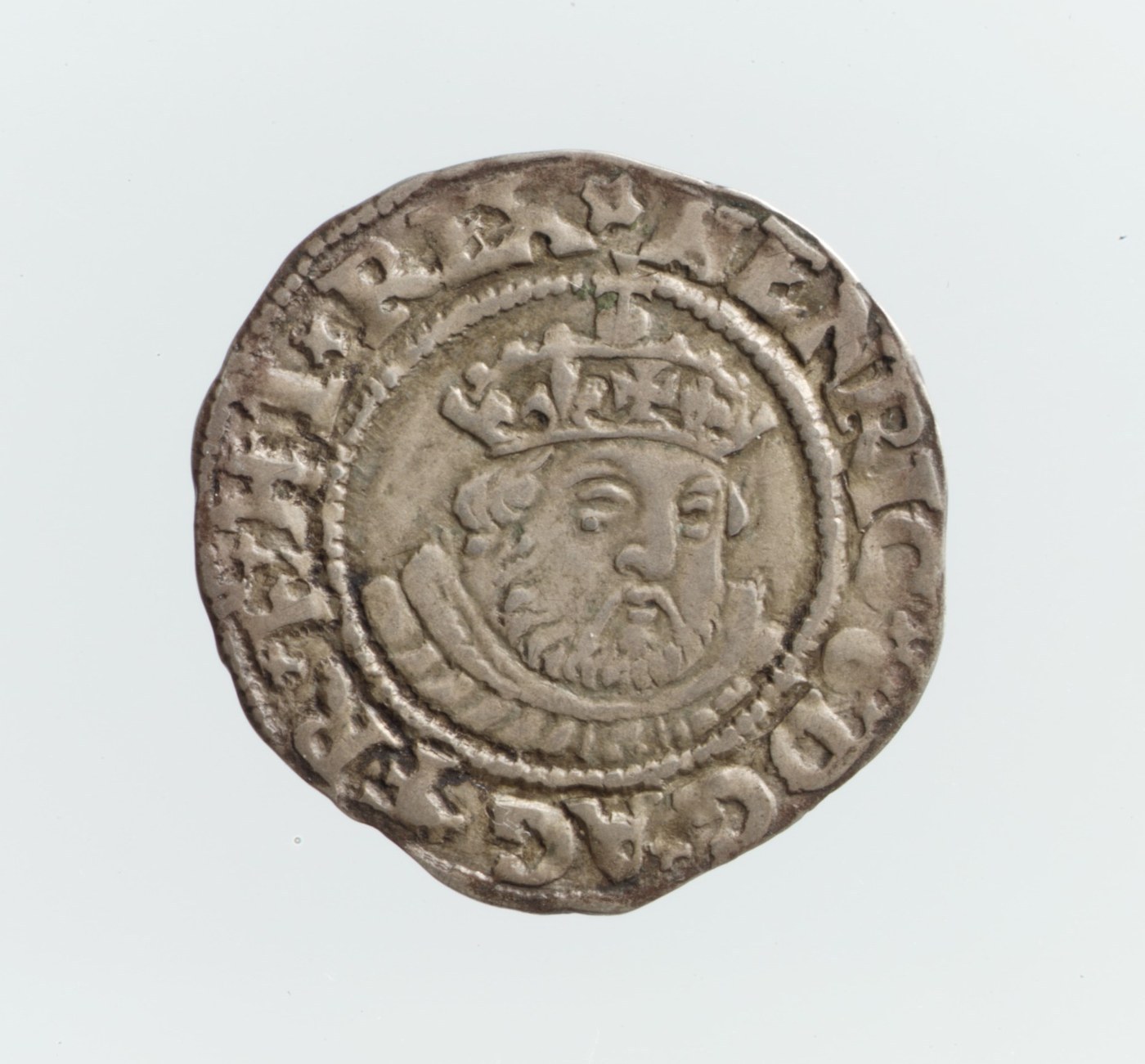
Half Groat of Henry VIII
A small hammered English silver coin worth twopence, struck across the reign of Henry VIII and bearing his crowned facing bust.
- Country
- England
- Denomination
- 1/2 Groat
- Metal
- Silver
Got a coin like this?
Identify any coin from a photo, free.
Overview
The half groat of Henry VIII is a small hand-struck silver coin valued at twopence, or half of the four-penny groat. It circulated throughout Henry's reign (1509-1547) as a workhorse denomination for everyday trade, sitting between the penny and the full groat.
The example shown here displays the classic obverse of the middle and later reign: a crowned, bearded facing bust of the king enclosed within an inner circle, surrounded by a Latin royal legend. Because half groats were produced in large numbers over nearly four decades and at several mints, they survive in quantity today and are a popular, accessible entry point into English hammered coinage.
Many half groats of this reign were struck under royal license at the ecclesiastical mints of Canterbury and York, and these often carry the initials or badges of the presiding archbishop alongside the royal design.
History & Background
Henry VIII came to the throne in 1509 and his silver coinage is usually divided into three phases. The first coinage (1509-1526) continued the style and standards inherited from his father, Henry VII, and its portrait can look very like the earlier king. The second coinage (1526-1544) introduced Henry's own crowned facing bust and revised weight standards. The third coinage (1544-1547) is the notorious debasement, when the crown drastically reduced the silver content of the money to fund war, leaving coins that were pale and quick to wear at the high points.
The bearded facing portrait seen on this half groat belongs to the later portraiture of the reign. Debased pieces of the third coinage earned Henry the lasting nickname 'Old Coppernose,' because as the thin silver surface wore away on the raised nose, the coppery base metal beneath showed through.
Half groats were struck at the royal mint in London (the Tower) and at the archiepiscopal mints of Canterbury and York, which operated under royal authority. This is why so many surviving half groats of Henry VIII carry an archbishop's initials or ecclesiastical marks in addition to the king's name and titles.
How to Identify
Look first for a small silver coin, noticeably smaller than a groat, with a crowned facing bust of the king inside an inner beaded or linear circle, as on the photographed example. The surrounding Latin legend names Henry as king, typically reading in abbreviated form as HENRIC(us) VIII D(ei) G(ratia) R(ex) with reference to England and France.
The reverse, not visible in this image, normally carries a royal shield of arms over a long cross, with a legend such as POSVI DEVM ADIVTOREM MEVM ('I have made God my helper'). On Canterbury and York issues you will often find the archbishop's initials, a cardinal's hat, keys, or similar marks flanking the shield, which help attribute the coin to a specific mint and archbishop.
Mint marks (small symbols at the start of the legend) and portrait style are the main tools for narrowing down which coinage a given half groat belongs to. Debased third-coinage pieces tend to look grayer or show a faint coppery tone at worn high points.
Value & Collectibility
Half groats of Henry VIII are relatively common and remain among the more affordable Tudor silver coins. Ordinary, well-worn examples of the ecclesiastical issues generally trade in the modest tens of dollars, while sharper, better-centered coins with clear portraits and legends can reach into the low hundreds.
Value is driven by which coinage the piece belongs to, the mint and archbishop, the strength of the strike, and overall preservation. Cleanly struck second-coinage portraits and scarcer mint-mark combinations command premiums, whereas heavily debased or badly clipped third-coinage pieces sit at the lower end.
As with all hammered coinage, condition is judged differently from milled coins: soft or uneven striking is normal, so eye appeal, a legible legend, and a complete flan matter more than flawless surfaces. For precise attributions and value, compare against a standard reference such as Spink's catalogue or consult a specialist dealer.
Frequently asked questions
How much was a half groat worth?
A half groat was worth twopence, that is, two pennies or half of the four-penny groat. It was a mid-range silver denomination for everyday transactions.
Why do some Henry VIII half groats show initials next to the shield?
Many were struck at the archbishops' mints of Canterbury and York under royal license. The initials, hats, or keys identify the presiding archbishop and the mint that produced the coin.
What does 'Old Coppernose' mean?
It is a nickname for Henry's debased late coinage. The thin silver layer wore off the raised nose of the portrait first, exposing the copper-rich base metal underneath.
Is the half groat of Henry VIII rare?
No. It was struck in large numbers over nearly four decades, so many survive today. Rarity depends more on the specific coinage, mint, and condition than on the denomination itself.
Half Groat of Henry VIII guides
In-depth guides for identifying, valuing, and collecting Half Groat of Henry VIII.
Other coins you may enjoy
English Sixpence
Early 1600s (James I, 1603-1625)
Sixpence of James I
1603-1625
Thistle Merk
1567–1625
James VI Ryal
1567–1571
Quarter Merk
c. 1580–1691
Sixpence of Elizabeth I
1560–1603
Quarter Angel of Elizabeth I
1581-1583
Laurel
1619-1625
Mary I Groat
1553-1558
Medieval Coin
c. 500–1500 (Medieval)
Half Thistle Merk
1567-1625
Irish Pistole
1640s (17th century)