
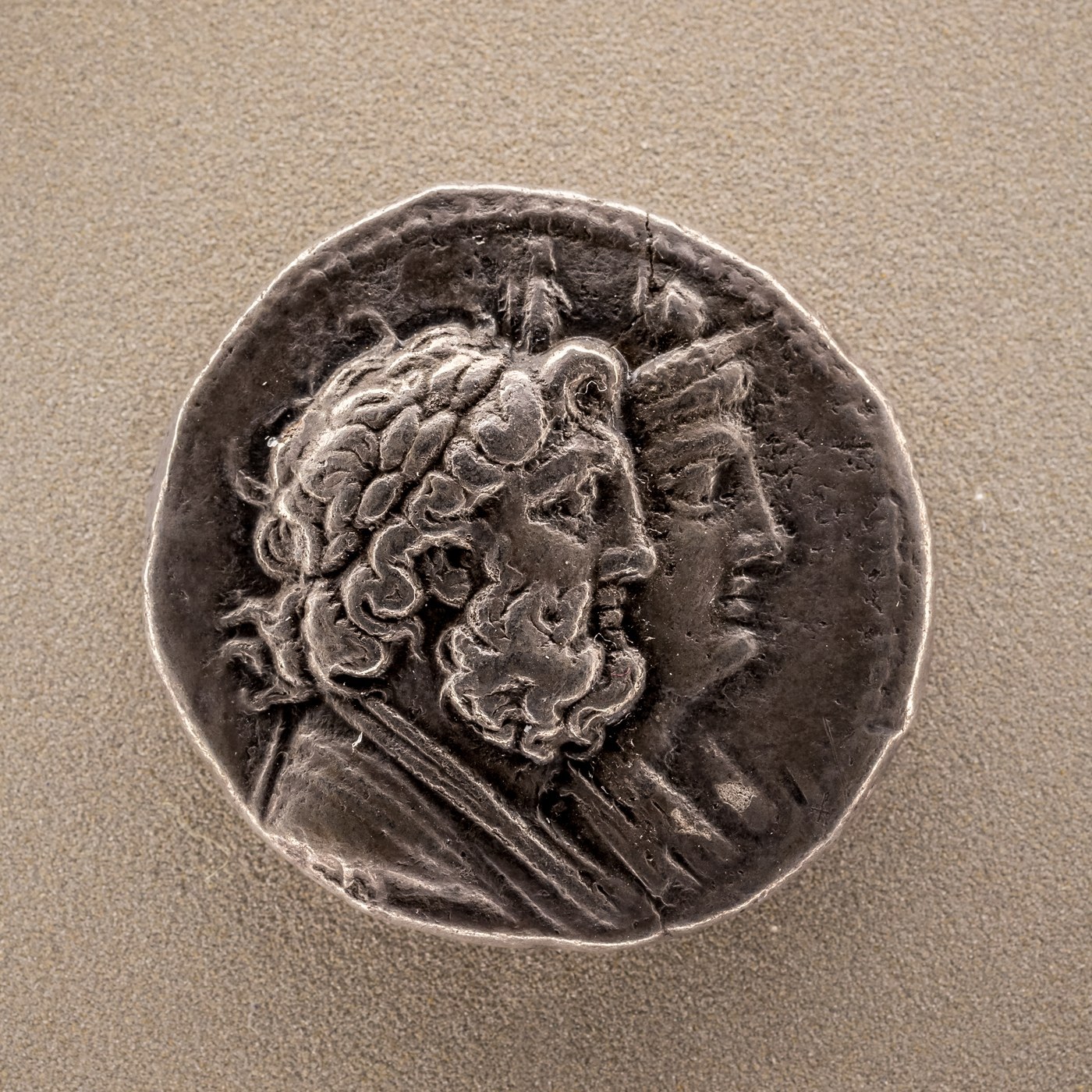
Gold Tetradrachm of Ptolemy II and Arsinoe II
Ptolemaic gold of Egypt, c. 260-240 BC, with paired busts of Ptolemy II and Arsinoe II on one side and Ptolemy I and Berenike I on the other.
- Country
- Ancient Egypt
- Denomination
- Tetradrachm
- Metal
- Gold
Got a coin like this?
Identify any coin from a photo, free.
Overview
This is a piece of Ptolemaic gold coinage from Hellenistic Egypt, struck to honor the ruling dynasty. It is instantly recognizable by its jugate (overlapping) busts: one side shows Ptolemy II Philadelphos paired with his sister-wife Arsinoe II, while the other shows the founders of the dynasty, Ptolemy I Soter and his queen Berenike I. Every face is turned in the same direction, one head layered slightly behind the other.
The example shown belongs to roughly 260-240 BC, the mature reign of Ptolemy II and the decades that followed, when the Ptolemaic mint at Alexandria produced a celebrated series of dynastic gold. Struck in high-purity gold on a compact, heavy flan, coins of this kind were prestige objects as much as money, projecting the legitimacy and divine status of the royal house.
The defining feature is the double dynastic portrait program: the living sibling-monarchs on one face and the deified founders on the other, linking the current king to his revered parents. This makes it one of the most distinctive and sought-after gold types of the ancient Greek world.
History & Background
Ptolemy II Philadelphos ruled Egypt from 285 to 246 BC as the second king of the dynasty founded by Ptolemy I Soter, one of Alexander the Great's generals who took Egypt after Alexander's death in 323 BC. Ptolemy II married his full sister Arsinoe II, an unusual union that echoed Egyptian pharaonic and divine tradition and earned the royal couple the title Theoi Adelphoi, the "Sibling Gods."
After Arsinoe II's death, Ptolemy II promoted an elaborate ruler cult, and the dynastic gold coinage grew out of this program. By placing the reigning couple on one side and the founders Ptolemy I and Berenike I, styled the Theoi Soteres or "Savior Gods," on the other, the coins presented an unbroken chain of deified rulers and reinforced the family's claim to godlike authority.
Alexandria was the wealthiest court of the Hellenistic age, and its gold underwrote patronage of the famous Library and Museum, mercenary armies, and grand ceremony. These jugate-bust issues continued to be struck and honored across the middle of the third century BC, becoming an enduring emblem of Ptolemaic power and one of the signature coinages of the era.
How to Identify
The key diagnostic is the pair of jugate busts on each side. On the primary face, look for two overlapping heads facing the same way, identified in the standard series as Ptolemy II and Arsinoe II, often with a Greek legend reading ΑΔΕΛΦΩΝ ("of the siblings"). The opposite face shows a second pair, Ptolemy I and Berenike I, the deified founders, typically with the legend ΘΕΩΝ ("of the gods").
The busts are cut in bold Hellenistic relief and are diademed, the male heads sometimes draped or with a spear or aegis, the queens veiled or with a rolled diadem; the overlapping arrangement, with one profile set just behind the other, is the surest sign that you are looking at this dynastic type rather than a single-portrait coin.
In hand this is a substantial piece of high-purity yellow gold, hand-struck so the flan is somewhat irregular and the centering can vary from coin to coin. Ptolemaic dynastic gold was issued in several denominations of the same design, so weight and diameter must be measured to place a given coin within the series. The combination of two overlapping royal portraits on each side, Greek dynastic legends, and solid gold fabric is the core identifier.
Value & Collectibility
Ptolemaic dynastic gold with jugate royal busts is among the most prized of ancient Greek coinages, and genuine examples command strong prices. Even circulated or off-center pieces trade well into the four figures, while sharply struck, well-centered coins with clear portraits and legends reach five figures and beyond at specialist auction.
Value turns on the sharpness and style of the four royal portraits, the completeness of the Greek legends, the centering of the flan, the purity and surface of the gold, and overall eye appeal. Larger denominations of the type, strong provenance, and secure attribution to Alexandria add substantial premiums.
These figures are general market context, not appraisals. Because high-value ancient gold of this kind is heavily faked and closely studied, any specific coin's worth depends on authentication, condition, denomination, and provenance, and important examples are normally sold with specialist cataloguing or third-party certification.
Frequently asked questions
Who are the four people on this coin?
One side pairs Ptolemy II Philadelphos with his sister-wife Arsinoe II, the reigning "Sibling Gods." The other side pairs the dynasty's founders, Ptolemy I Soter and Berenike I, the deified "Savior Gods." Together they present an unbroken line of Ptolemaic rulers.
Why are the busts overlapping?
The overlapping, or jugate, arrangement shows a royal couple as a single unit, one head set just behind the other. It emphasizes the pairing of king and queen and was a favored device on Ptolemaic dynastic coinage.
What do the Greek legends mean?
The dynastic gold typically carries ΑΔΕΛΦΩΝ, "of the siblings," for Ptolemy II and Arsinoe II, and ΘΕΩΝ, "of the gods," for the founders Ptolemy I and Berenike I. The words underline the couples' divine, dynastic status.
Why did Ptolemy II marry his own sister?
The marriage of Ptolemy II and Arsinoe II followed Egyptian pharaonic and divine tradition and reinforced the royal family's claim to godlike status. The couple were worshipped as the Theoi Adelphoi, the Sibling Gods.
Is this a common coin?
No. Ptolemaic dynastic gold is scarce and highly prized, and genuine examples are valuable. Because the type is famous and heavily faked, authentication is essential before treating any piece as genuine.
Gold Tetradrachm of Ptolemy II and Arsinoe II guides
In-depth guides for identifying, valuing, and collecting Gold Tetradrachm of Ptolemy II and Arsinoe II.
Other coins you may enjoy
Tetradrachm of Ptolemy XII
80-51 BC
Tetradrachm of Ptolemy I
305-283 BC
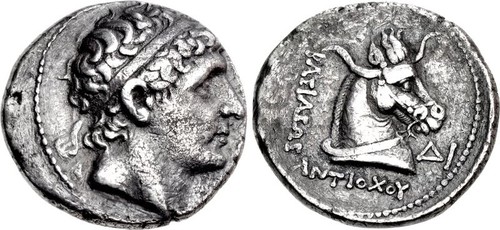
Tetradrachm of Antiochos I Soter
281-261 BC
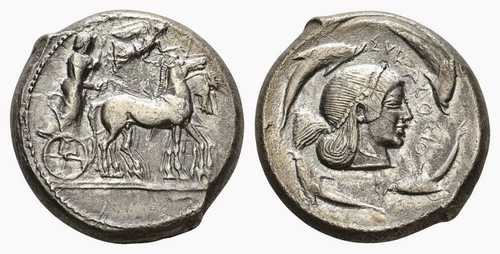
Syracuse Tetradrachm
c. 5th-4th century BC (Classical period)
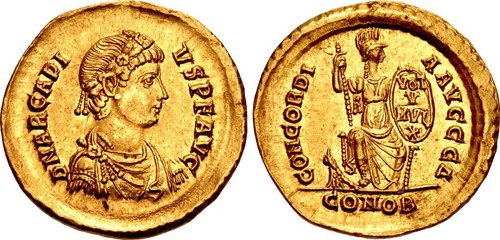
Solidus of Arcadius
AD 395-402
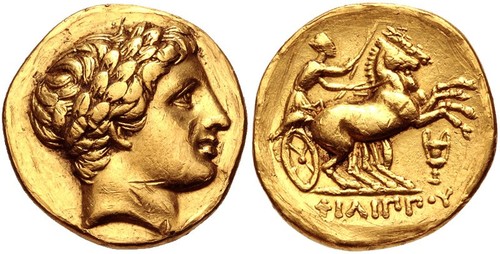
Philip III Gold Stater
323-317 BC
Siliqua of Gratian
AD 367-383
Sestertius of Maximinus Thrax
235-238 AD
Solidus of Valentinian III
AD 425-455
Seleucus I Nicator Tetradrachm
Late 4th-3rd century BC
Nummus of Magnentius
AD 350-353
Follis of Galerius
AD 308-310