
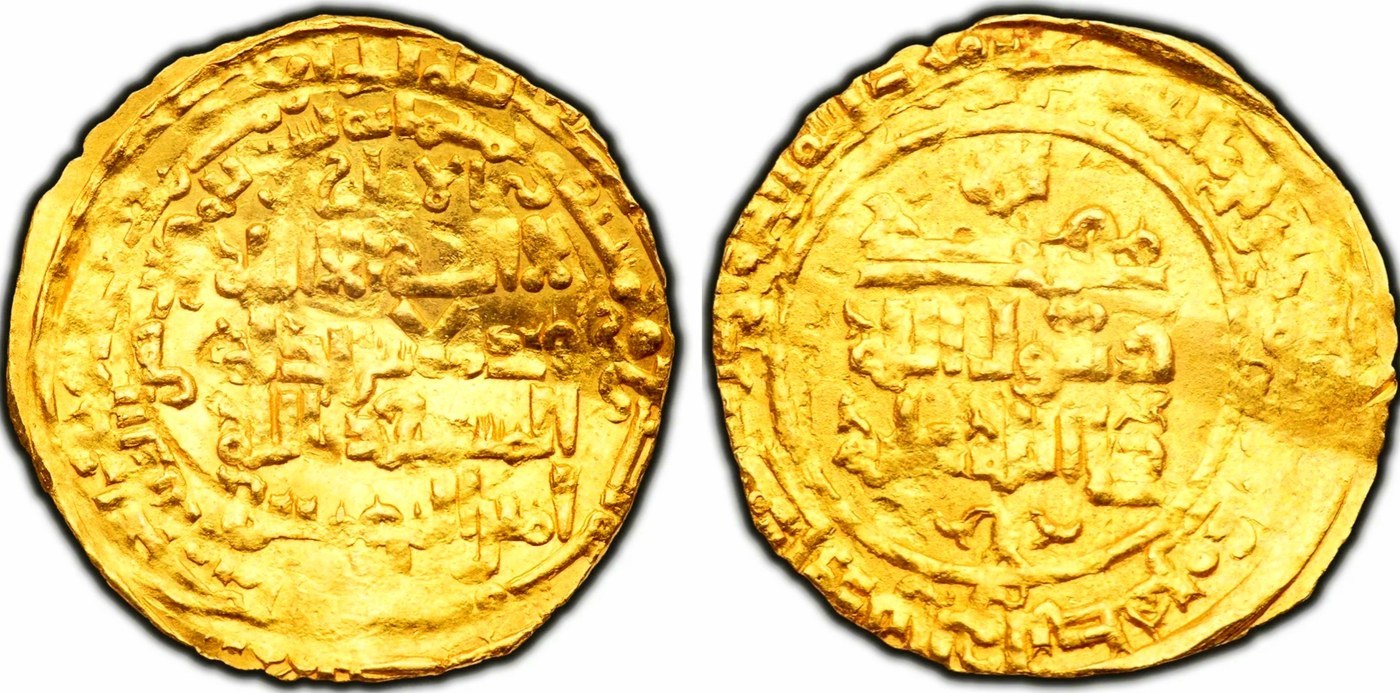
Gold Dinar of al-Mustanjid
A hand-struck Abbasid gold dinar of Caliph al-Mustanjid, bearing only Arabic calligraphy within concentric ring borders and dated AH 557.
- Country
- Islamic (Abbasid Caliphate)
- Denomination
- Dinar
- Metal
- Gold
Got a coin like this?
Identify any coin from a photo, free.
Overview
The gold dinar of al-Mustanjid is a hand-struck coin of the late Abbasid Caliphate, issued in the name of the caliph Abu al-Muzaffar Yusuf al-Mustanjid bi'llah. The example shown carries Arabic calligraphic inscriptions on both faces, each arranged in a central field enclosed by decorative circular border bands, and is dated AH 557 (AD 1161–1162).
Like other classical Islamic dinars, it is entirely aniconic: there is no portrait, animal, or figural image of any kind, only religious formulas and the names and titles that identify the issuing authority. The obverse and reverse are distinguished by their inscriptions rather than by any pictorial design, with the caliph's name and the profession of faith forming the core of the legends.
As a gold coin of a named Abbasid caliph tied to a specific Hijri year, this dinar sits within one of the longest-running coin traditions in the Islamic world, and its content follows the well-established late Abbasid formula of concentric religious and dynastic legends.
History & Background
Al-Mustanjid bi'llah was the thirty-second Abbasid caliph, reigning in Baghdad from AH 555 to 566 (AD 1160–1170). By his time the Abbasid caliphs, based in Iraq, held direct authority over a much reduced territory compared to the dynasty's early centuries, though the caliph remained the central religious figure of Sunni Islam and continued to issue gold coinage in his own name.
The dinar was the standard gold denomination of the medieval Islamic world, a tradition reaching back to the reform coinage of the Umayyad caliph Abd al-Malik in the late seventh century. Abbasid dinars of the twelfth century typically name the reigning caliph and often acknowledge contemporary secular powers, reflecting the political arrangements of the period, all rendered in Arabic calligraphy without images.
This coin's date of AH 557 places it early in al-Mustanjid's reign. Dinars of this era were produced by hand striking rather than machinery, so each piece is an individual product of dies engraved with the standard religious and dynastic legends of the Baghdad caliphate.
How to Identify
An al-Mustanjid dinar is a small, hand-struck gold coin, generally on a thin, somewhat irregular flan rather than a perfectly round modern blank. Late Abbasid dinars of this type are typically in the broad range of roughly 20–25 mm across with weights near the classical dinar standard of about 4 grams, though hand production means individual pieces vary and are often slightly wavy or unevenly shaped.
Both faces show Arabic calligraphy set in a central field surrounded by one or more concentric circular border bands, matching the design seen on the photographed coin. The legends carry the Islamic profession of faith together with the names and titles of the caliph al-Mustanjid; reading the caliph's name is the surest way to attribute the coin, since the overall layout is shared across many Abbasid issues. The Hijri date, here AH 557, is expressed in written-out Arabic words rather than numerals.
There is no Latin lettering, no portrait, and no coat of arms — only Arabic script. Because the dies were often larger than the flan and the gold is thin, portions of the outer legend may be weak, crowded, or off the edge, which is normal for coins struck this way.
Value & Collectibility
Gold dinars of named Abbasid caliphs are collected both as bullion-related gold and as historical artifacts, so their value combines precious-metal content with numismatic demand. A twelfth-century dinar of an identifiable caliph such as al-Mustanjid generally carries a clear premium over its raw gold weight because of its age, attribution, and collector interest.
Within the series, value is driven by the completeness and legibility of the legends, the specific mint and date, the roundness and centering of the strike, and overall preservation. Well-centered coins with the caliph's name and the date fully readable are more desirable than crowded or clipped examples, and unusual mints or dates can add further premium.
Because each piece is hand-struck and condition varies widely, precise pricing depends on grade, eye appeal, and specialist demand rather than a fixed figure. An accurate reading of the caliph's name and the Hijri date is the single most important factor in placing one of these dinars in the market.
Frequently asked questions
Who was al-Mustanjid?
Al-Mustanjid bi'llah was the thirty-second Abbasid caliph, ruling from Baghdad between AH 555 and 566 (AD 1160–1170). This gold dinar was struck in his name and is dated AH 557.
Is the dinar made of real gold?
Yes. The dinar was the standard gold denomination of the medieval Islamic world, struck to a classical weight of roughly 4 grams. Abbasid dinars of this period are gold coins, not base-metal pieces.
Why is there no picture on the coin?
Classical Islamic coinage is aniconic, avoiding portraits and figures. Instead the dinar carries only Arabic calligraphy — the profession of faith and the caliph's name and titles — arranged within decorative ring borders.
What does AH 557 mean?
AH refers to the Islamic Hijri calendar. AH 557 corresponds to about AD 1161–1162, placing this coin early in the reign of al-Mustanjid.
Are these dinars rare?
Abbasid gold dinars survive in meaningful numbers but are far scarcer than base-metal coins, and value depends heavily on the caliph, mint, date, and how completely the legends are preserved.
Gold Dinar of al-Mustanjid guides
In-depth guides for identifying, valuing, and collecting Gold Dinar of al-Mustanjid.
Other coins you may enjoy
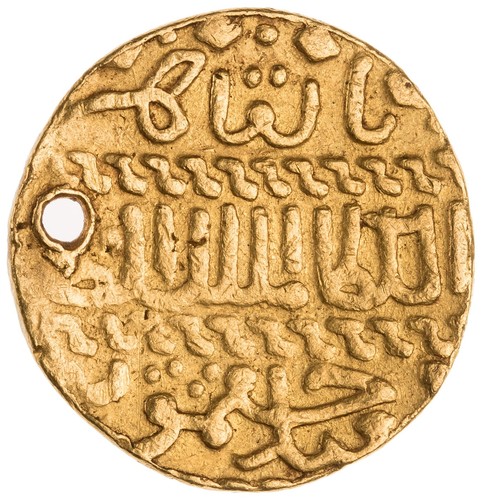
Gold Dinar of Jaqmaq
1438-1453 CE
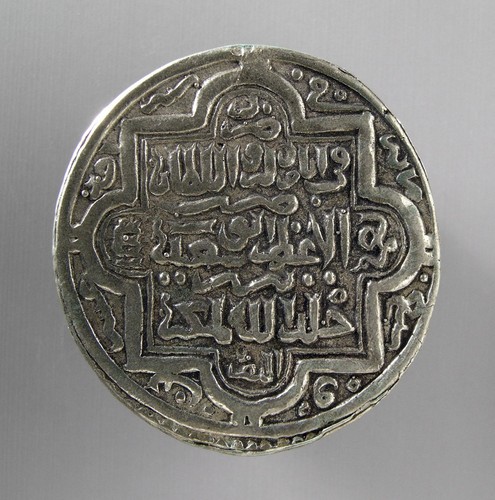
Ilkhanid Dirham
13th–14th century (Ilkhanate, c. 1256–1335 CE)
Ilkhanid Dirham of Ghazan
14th century (c. 1295-1304 CE)
Gold Dinar of al-Muqtadi
c. 467-475 AH (1074-1082 CE)
Gold Dinar of al-Hafiz li-Din Allah
AH 544 (AD 1149–1150)
Samanid Dirham
9th–10th century CE (roughly AH 3rd–4th century)
Copper Fals of Barquq
1382–1389 CE (first reign of Barquq)
Copper Fals of as-Salih Salih
Mid-14th century CE (reign of as-Salih Salih, AH 752–755 / 1351–1354 CE)
Gold Dinar of Malik Shah I
AH 465–485 (1072–1092 CE)
Ilkhanid Dirham of Abu Said
c. 1316-1335 CE (AH 716-736)
Silver Dirham of Salm ibn Ziyad
c. 682-683 CE
Silver Dirham (LACMA M.2002.1.437)
8th century CE (roughly AH 80s–190s)