
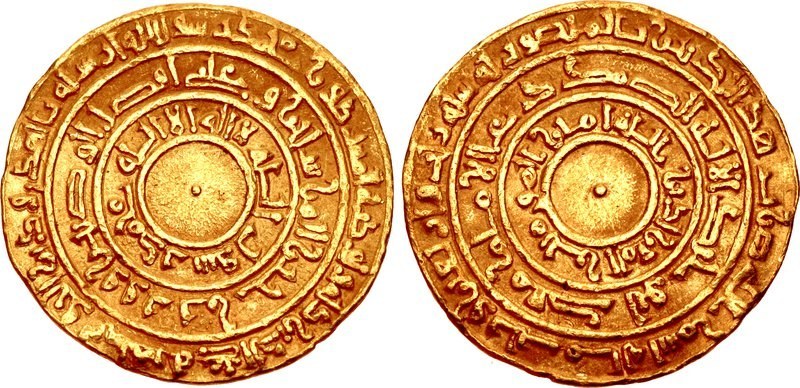
Gold Dinar of al-Mu'izz li-Din Allah
A gold dinar of the Fatimid caliph al-Mu'izz li-Din Allah dated AH 343, struck as concentric Arabic inscriptions with no image on either face.
- Country
- Islamic Caliphate
- Denomination
- Dinar
- Metal
- Gold
Got a coin like this?
Identify any coin from a photo, free.
Overview
The Gold Dinar of al-Mu'izz li-Din Allah is a hand-struck gold coin issued in the name of the fourth Fatimid caliph, al-Mu'izz li-Din Allah, who reigned from 953 to 975 CE. The example shown is dated AH 343 (954–955 CE), placing it in the earliest years of his rule, when the Fatimid state was still centered in North Africa. Both faces are covered entirely with Arabic inscriptions arranged in concentric circles, with no portrait, figure, or emblem of any kind.
The obverse carries the ruler's name and titles together with religious invocations, while the reverse holds further pious legends along with the date and mint information in its marginal band. This distinctive layout — multiple rings of text encircling a short central legend — is the hallmark of Fatimid dinar design and is often described by collectors as a "bullseye" or concentric-circle style.
As a full gold dinar, this was the principal high-value coin of the Fatimid monetary system and a symbol of the dynasty's wealth and its claim to the caliphate. Fatimid gold was prized for its fineness and circulated widely across the medieval Mediterranean world.
History & Background
Al-Mu'izz li-Din Allah was the fourth caliph of the Fatimid dynasty, an Isma'ili Shi'a line that proclaimed itself the rightful caliphate in opposition to the Abbasids of Baghdad. When this coin was struck in AH 343, the Fatimid capital lay in Ifriqiya (modern Tunisia and eastern Algeria), the North African heartland from which the dynasty had risen earlier in the tenth century. It would be later in al-Mu'izz's reign, in 969 CE, that his forces conquered Egypt and founded Cairo, after which the dynasty's center of gravity shifted eastward.
Gold dinars in the caliph's name served both economic and ideological purposes. They provided a trusted high-value currency for trade and taxation, and their inscriptions publicly asserted the Fatimid caliph's religious authority, distinguishing his coinage from the contemporary Abbasid and Umayyad-of-Spain issues through both wording and the characteristic concentric design.
Fatimid dinars of this period are noted for their high gold purity, which helped them win acceptance far beyond the dynasty's borders. The coinage of al-Mu'izz stands at a pivotal moment, bridging the dynasty's North African origins and the imperial phase that followed the move to Egypt.
How to Identify
The most immediate identifier is the design itself: both faces are filled with Arabic inscriptions laid out as concentric circular bands around a short central legend, with a completely aniconic surface — no ruler's portrait, animal, or ornament. This bullseye arrangement is typical of Fatimid dinars and sets them apart from many other medieval Islamic gold coins whose legends run in horizontal lines within a plain circle.
The coin is struck in gold and, as a dinar, is a small, thin flan roughly in the 20–23 mm range and near the classical dinar weight of about 4.2 grams, though hand striking produces variation. Attribution to al-Mu'izz li-Din Allah depends on reading the ruler's name and caliphal titles in the inscriptions, while the marginal legend of the reverse supplies the mint name and the date — here AH 343 — usually introduced by the standard formula naming the coin as a dinar struck at a given place in a given year.
Because the dies were often larger than the flan, portions of the outer legends may be weak or off the edge, and the concentric rings can appear partly incomplete. Reading the caliph's name and the visible portions of the date and mint formula is the reliable way to confirm the type rather than relying on style alone.
Value & Collectibility
Fatimid gold dinars carry intrinsic value as high-purity gold, so even common examples trade well above the level of base-metal coins. Beyond bullion, they are actively collected as historically important Islamic gold, and pieces naming a specific caliph such as al-Mu'izz with a clear date and mint are desirable to specialists.
Value within the series is shaped by the mint, the exact date and reign year, the completeness and centering of the inscriptions, and overall condition. Well-struck coins showing the full concentric legends command more than pieces with large flat or off-flan areas, and scarce or short-lived mints can add a substantial premium. Fully legible, well-centered early dinars are correspondingly more sought after.
Because pricing depends heavily on grade, legibility, mint, and collector demand — and because forgeries exist for high-value Islamic gold — figures should be treated as general context rather than fixed quotes. An accurate reading of the mint and date, ideally confirmed against a specialist reference or by a knowledgeable dealer, is the single biggest factor in placing a given coin in the market.
Frequently asked questions
Who was al-Mu'izz li-Din Allah?
He was the fourth Fatimid caliph, an Isma'ili Shi'a ruler who reigned from 953 to 975 CE. Under him the Fatimids conquered Egypt and founded Cairo, though this coin dated AH 343 comes from the earlier North African phase of his reign.
What does AH 343 mean?
AH stands for Anno Hegirae, the Islamic lunar calendar counted from the Hijra of 622 CE. AH 343 corresponds to roughly 954–955 CE, early in al-Mu'izz's reign.
Why are there no pictures on the coin?
Fatimid coinage, like most medieval Islamic coinage, is aniconic. Instead of portraits or figures it uses Arabic inscriptions — here arranged in concentric circles — to name the ruler, proclaim religious formulas, and record the mint and date.
Is this coin made of real gold?
Yes. The dinar was the Fatimid gold denomination, and Fatimid dinars of this period are known for their high gold purity, which is part of why they circulated widely in medieval trade.
How can I tell it apart from other Islamic gold dinars?
The concentric circular inscriptions are the key visual clue to a Fatimid dinar, and the ruler's name and titles in the legend, together with the AH 343 date and mint in the reverse margin, identify it specifically as an issue of al-Mu'izz li-Din Allah.
Gold Dinar of al-Mu'izz li-Din Allah guides
In-depth guides for identifying, valuing, and collecting Gold Dinar of al-Mu'izz li-Din Allah.
Other coins you may enjoy
Gold Dinar of Jaqmaq
1438-1453 CE
Ilkhanid Dirham
13th–14th century (Ilkhanate, c. 1256–1335 CE)
Ilkhanid Dirham of Ghazan
14th century (c. 1295-1304 CE)
Gold Dinar of al-Muqtadi
c. 467-475 AH (1074-1082 CE)
Gold Dinar of al-Hafiz li-Din Allah
AH 544 (AD 1149–1150)
Samanid Dirham
9th–10th century CE (roughly AH 3rd–4th century)
Copper Fals of Barquq
1382–1389 CE (first reign of Barquq)
Copper Fals of as-Salih Salih
Mid-14th century CE (reign of as-Salih Salih, AH 752–755 / 1351–1354 CE)
Gold Dinar of Malik Shah I
AH 465–485 (1072–1092 CE)
Ilkhanid Dirham of Abu Said
c. 1316-1335 CE (AH 716-736)
Silver Dirham of Salm ibn Ziyad
c. 682-683 CE
Silver Dirham (LACMA M.2002.1.437)
8th century CE (roughly AH 80s–190s)