
How to Identify the Gold Dinar of al-Mu'izz li-Din Allah
A collector's guide to attributing a Fatimid gold dinar of al-Mu'izz: the concentric legends, gold flan, ruler's name, AH 343 date and authentication cautions.
Read the full Gold Dinar of al-Mu'izz li-Din Allah encyclopedia entry →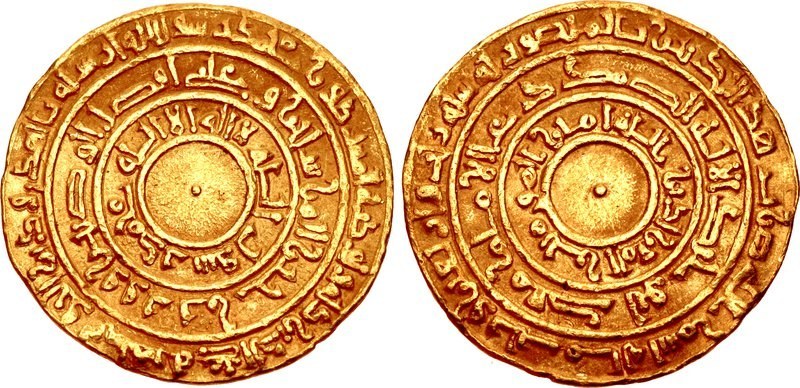
Start with the overall layout, which is the fastest way to recognize a Fatimid dinar. Both faces are entirely inscriptional and arranged as concentric rings of Arabic text encircling a short central legend, with no image, portrait, or ornament anywhere on the coin. This "bullseye" style is characteristic of Fatimid gold and distinguishes it at a glance from many other medieval Islamic dinars whose legends run in stacked horizontal lines inside a single plain circle.
Confirm the metal and format. This is a gold dinar: a small, thin, hand-struck disc generally around 20–23 mm across and close to the classical dinar weight of about 4.2 grams, with a warm, rich color consistent with high-purity gold rather than a pale or brassy alloy. Because the flan is thin and the dies were often larger than the blank, expect some legends to run off the edge or appear weakly struck; this is normal and does not by itself indicate a problem.
Read the legends to pin down the ruler and date. Attribution to al-Mu'izz li-Din Allah rests on finding his name and caliphal titles within the inscriptions, while the reverse marginal band carries the mint-and-date formula that should include the year AH 343 (954–955 CE) and the mint city. On coins of this period that mint lies in the Fatimids' North African heartland, before the move to Egypt in 969. Working through the visible portions of the name, date, and mint is far more reliable than judging by style alone.
Be alert to look-alikes. Contemporary Abbasid dinars and later Fatimid issues share the gold medium and Arabic-only design, so do not assume every concentric-legend dinar is this exact type; other Fatimid caliphs (before and after al-Mu'izz) used the same general format, and only the ruler's name and the AH 343 date confirm this issue. Later Fatimid dinars from Egyptian and Syrian mints continue the concentric style with different names and dates.
Apply careful authentication. High-value Islamic gold attracts forgeries, including cast copies and modern struck fakes, so weigh and measure the coin, examine the lettering for the crisp, confident strokes of a genuine die rather than mushy or granular cast detail, and look for casting seams, bubbles, or an incorrect weight. Suspicious color, a wrong diameter, or legends that do not read coherently are warning signs. When any doubt remains, have the coin checked against a specialist catalog of Fatimid coinage or by an experienced dealer or grading service before relying on the attribution.
Frequently asked questions
What is the quickest way to recognize a Fatimid dinar like this?
Look for the concentric circular inscriptions on both faces with no image at all. That bullseye arrangement of Arabic text is the signature of Fatimid dinar design and immediately narrows the coin down from other Islamic gold.
Where do I find the date and mint?
They appear in the marginal legend of the reverse, typically in a formula stating that the dinar was struck at a named mint in a given year. On this type the year reads AH 343, and the mint lies in the Fatimids' North African territory of the mid-tenth century.
How do I distinguish it from a dinar of another Fatimid caliph?
The design is shared across the dynasty, so you must read the legends. Only the name and titles of al-Mu'izz li-Din Allah together with the AH 343 date identify this specific issue; other caliphs used the same concentric format with their own names and dates.
How can I guard against a fake?
Check that weight and diameter match a genuine dinar, that the gold color and purity look right, and that the lettering is sharp and struck rather than soft or granular. Watch for casting seams or bubbles, and when in doubt seek expert confirmation, since valuable Islamic gold is frequently counterfeited.