
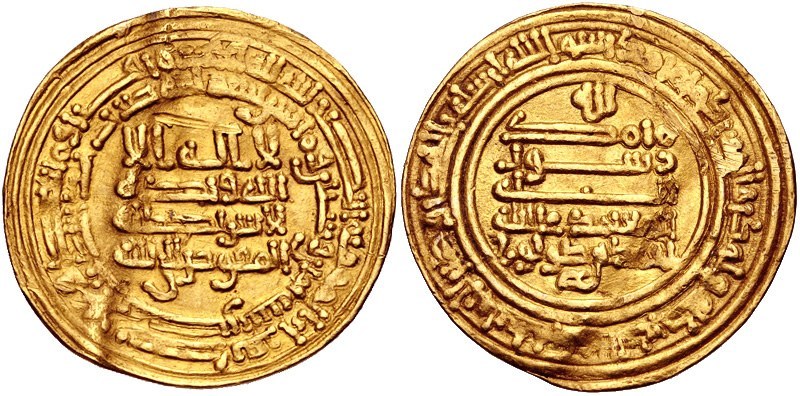
Gold Dinar of Ahmad ibn Tulun
A late-9th-century Islamic gold dinar of the Tulunid ruler Ahmad ibn Tulun, its faces filled with concentric Arabic inscriptions and dated AH 268 (881–882 CE).
- Country
- Islamic Caliphate
- Denomination
- Dinar
- Metal
- Gold
Got a coin like this?
Identify any coin from a photo, free.
Overview
The Gold Dinar of Ahmad ibn Tulun is a medieval Islamic gold coin struck under the Tulunid dynasty, the semi-independent line founded by Ahmad ibn Tulun who governed Egypt and much of Syria while nominally under the Abbasid Caliphate. The example shown here is dated AH 268, corresponding to 881–882 CE, near the end of Ahmad's rule.
Like other early Islamic dinars, the coin bears no portrait or image of any kind. Both faces are covered instead with concentric circular bands of Arabic inscription in a clean early Kufic script. The obverse carries the Muslim profession of faith and religious formulas opening with the Bismillah invocation, while the reverse records the religious and political authority together with the mint-and-date formula that fixes where and when the piece was struck.
Struck in high-purity gold to the standard dinar weight of roughly 4.25 grams, it is a small, thin, handsome coin that reflects both the wealth of Tulunid Egypt and the epigraphic, aniconic tradition of Islamic coinage established since the Umayyad reform of the late 7th century.
History & Background
Ahmad ibn Tulun (ruled 868–884 CE) was sent to Egypt as a Turkish military governor on behalf of the Abbasid Caliphate but rapidly built an autonomous power base, founding the Tulunid dynasty and extending his control over Syria. His reign brought a period of prosperity, monumental building in his new capital quarter at al-Qata'i near Fustat, and a measure of independence from Baghdad, though he continued to acknowledge Abbasid overlordship in name.
Gold dinars struck in his territory reflect this delicate balance. The inscriptions typically name the reigning Abbasid caliph and often the caliph's heir, while also signalling Tulunid authority, so the coinage sits at the junction between formal Abbasid legitimacy and de facto Tulunid rule. A dinar dated AH 268 belongs to the last years of Ahmad's life, before his death in 884 and the succession of his son Khumarawayh.
These issues continue the reformed Islamic dinar tradition begun under the Umayyad caliph Abd al-Malik around AH 77 (696–697 CE), which replaced images with purely epigraphic designs. Tulunid dinars are prized by historians as tangible evidence of one of the first effectively independent dynasties to emerge within the Abbasid world.
How to Identify
The defining feature is that the coin is entirely epigraphic: there is no ruler's portrait, animal or emblem, only Arabic text arranged in concentric circles. On the obverse, a central legend carrying the Islamic declaration of faith is ringed by an outer marginal inscription that opens with the Bismillah ("In the name of God") and continues with a Qur'anic religious formula. The reverse likewise has a central legend naming the religious and governing authority, encircled by a margin giving the mint-and-date formula.
Physically, look for a thin, round gold coin of about 4.2–4.3 grams and roughly 19–20 mm in diameter, struck on a slightly irregular hand-made flan typical of the period. The metal is a rich, warm high-fineness gold. The script is an early angular Kufic without the dots or vowel marks used in later centuries, so reading it requires familiarity with the standard dinar formulae.
To attribute the piece specifically to Ahmad ibn Tulun and to AH 268, a specialist reads the reverse margin for the mint name and date and the field legends for the names of the caliph and the Tulunid authority. Because so many Abbasid-period dinars share the same overall layout, correct attribution depends on those inscriptions rather than on the general appearance, which is common to the whole class of reformed dinars.
Value & Collectibility
Tulunid gold dinars are genuine medieval artifacts in precious metal, so they carry both bullion and collector value, and a coin securely attributed to Ahmad ibn Tulun sits at the more desirable end of the early Islamic gold series because of the dynasty's historical importance. Prices are driven by legibility of the inscriptions, the specific mint and date, striking quality, and overall preservation.
A well-centered, fully legible example with clear margins and a firm strike commands a strong premium over a weakly struck, clipped or partly off-flan coin where the mint and date cannot be read. Provenance and, for higher-value pieces, third-party authentication also affect price. As with all hand-struck medieval gold, condition and eye appeal matter as much as the ruler's name.
Because each specimen differs and the market for early Islamic gold moves with demand and gold prices, any figure should be treated as general context rather than a fixed quote. Buyers should weigh the coin against the standard dinar weight and buy from reputable specialists, since gold coins of this stature attract both fakes and modern copies.
Frequently asked questions
Who was Ahmad ibn Tulun?
He was a Turkish military commander sent to govern Egypt for the Abbasid Caliphate in 868 CE who established the largely independent Tulunid dynasty ruling Egypt and Syria. This dinar was struck in his territory and is dated AH 268 (881–882 CE), in the last years of his reign.
Why are there no pictures on the coin?
Islamic coinage after the Umayyad reform of the late 7th century abandoned images in favor of Arabic inscriptions. Both faces of this dinar carry only concentric bands of religious and administrative text, following that aniconic tradition.
What does AH 268 mean?
AH stands for Anno Hegirae, the Islamic lunar calendar counted from the Hijra in 622 CE. Year 268 AH corresponds to about 881–882 CE. The date is written out in words in the reverse marginal inscription, not in numerals.
Is it real gold?
Yes. The dinar was struck in high-purity gold to a standard weight of roughly 4.25 grams. That gold content, together with its age and historical association, gives the coin both intrinsic and collector value.
Does the coin mention the Abbasid caliph too?
Typically yes. Tulunid dinars generally name the reigning Abbasid caliph, and often his heir, alongside Tulunid authority, reflecting Ahmad ibn Tulun's status as an effectively independent ruler who still acknowledged Abbasid overlordship.
Gold Dinar of Ahmad ibn Tulun guides
In-depth guides for identifying, valuing, and collecting Gold Dinar of Ahmad ibn Tulun.
Other coins you may enjoy
Gold Dinar of Jaqmaq
1438-1453 CE
Ilkhanid Dirham
13th–14th century (Ilkhanate, c. 1256–1335 CE)
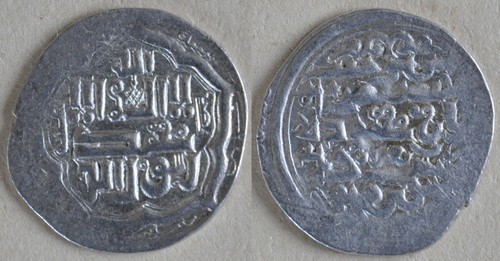
Ilkhanid Dirham of Ghazan
14th century (c. 1295-1304 CE)
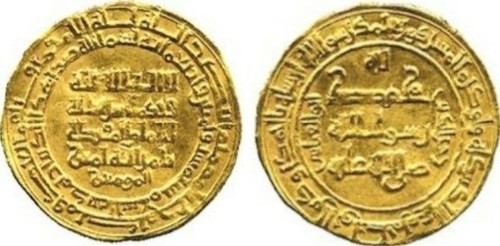
Gold Dinar of al-Muqtadi
c. 467-475 AH (1074-1082 CE)
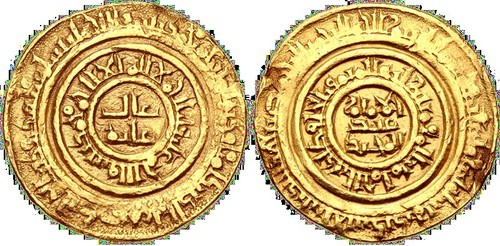
Gold Dinar of al-Hafiz li-Din Allah
AH 544 (AD 1149–1150)
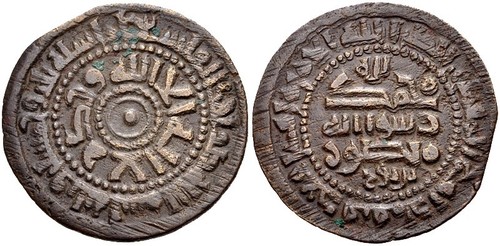
Samanid Dirham
9th–10th century CE (roughly AH 3rd–4th century)
Copper Fals of Barquq
1382–1389 CE (first reign of Barquq)
Copper Fals of as-Salih Salih
Mid-14th century CE (reign of as-Salih Salih, AH 752–755 / 1351–1354 CE)
Gold Dinar of Malik Shah I
AH 465–485 (1072–1092 CE)
Ilkhanid Dirham of Abu Said
c. 1316-1335 CE (AH 716-736)
Silver Dirham of Salm ibn Ziyad
c. 682-683 CE
Silver Dirham (LACMA M.2002.1.437)
8th century CE (roughly AH 80s–190s)