
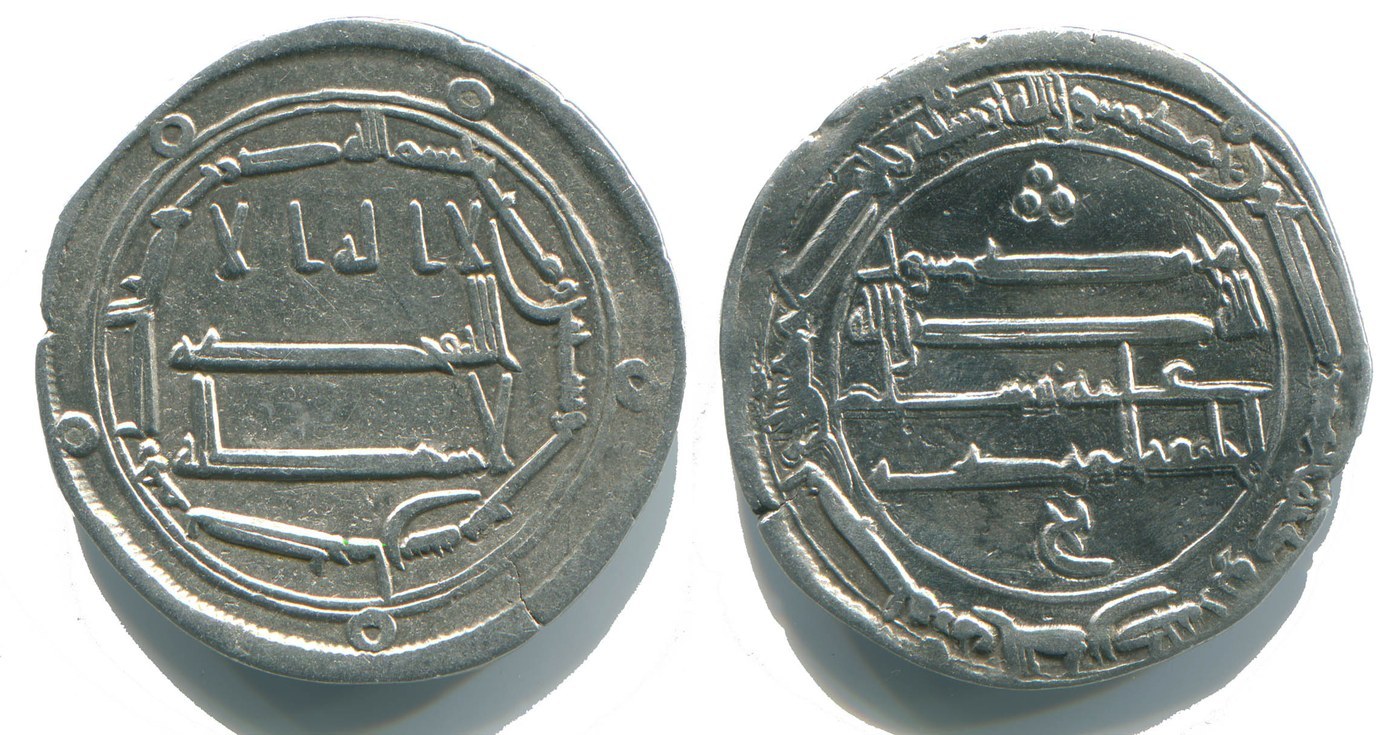
Dirham of al-Mahdi
A silver Abbasid dirham struck under Caliph al-Mahdi in AH 166 (783 CE), its faces filled with linear Kufic Arabic legends declaring the Islamic faith.
- Country
- Islamic Caliphate
- Denomination
- Dirham
- Metal
- Silver
Got a coin like this?
Identify any coin from a photo, free.
Overview
The Dirham of al-Mahdi is a thin silver coin issued by the Abbasid Caliphate during the reign of the third Abbasid caliph, al-Mahdi (r. AH 158–169 / 775–785 CE). The example photographed here is dated AH 166, corresponding to 783 CE. Like other early Islamic dirhams, it bears no portrait or figural image; both faces are given over entirely to linear Arabic inscriptions in the angular Kufic script, framed by circular borders and marginal legends.
The obverse carries the central declaration of faith and is ringed by a marginal legend giving the mint and the year of striking in the standard formula "in the name of God, this dirham was struck at [mint] in the year..." The reverse holds a further religious inscription, commonly continuing the affirmation of God's oneness and the mission of the Prophet Muhammad. On our coin the reverse also preserves the mintmark information within its marginal band.
As an epigraphic (inscription-only) silver coin of the classical caliphal type, it belongs to the vast series of Abbasid dirhams that served as the principal silver currency across the Islamic world in the eighth and ninth centuries.
History & Background
Al-Mahdi ruled the Abbasid Caliphate at the height of its early power, governing a realm that stretched from North Africa to Central Asia from his capital at Baghdad (Madinat al-Salam). His reign fell within the classical age of Islamic coinage established by the earlier Umayyad reform, in which coins were deliberately non-figural and carried Qur'anic and confessional texts rather than rulers' images.
The silver dirham was the standard silver denomination of this system, complementing the gold dinar and the copper fals. Dirhams of al-Mahdi were struck in large quantities at many provincial mints across the caliphate, and because each die-cutter recorded the mint and Hijri year in the margins, individual coins can usually be attributed to a specific city and year — here AH 166. These coins circulated far beyond the caliphate's borders and are found in great numbers in hoards across the Near East, the Caucasus, Russia and even northern Europe, reflecting the reach of Abbasid trade.
The general design continued largely unchanged across successive caliphs, so al-Mahdi's dirhams sit within a long, stylistically conservative tradition; they are distinguished chiefly by the date and by the names and formulas within the inscriptions rather than by any change in imagery.
How to Identify
Identify this coin first by what it is not: it has no portrait, animal or figure of any kind. Both faces are covered with horizontal lines of angular Kufic Arabic script within plain circular borders, a hallmark of early Islamic silver. The metal is silver, and the flan is thin, broad and slightly irregular in outline, typically around 25–26 mm across and light in weight, as is normal for hand-struck dirhams of this period.
The obverse shows a short central legend — the profession of faith affirming that there is no god but God alone — surrounded by a marginal inscription naming the mint and the Hijri year with the phrase "bismillah duriba hadha al-dirham bi-... sanat..." (in the name of God, this dirham was struck at ... in the year ...). The reverse carries a further multi-line religious legend, often continuing the affirmation of God's unity and reference to Muhammad as His messenger, and it is on this side that the mintmark formula and date can be read on our coin.
Attribution to al-Mahdi and to AH 166 depends on reading these Arabic legends, since the design itself is shared with dirhams of neighboring reigns. The combination of the Kufic script style, the thin broad silver flan, the doubled circular borders, and the marginal mint-and-date formula together identify the piece as a classical Abbasid dirham of this era.
Value & Collectibility
Abbasid dirhams of al-Mahdi are relatively common as a class, because enormous quantities were struck and many survive in hoards. Value is driven less by the caliph's name than by the specific mint, the year, the completeness and centering of the strike, the sharpness of the legends, and the coin's overall preservation. Well-struck, fully legible examples on round flans command more than weakly struck or clipped pieces with off-center or partly missing marginal legends.
Scarcer mints and rarer date-and-mint combinations are of particular interest to specialists, and because attribution rests on reading the inscriptions, a coin whose mint and date are clearly legible is worth more than an otherwise similar coin whose margins are flat. Toning, cleaning and any edge or surface damage also affect desirability.
As with all ancient and medieval coins, prices vary widely with grade, eye appeal and the state of the market, so these are general considerations rather than fixed quotes. A clear, well-centered dirham with a fully readable mint and AH date is a genuinely collectible piece; worn, corroded or fragmentary examples are more modest.
Frequently asked questions
Why are there no pictures on this coin?
Early Islamic coinage was deliberately aniconic, avoiding portraits and figural images. Instead the dies carry religious texts and the mint-and-date formula in Kufic Arabic script, a tradition established well before al-Mahdi's reign.
What does the date AH 166 mean?
AH stands for Anno Hegirae, the Islamic lunar calendar counted from the Hijra of AD 622. AH 166 corresponds to about 783 CE, placing the coin firmly within the reign of the Abbasid caliph al-Mahdi.
What is written on the coin?
The legends are Arabic religious texts — chiefly the declaration that there is no god but God alone and that Muhammad is His messenger — together with a marginal formula stating that this dirham was struck at a named mint in a given year.
Is it real silver?
Yes. The dirham was the standard silver denomination of the caliphate, struck on thin, broad silver flans. Surviving examples can show gray toning or patina but are genuinely silver, not base metal.
How can I tell which mint struck it?
The mint name appears in the marginal legend using the phrase 'duriba bi-...' (struck at ...). Reading that Arabic band identifies the city; Abbasid dirhams of this era were made at many mints across the caliphate.
Dirham of al-Mahdi guides
In-depth guides for identifying, valuing, and collecting Dirham of al-Mahdi.
Other coins you may enjoy
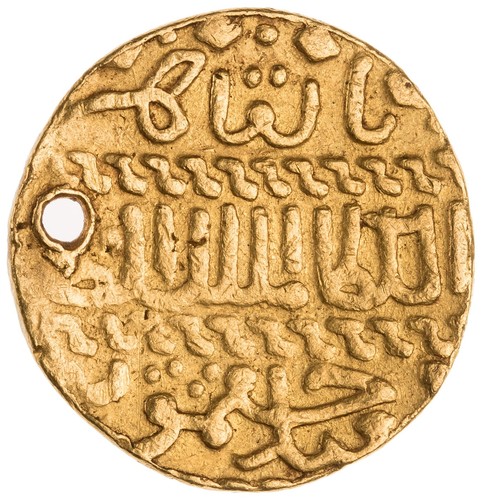
Gold Dinar of Jaqmaq
1438-1453 CE
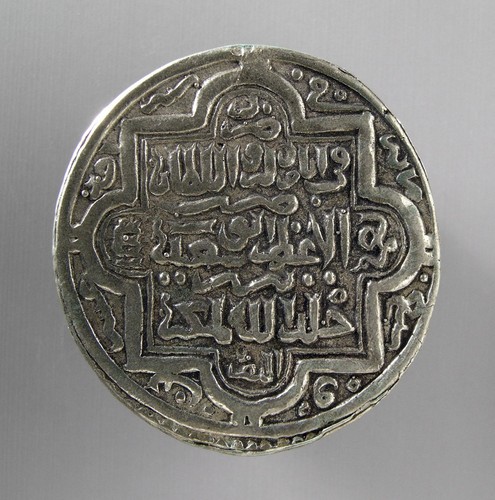
Ilkhanid Dirham
13th–14th century (Ilkhanate, c. 1256–1335 CE)
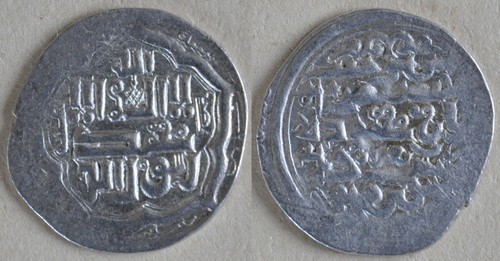
Ilkhanid Dirham of Ghazan
14th century (c. 1295-1304 CE)
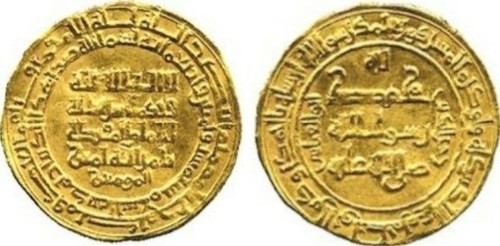
Gold Dinar of al-Muqtadi
c. 467-475 AH (1074-1082 CE)
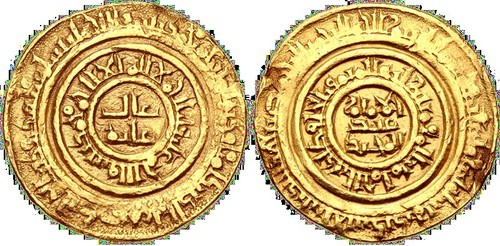
Gold Dinar of al-Hafiz li-Din Allah
AH 544 (AD 1149–1150)
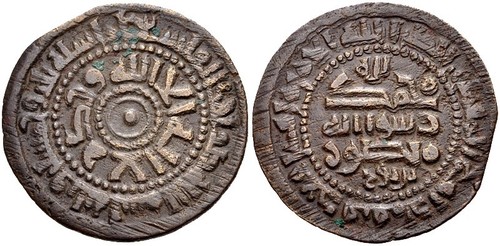
Samanid Dirham
9th–10th century CE (roughly AH 3rd–4th century)
Copper Fals of Barquq
1382–1389 CE (first reign of Barquq)
Copper Fals of as-Salih Salih
Mid-14th century CE (reign of as-Salih Salih, AH 752–755 / 1351–1354 CE)
Gold Dinar of Malik Shah I
AH 465–485 (1072–1092 CE)
Ilkhanid Dirham of Abu Said
c. 1316-1335 CE (AH 716-736)
Silver Dirham of Salm ibn Ziyad
c. 682-683 CE
Silver Dirham (LACMA M.2002.1.437)
8th century CE (roughly AH 80s–190s)