
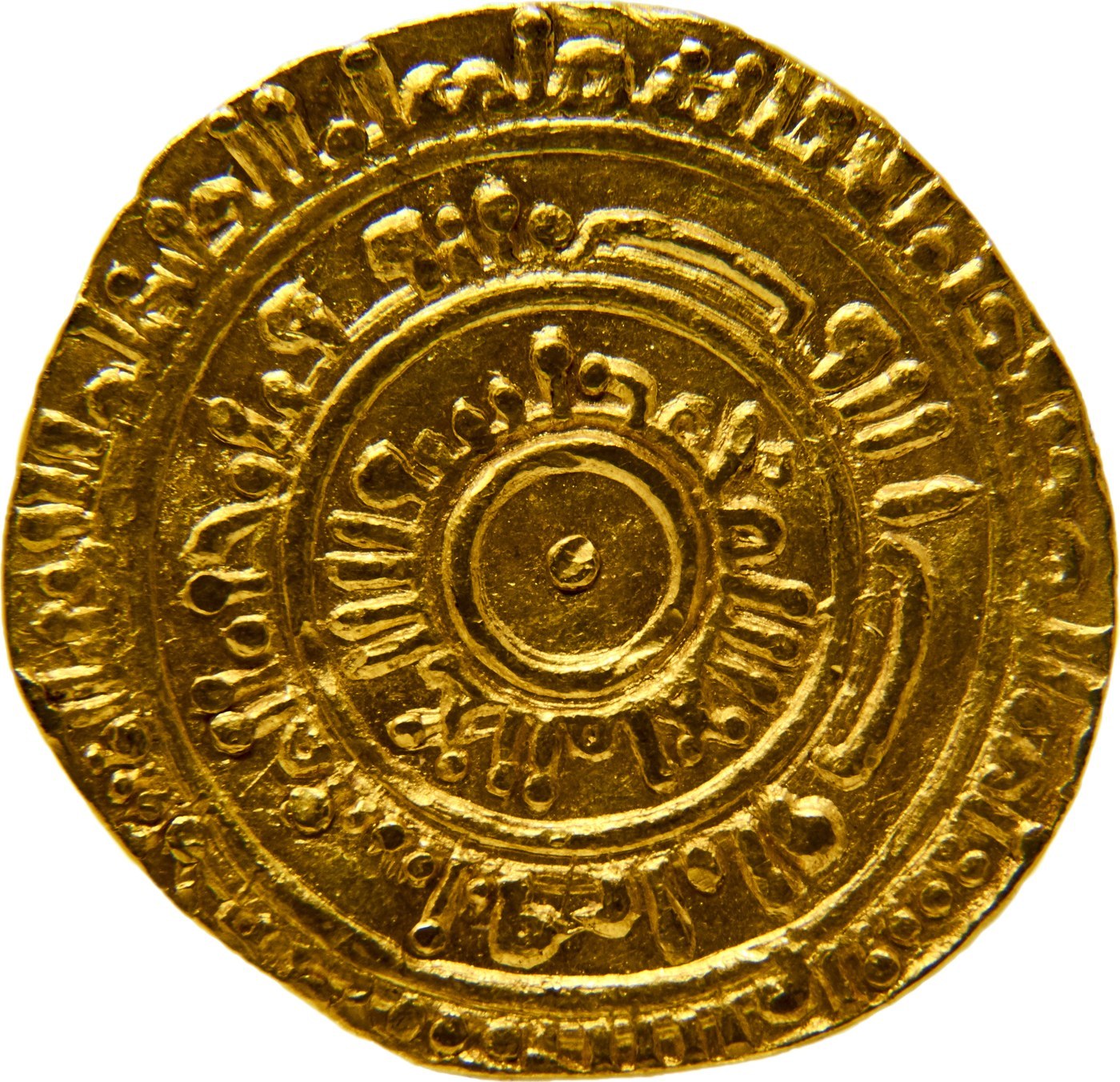
Fatimid Dinar of Imam Nizar
An 11th-century Fatimid gold dinar with concentric circular Kufic inscriptions naming the ruler and Shi'a invocations, a hallmark of Fatimid coinage.
- Country
- Islamic Caliphate
- Denomination
- Dinar
- Metal
- Gold
Got a coin like this?
Identify any coin from a photo, free.
Overview
The Fatimid Dinar of Imam Nizar is a medieval Islamic gold coin struck by the Fatimid Caliphate, the Isma'ili Shi'a dynasty that ruled from Egypt and North Africa. It belongs to the classic Fatimid dinar tradition of the 11th century CE, distinguished by its striking design of concentric circular inscriptions: rings of Arabic text arranged around a small central legend rather than the block or field inscriptions of most other Islamic coinages.
On the coin photographed, the obverse carries concentric Kufic bands bearing a ruler's name together with religious invocations, while the reverse carries further concentric bands naming the issuing authority and the date and mint. Both faces are entirely epigraphic — there are no portraits or figural images, in keeping with Islamic coinage convention — and the design is read from the center outward across the rings.
The name attached to this type references Nizar, the Fatimid figure remembered in Isma'ili tradition; Nizar was a son of the caliph-imam al-Mustansir Billah, and the Nizari branch of Isma'ilism takes its name from him. Coins of this class circulated as high-value gold money across the Fatimid realm and the wider medieval Mediterranean and Red Sea trade world.
History & Background
The Fatimid Caliphate (909–1171 CE) was founded as a rival to the Abbasid caliphs of Baghdad and, at its height under the caliph-imam al-Mustansir Billah (reigned 1036–1094 CE), controlled Egypt, much of North Africa, the Levant coast and the Hijaz. Fatimid gold dinars of this era were renowned for their high purity and were among the most trusted coins in medieval Mediterranean commerce.
Nizar ibn al-Mustansir was al-Mustansir's designated heir, but on the caliph's death in 1094 a succession dispute broke out: the court in Cairo installed his younger brother al-Musta'li, while Nizar's supporters upheld Nizar's claim. Nizar was ultimately defeated and killed, but his followers — the Nizari Isma'ilis — maintained his line of imams, a movement that became historically prominent and endures today.
Because of this history, the name Nizar is closely tied to Fatimid dynastic memory. A dinar associated with Nizar sits within the long 11th-century series of concentric-legend Fatimid gold, coinage that names the reigning imam-caliph and proclaims Isma'ili Shi'a religious formulas. The date and mint on such coins are given in the Hijri (Islamic) calendar in the outer marginal ring.
How to Identify
The single most diagnostic feature is the layout: two or three concentric circular lines of Arabic inscription on each face, arranged as rings around a short central legend. This bullseye-of-text design is a signature of Fatimid dinars and immediately separates them from Abbasid, Umayyad, Byzantine or later Islamic gold, which use horizontal field inscriptions.
The script is angular Kufic. The obverse rings carry a ruler's name together with religious invocations — typically the Shi'a affirmation of the oneness of God, the prophethood of Muhammad and the authority of Ali and the imams. The reverse rings name the issuing authority and give the mint and Hijri date in the outer margin, so the specific mint city and year can be read there by anyone able to parse the Kufic. Look for phrases built around the shahada and Fatimid formulas rather than any image.
Physically this is a hand-struck gold coin, thin and broad, generally on the order of about 20–25 mm across and roughly 4 grams in weight, though hand striking makes both size and flan shape somewhat irregular. The surfaces are deep yellow high-purity gold. Because the dies were larger than the flan, part of the outer legend is often off the edge, and the strike is frequently slightly uneven — normal traits for the series rather than signs of a problem.
Value & Collectibility
Fatimid gold dinars are collectible as both historic Islamic coinage and as high-purity medieval gold, so they carry a meaningful premium over their bullion content. Value depends heavily on the caliph named, the mint, the date, the completeness and centering of the concentric legends, and the overall state of preservation.
Common issues of well-known caliphs in average condition are relatively obtainable, while coins tied to short reigns, scarce mints, or historically charged names — anything convincingly connected to the Nizar succession — command stronger interest from specialists. Sharp, fully legible legends and a well-centered strike add substantially to desirability, since so many surviving pieces are struck off-center.
Attribution matters enormously here: a coin's worth is driven by exactly which ruler, mint and year the Kufic legends record, and by whether that reading is confirmed by an expert. Treat any figure as general context rather than a fixed quote, and be cautious with grand attributions, since the specific naming is what separates an ordinary Fatimid dinar from a rarity.
Frequently asked questions
Why is this coin covered in circles of writing instead of a picture?
Fatimid dinars are purely epigraphic — Islamic coinage generally avoids figural images — and the Fatimids arranged their text in distinctive concentric rings. The design is read from the center outward and names the ruler, religious formulas, mint and date.
Who was Nizar?
Nizar ibn al-Mustansir was a son of the Fatimid caliph-imam al-Mustansir Billah and his designated heir. After a disputed succession in 1094 CE his line became the Nizari Isma'ilis, which is why his name carries special weight in Fatimid history.
Is it real gold?
Yes. Fatimid dinars were struck in high-purity gold and were prized in medieval trade for their fineness. The deep yellow color and heft reflect genuine gold content rather than an alloy or plating.
How do I know which mint and year my coin is?
The mint city and the Hijri (Islamic-calendar) date are written in the outer marginal ring of the reverse in Kufic Arabic. Reading them — or having a specialist read them — is what pins down the exact issue.
Why is part of the writing missing at the edge?
These coins were hand-struck with dies larger than the gold flan, so the outermost legend often runs off the edge and the strike can be uneven. This is normal for the series and not a sign of damage or a fake.
Fatimid Dinar of Imam Nizar guides
In-depth guides for identifying, valuing, and collecting Fatimid Dinar of Imam Nizar.
Other coins you may enjoy
Gold Dinar of Jaqmaq
1438-1453 CE
Ilkhanid Dirham
13th–14th century (Ilkhanate, c. 1256–1335 CE)
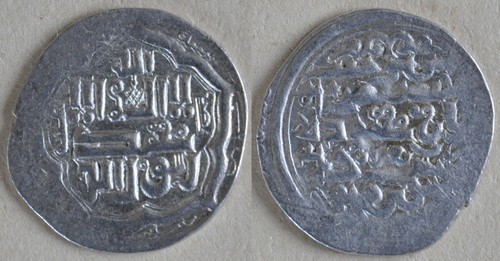
Ilkhanid Dirham of Ghazan
14th century (c. 1295-1304 CE)
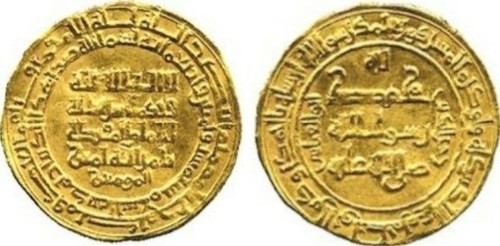
Gold Dinar of al-Muqtadi
c. 467-475 AH (1074-1082 CE)
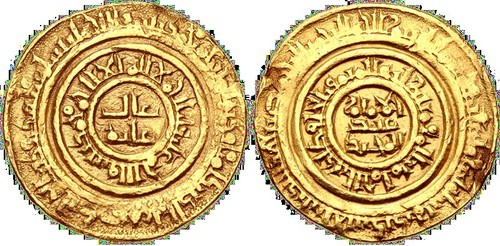
Gold Dinar of al-Hafiz li-Din Allah
AH 544 (AD 1149–1150)
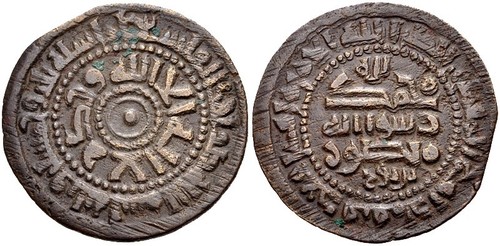
Samanid Dirham
9th–10th century CE (roughly AH 3rd–4th century)
Copper Fals of Barquq
1382–1389 CE (first reign of Barquq)
Copper Fals of as-Salih Salih
Mid-14th century CE (reign of as-Salih Salih, AH 752–755 / 1351–1354 CE)
Gold Dinar of Malik Shah I
AH 465–485 (1072–1092 CE)
Ilkhanid Dirham of Abu Said
c. 1316-1335 CE (AH 716-736)
Silver Dirham of Salm ibn Ziyad
c. 682-683 CE
Silver Dirham (LACMA M.2002.1.437)
8th century CE (roughly AH 80s–190s)