
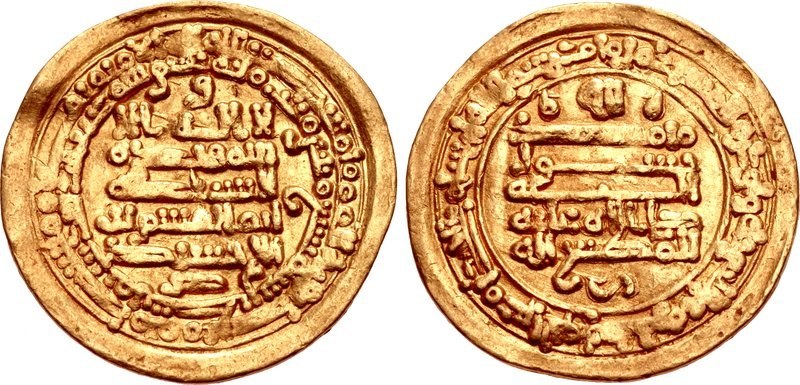
Gold Dinar of Abu'l-Qasim Unujur
An Ikhshidid gold dinar of Abu'l-Qasim Unujur, dated AH 337, with purely calligraphic Arabic legends inside ornamental borders on both faces.
- Country
- Islamic (Ikhshidid Dynasty)
- Denomination
- Dinar
- Metal
- Gold
Got a coin like this?
Identify any coin from a photo, free.
Overview
The Gold Dinar of Abu'l-Qasim Unujur is a medieval Islamic gold coin struck under the Ikhshidid dynasty, which governed Egypt and parts of Syria in the tenth century. The photographed example is dated AH 337 (948–949 CE). Both faces carry Arabic calligraphic inscriptions arranged in a central field and concentric marginal legends, framed by ornamental borders; there is no portrait or figural imagery.
Unujur ibn al-Ikhshid (also transliterated Anujur, with the honorific Abu'l-Qasim) was the son of Muhammad ibn Tughj al-Ikhshid, the founder of the dynasty. Coins in his name follow the standard Islamic aniconic template established centuries earlier: the profession of faith and Qur'anic phrasing occupy the fields, while the margins record the mint, the year of striking, and the names of the reigning Abbasid caliph and the Ikhshidid authority.
As a hand-struck gold dinar of a short-lived regional dynasty, the coin is of interest both as bullion-quality medieval gold and as a document of Egypt's semi-autonomous rule under nominal Abbasid overlordship.
History & Background
The Ikhshidid dynasty was founded by Muhammad ibn Tughj, a Turkic-descended governor who received the title al-Ikhshid and ruled Egypt as a largely independent power while still acknowledging the Abbasid caliph in Baghdad. On his death in AH 334 (946 CE) he was succeeded by his young son Unujur, whose reign is dated to roughly 946–961 CE. Real authority through much of this period lay with the powerful regent and commander Abu al-Misk Kafur, who administered the state on the young ruler's behalf.
A dinar dated AH 337 places this coin early in Unujur's nominal reign, during the years of Kafur's ascendancy. Ikhshidid coinage of this era continued the monetary conventions of the wider Islamic world: gold dinars modeled on the long-standing dinar tradition, inscribed with religious formulae and with the names of overlords in the margins. Naming the Abbasid caliph on the coinage signaled formal allegiance even as Egypt functioned autonomously.
The dynasty was comparatively brief; within a few decades Egypt fell to the Fatimids in AH 358 (969 CE). Ikhshidid dinars therefore belong to a narrow, transitional window in Egyptian history between Tulunid and Fatimid rule.
How to Identify
This dinar is fully aniconic: both the obverse and reverse consist of Arabic inscriptions only, set in a central area with one or more circular marginal legends around them, enclosed by ornamental borders. There is no ruler portrait, animal, or other figural device — a hallmark of classical Islamic gold coinage.
Attribution rests on reading the legends. The fields typically carry the Islamic profession of faith and associated religious text; the margins name the mint, give the date (here AH 337), and cite the reigning Abbasid caliph together with the Ikhshidid ruler Unujur (Abu'l-Qasim). It is the combination of these names and the date, not any pictorial element, that identifies the coin as an Ikhshidid dinar of this ruler rather than a contemporary Abbasid, Fatimid, or other issue.
Physically it is a small, hand-struck gold disc in the dinar tradition, on the order of about 4 grams and roughly 20–23 mm across, with the slight variation in weight, centering, and flan shape expected of individually struck medieval coins. The script is a mature Kufic-style Arabic.
Value & Collectibility
Ikhshidid gold dinars are genuine medieval gold coins of a short-lived dynasty, so they carry clear collector interest above their gold content. They are less abundant than mainstream Abbasid or Fatimid dinars but appear on the specialist Islamic market with some regularity, meaning prices are driven more by condition and legibility than by extreme rarity alone.
Value turns on how complete and readable the legends are, how well centered the strike is, the specific mint and date, and overall preservation, along with authenticity and provenance. A well-struck, fully legible dated example is worth more than a weakly struck or clipped piece. Because these are individually struck, no two are identical, and coins should be assessed one at a time by someone familiar with the series.
As with all early Islamic gold, imitations and modern reproductions exist, so verified authenticity and a documented chain of ownership meaningfully affect price. Precise figures vary by market and variety, so treat any single valuation as indicative rather than fixed.
Frequently asked questions
Who was Abu'l-Qasim Unujur?
Unujur ibn al-Ikhshid (Abu'l-Qasim) was an Ikhshidid ruler of Egypt and son of the dynasty's founder, Muhammad ibn Tughj al-Ikhshid. His nominal reign is dated to roughly 946–961 CE, with real power largely held by the regent Kafur.
What does AH 337 mean on this coin?
AH 337 is the year in the Islamic Hijri calendar, corresponding to about 948–949 CE. The date appears in the marginal legend and places the coin early in Unujur's reign.
Why are there no pictures on the coin?
It follows the classical Islamic aniconic template: both faces carry only Arabic religious inscriptions, mint, date, and rulers' names, with no portrait or figural imagery.
Whose names appear on an Ikhshidid dinar?
The margins typically name the reigning Abbasid caliph as overlord alongside the Ikhshidid ruler, reflecting Egypt's autonomy under formal Abbasid allegiance.
How much gold does the dinar contain?
It follows the dinar standard of roughly 4 grams of gold, though individual hand-struck coins vary somewhat around that weight.
Gold Dinar of Abu'l-Qasim Unujur guides
In-depth guides for identifying, valuing, and collecting Gold Dinar of Abu'l-Qasim Unujur.
Other coins you may enjoy
Gold Dinar of Jaqmaq
1438-1453 CE
Ilkhanid Dirham
13th–14th century (Ilkhanate, c. 1256–1335 CE)
Ilkhanid Dirham of Ghazan
14th century (c. 1295-1304 CE)
Gold Dinar of al-Muqtadi
c. 467-475 AH (1074-1082 CE)
Gold Dinar of al-Hafiz li-Din Allah
AH 544 (AD 1149–1150)
Samanid Dirham
9th–10th century CE (roughly AH 3rd–4th century)
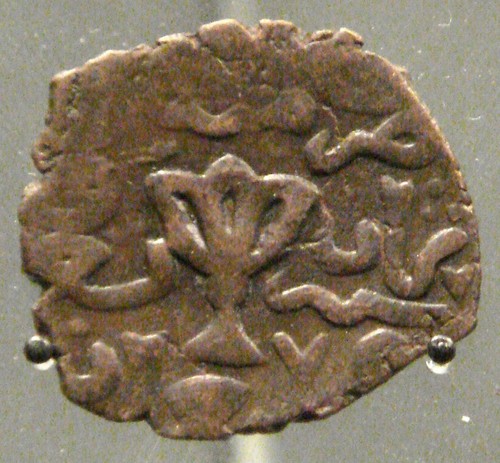
Copper Fals of Barquq
1382–1389 CE (first reign of Barquq)
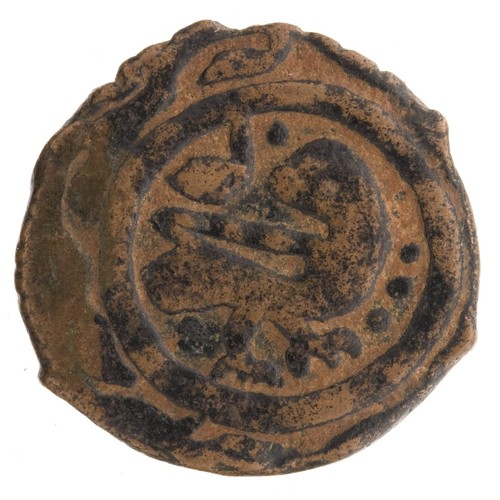
Copper Fals of as-Salih Salih
Mid-14th century CE (reign of as-Salih Salih, AH 752–755 / 1351–1354 CE)
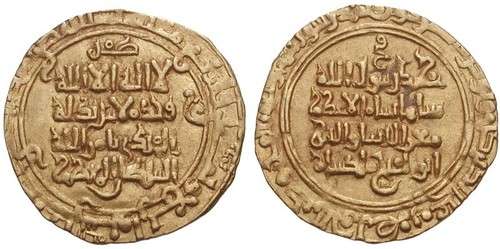
Gold Dinar of Malik Shah I
AH 465–485 (1072–1092 CE)
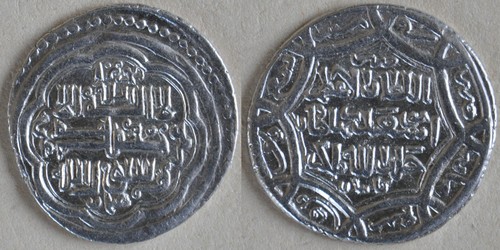
Ilkhanid Dirham of Abu Said
c. 1316-1335 CE (AH 716-736)
Silver Dirham of Salm ibn Ziyad
c. 682-683 CE
Silver Dirham (LACMA M.2002.1.437)
8th century CE (roughly AH 80s–190s)