
How to Identify the Gold Dinar of Abu'l-Qasim Unujur
A collector's guide to the Ikhshidid gold dinar of Unujur: reading the calligraphic legends, mint and date, weight checks, and authentication.
Read the full Gold Dinar of Abu'l-Qasim Unujur encyclopedia entry →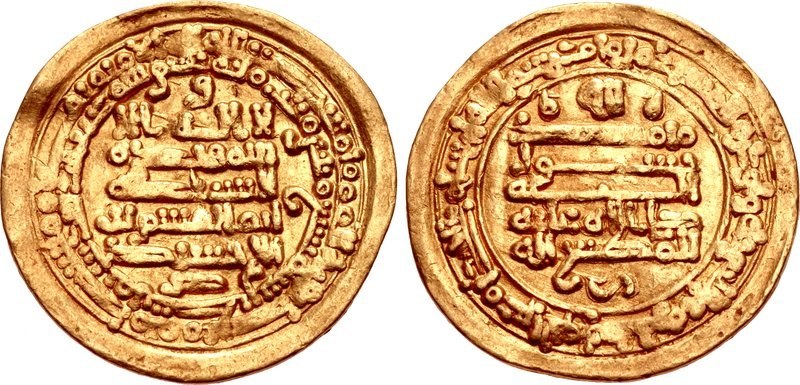
Begin by confirming that the coin is fully calligraphic. A genuine dinar of this type shows Arabic inscriptions on both faces — a central legend surrounded by one or more circular marginal legends inside an ornamental border — with no portrait, animal, or figure anywhere. If you see figural imagery, it is not this aniconic Islamic dinar.
The attribution lives in the text, so the key step is reading the legends. The margins carry the mint name, the Hijri date, and the names of the overlord Abbasid caliph and the Ikhshidid ruler. Look specifically for the name Unujur (also rendered Anujur) with the honorific Abu'l-Qasim, and for a date such as AH 337. Ikhshidid dinars were commonly struck at Misr (Fustat) and at Filastin (al-Ramla), so the mint word in the margin helps confirm both dynasty and issue. Because the legends are the diagnostic, weakly struck or off-center coins where the margins are lost are much harder to attribute with confidence.
Check the physical characteristics. This is a small, hand-struck gold coin in the dinar tradition, on the order of about 4 grams and roughly 20–23 mm in diameter, on a slightly irregular flan. Gold does not rust or tarnish, so heavy corrosion, a pale base-metal tone, or any magnetic response argues against an authentic gold dinar. Weight well under the dinar standard can indicate clipping or a non-gold copy.
Separate it from look-alikes. Contemporary Abbasid, Fatimid, and other Islamic dinars share the same aniconic, calligraphic look, so the difference is entirely in the names and mint/date in the legends — do not attribute by appearance alone. Silver dirhams of the same period look similar in style but are a different metal and denomination. When the legends are illegible, the coin can usually only be classed generically as an Islamic gold dinar rather than assigned to this ruler.
Apply normal caution for early Islamic gold. Struck genuine coins show crisp Kufic lettering and correct weight and diameter; cast copies show soft detail, seams, or surface bubbles. Given that the identification depends on technical legend reading and the metal is gold, have any candidate reviewed by a specialist in Islamic coinage and favor examples with documented provenance.
Frequently asked questions
What is the single most important diagnostic?
The legends. Both faces are pure Arabic calligraphy, and identification depends on reading the ruler's name (Unujur / Abu'l-Qasim), the mint, and the Hijri date in the margins — not on any picture, which the coin does not have.
How do I tell it from a Fatimid or Abbasid dinar?
They look very similar because all are aniconic and calligraphic. The distinction is in the names cited in the legends and the mint and date; only the marginal text confirms an Ikhshidid dinar of Unujur.
What weight and size should it be?
Roughly 4 grams of gold and about 20–23 mm across, on a hand-struck flan. Significant underweight, corrosion, a pale base-metal look, or any magnetism is a warning sign.
How do I avoid a fake?
Look for sharply struck (not cast) Kufic lettering, correct weight and diameter, and no casting seams or bubbles. Because attribution is technical and the coin is gold, seek a specialist opinion and prefer pieces with clear provenance.