
How to Identify the Gold Dinar of Ahmad ibn Tulun
A collector's guide to attributing a Tulunid gold dinar: reading the concentric Kufic legends, the mint-and-date margin, weight, and telltale look-alikes.
Read the full Gold Dinar of Ahmad ibn Tulun encyclopedia entry →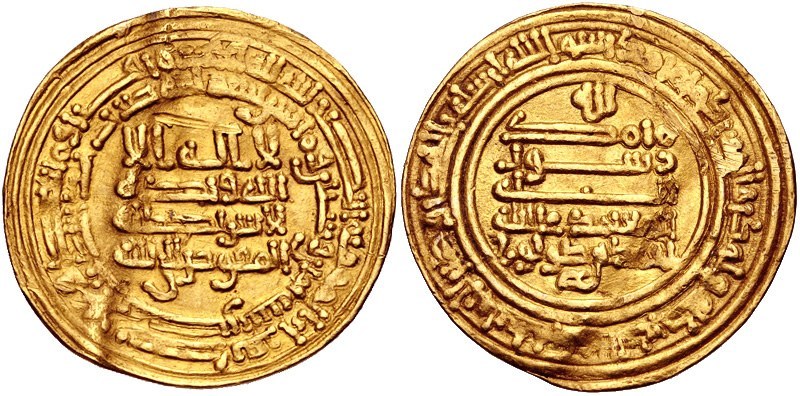
Start by confirming the coin belongs to the reformed Islamic dinar family. It should be a thin round gold piece with no images at all, both faces filled by concentric circular bands of angular Kufic Arabic. If you see a portrait, an animal, or any pictorial device, it is not a coin of this type. The layout — a central legend inside one or more ring-shaped marginal legends on each side — is the first checkpoint.
Read the two faces by function. The obverse center carries the Islamic profession of faith, and its outer margin opens with the Bismillah ("In the name of God, this dinar was struck…") followed by a Qur'anic formula. The reverse center names the religious and governing authority, and its margin gives the all-important mint-and-date statement. To pin the coin to Ahmad ibn Tulun and to AH 268, you must read that reverse margin for the mint city and the year written out in words, and check the field legends for the caliph's and the Tulunid names; the general design alone is shared across many Abbasid-era dinars and cannot by itself identify the ruler.
Check the physical standard. A genuine dinar of this period weighs close to 4.25 grams, measures about 19–20 mm across, and is made of warm, high-fineness gold on a slightly irregular hand-struck flan. Weigh and measure the coin: a piece well under standard weight may be clipped or a lightweight forgery, and one well over may be a cast copy or a coin of a different denomination. The gold should be soft and rich in tone, not brassy.
Watch for look-alikes and misattributions. Contemporary Abbasid dinars from Baghdad and other mints, and later dinars of Ahmad's son Khumarawayh and successors, use the same script and format, so an unread or worn margin is easy to mis-catalog. Only the correct mint and the date AH 268, together with the appropriate names in the field, secure this specific attribution. Dealers sometimes describe any anonymous early Islamic gold as "Tulunid"; insist on seeing the legends confirmed.
Finally, apply authentication cautions. Because early Islamic gold is valuable, it attracts modern forgeries, cast copies and pressed replicas. Genuine coins are struck, showing crisp lettering with slightly raised, sharp strokes and occasional flat or off-flan areas from hand striking; be suspicious of soft, rounded detail, casting seams or bubbles, an incorrect weight, or lettering that does not match published dinar formulae. For a piece of this value, verification against a standard reference for Tulunid and Abbasid coinage, and third-party authentication, are well worth the effort.
Frequently asked questions
How do I read the date if there are no numerals?
The date is spelled out in Arabic words within the reverse marginal legend, in the standard "struck in the year…" formula. You match that phrase against known dinar legends to confirm it reads AH 268 (881–882 CE); it is not written as digits.
How can I tell a Tulunid dinar from an ordinary Abbasid one?
They look nearly identical in layout and script, so you must read the inscriptions. The field legends and the mint named in the reverse margin distinguish a coin struck under Ahmad ibn Tulun from a mainstream Abbasid caliphal issue. Never rely on appearance alone.
What weight and size should a genuine example be?
Aim for roughly 4.2–4.3 grams and about 19–20 mm in diameter, in high-purity gold. Significant deviation from the standard dinar weight is a warning sign of clipping, a forgery, or a different denomination.
How do I spot a fake?
Genuine dinars are hand-struck with sharp, slightly raised Kufic lettering and sometimes off-center or flat areas. Cast copies show mushy detail, seams or air bubbles and often the wrong weight. Given the value, confirm the legends against a reliable reference and consider professional authentication.