
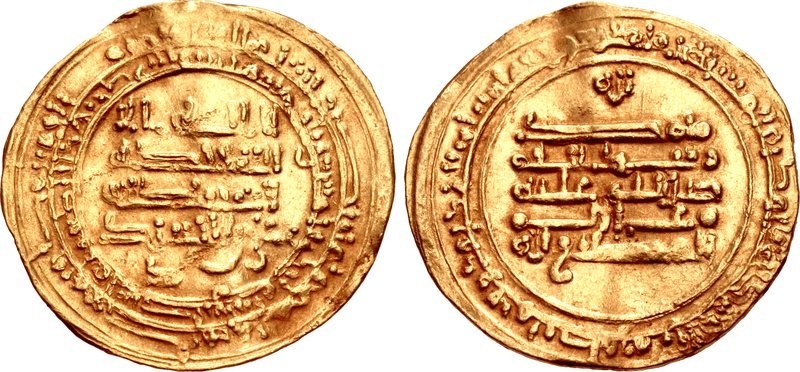
Gold Dinar of Abu'l-Hasan Ali
A high-purity Islamic gold dinar dated AH 351 (961-962 CE) in the name of the Ikhshidid ruler Abu'l-Hasan Ali, struck in fully calligraphic Kufic script.
- Country
- Islamic (Ikhshidid/Fatimid)
- Denomination
- Dinar
- Metal
- Gold
Got a coin like this?
Identify any coin from a photo, free.
Overview
The Gold Dinar of Abu'l-Hasan Ali is a medieval Islamic gold coin dated AH 351, corresponding to 961-962 CE, issued in the name of the Ikhshidid ruler Abu'l-Hasan Ali. Both faces shown in our photographs are entirely epigraphic: a central Arabic inscription in angular Kufic script framed by one or more concentric circular legends, with small decorative devices such as pellets or annulets punctuating the fields. There is no portrait or figural image, in keeping with the aniconic tradition of early Islamic coinage.
Like the classic Abbasid-style dinar it descends from, the coin carries religious declarations (the profession of faith and Quranic phrases) together with the names of the reigning authorities and the mint-and-date formula. The result is a densely lettered design that must be read rather than simply looked at, which is why attribution rests on translating the inscriptions.
The piece is a full gold dinar, the standard high-value gold denomination of the medieval Islamic world. Ikhshidid dinars of this period are noted for their fine gold and neat calligraphy, and this AH 351 issue is a representative example of the dynasty's coinage struck in Egypt and the Levant.
History & Background
The Ikhshidids were a dynasty of governors who ruled Egypt and much of Syria from 935 CE, nominally on behalf of the Abbasid caliphs in Baghdad. Abu'l-Hasan Ali, the ruler named on this dinar, was a son of Muhammad ibn Tughj al-Ikhshid, the dynasty's founder. During Ali's tenure real power was largely exercised by the influential regent Kafur, and Ikhshidid coinage of these years continued to acknowledge the distant Abbasid caliph even as local rulers were named.
The date AH 351 (961-962 CE) places the coin in the final decade of Ikhshidid rule, shortly before the Fatimid conquest of Egypt in 969 CE brought the dynasty to an end. Gold dinars of this type were the backbone of a wealthy Mediterranean economy, used in long-distance trade, taxation and the payment of troops across Egypt and the Levant.
Because the Ikhshidids sat between the Abbasid and the rising Fatimid spheres, their dinars are of interest to historians as evidence of political allegiance: whose names appear, and in what order, reflects the layered authority of caliph and local ruler in a contested region on the eve of the Fatimid takeover.
How to Identify
Identification is a matter of reading the Arabic, since both faces are inscription-only. Expect a central legend of several lines within a circle, surrounded by one or two marginal legends running around the rim; the fields carry small ornamental dots or rings. One face typically bears the first part of the profession of faith and a Quranic marginal legend, while the other adds the continuation naming Muhammad as the messenger of God together with the names of the ruling authorities.
The key attributing elements are the name of the ruler, Abu'l-Hasan Ali, and the mint-and-date formula in the margin, which on this coin gives the year AH 351. The mint city is written out as a word (for Ikhshidid issues commonly Misr in Egypt, or Filastin or Dimashq in Syria) rather than shown as a symbol, so there is no pictorial mint mark to look for.
Physically this is a hand-struck gold dinar: a thin, warm-yellow disc generally around 20-23 mm across and close to the classical dinar standard of roughly 4.2-4.25 grams, though hand striking makes each piece slightly irregular in flan shape and centering. The high, soft luster of nearly pure medieval gold, combined with the crisp Kufic lettering, distinguishes a genuine dinar from base-metal imitations.
Value & Collectibility
Medieval Islamic gold dinars carry value on two levels: their intrinsic gold content and their numismatic interest. As a near-pure gold dinar, this coin always retains a bullion floor tied to its weight, but well-preserved, fully legible examples with clear ruler and mint-and-date legends command more than melt because collectors prize attribution and eye appeal.
For Ikhshidid dinars, value is driven by the sharpness of the strike, how much of the marginal legend is on the flan, the specific mint, and overall preservation. Coins that are well centered with complete inscriptions and bright surfaces are more desirable than weakly struck or clipped pieces where parts of the legend are lost off the edge.
Because each hand-struck dinar is individual and the market for medieval Islamic gold moves with both collector demand and the gold price, figures should be treated as general context rather than fixed quotes. A sound, clearly attributed AH 351 dinar of Abu'l-Hasan Ali is a genuinely collectible historical piece, while damaged, pierced or heavily clipped examples trade closer to their gold value.
Frequently asked questions
Who was Abu'l-Hasan Ali?
He was an Ikhshidid ruler of Egypt and Syria and a son of the dynasty's founder, Muhammad ibn Tughj al-Ikhshid. This dinar was struck in his name in AH 351 (961-962 CE), in the final decade of Ikhshidid rule before the Fatimid conquest.
Why are there no pictures on the coin?
Early Islamic gold coinage is aniconic, meaning it avoids figures and portraits. Instead the design is entirely calligraphic, filling both faces with Arabic inscriptions in Kufic script and small decorative devices.
What does the AH 351 date mean?
AH stands for Anno Hegirae, the Islamic lunar calendar counted from the Hijra in 622 CE. AH 351 converts to about 961-962 CE. The year is written out in words within the coin's marginal legend.
Is the coin really gold?
Yes. A dinar is the standard gold denomination of the medieval Islamic world, and Ikhshidid dinars are known for high-purity gold, giving them a warm, rich yellow color and a soft luster.
How large and heavy is it?
It is a thin hand-struck disc, generally around 20-23 mm in diameter and close to the classical dinar standard of about 4.2-4.25 grams, with slight variation from piece to piece because each was struck individually.
Gold Dinar of Abu'l-Hasan Ali guides
In-depth guides for identifying, valuing, and collecting Gold Dinar of Abu'l-Hasan Ali.
Other coins you may enjoy
Gold Dinar of Jaqmaq
1438-1453 CE
Ilkhanid Dirham
13th–14th century (Ilkhanate, c. 1256–1335 CE)
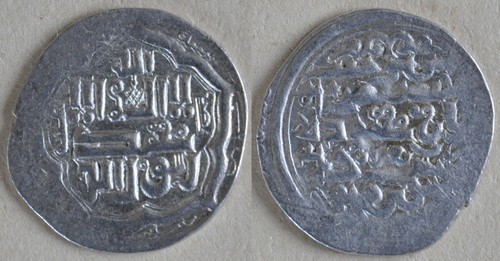
Ilkhanid Dirham of Ghazan
14th century (c. 1295-1304 CE)
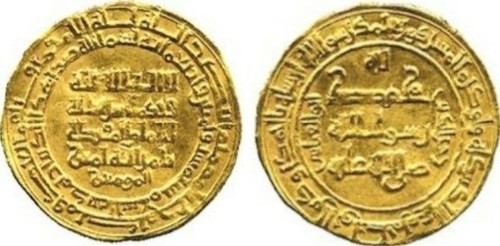
Gold Dinar of al-Muqtadi
c. 467-475 AH (1074-1082 CE)
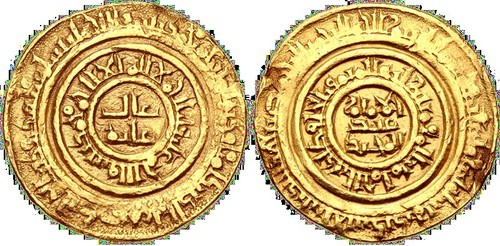
Gold Dinar of al-Hafiz li-Din Allah
AH 544 (AD 1149–1150)
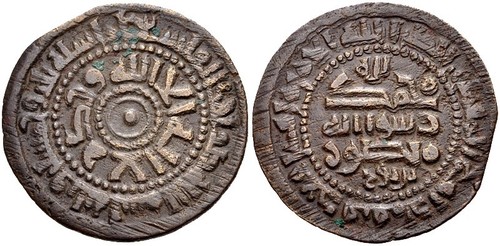
Samanid Dirham
9th–10th century CE (roughly AH 3rd–4th century)
Copper Fals of Barquq
1382–1389 CE (first reign of Barquq)
Copper Fals of as-Salih Salih
Mid-14th century CE (reign of as-Salih Salih, AH 752–755 / 1351–1354 CE)
Gold Dinar of Malik Shah I
AH 465–485 (1072–1092 CE)
Ilkhanid Dirham of Abu Said
c. 1316-1335 CE (AH 716-736)
Silver Dirham of Salm ibn Ziyad
c. 682-683 CE
Silver Dirham (LACMA M.2002.1.437)
8th century CE (roughly AH 80s–190s)