
How to Identify the Gold Dinar of Abu'l-Hasan Ali
A collector's guide to attributing an AH 351 Ikhshidid gold dinar: reading the Kufic legends, ruler and mint-date formula, weight, and spotting fakes.
Read the full Gold Dinar of Abu'l-Hasan Ali encyclopedia entry →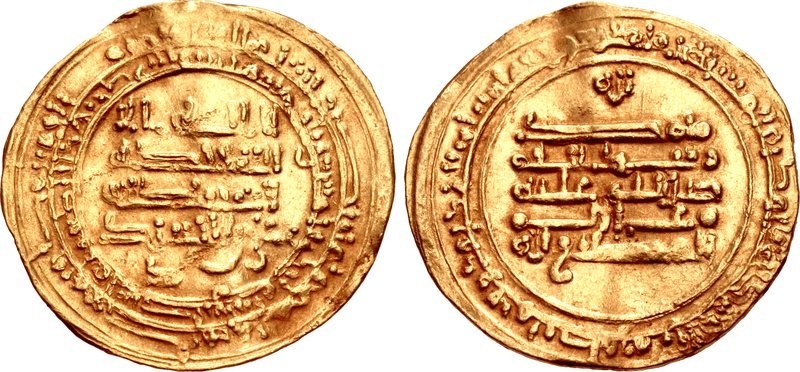
Start by accepting that this coin is read, not just viewed. Both faces are covered in Arabic Kufic script arranged as a multi-line central legend inside a circle, surrounded by one or two circular marginal legends, with small pellets or rings decorating the fields. There is no image, no portrait and no pictorial mint symbol, so every diagnostic detail is in the lettering. Orient the coin so the central inscription reads horizontally before trying to work through the margins.
Focus on three pieces of text. First, the central declarations of faith identify it as a standard Islamic dinar of the classical type. Second, the ruler's name, Abu'l-Hasan Ali, together with the acknowledgement of the Abbasid caliph, ties it to the Ikhshidid dynasty. Third, and most important for pinning down this exact coin, the mint-and-date formula in the margin spells out the mint city as a word and the year as AH 351. Confirming the year 351 and the ruler's name is what separates this issue from other Ikhshidid dinars.
Check the physical characteristics. A genuine dinar is high-purity gold with a warm, slightly deep yellow tone and a soft, greasy luster quite unlike brassy modern alloys. Expect a thin, somewhat irregular hand-struck flan roughly 20-23 mm across and close to about 4.2-4.25 grams; a piece that is markedly light, pale, reddish or magnetic is a warning sign. Weak or off-center striking often pushes part of the marginal legend off the edge, which is normal for the type but affects how completely you can read the mint and date.
Be aware of look-alikes and pitfalls. Abbasid, Fatimid and other Ikhshidid dinars share the same overall epigraphic layout, so a quick glance is not enough; you must read the ruler and date to avoid confusing this with a neighboring issue. Contemporary and modern imitations exist, including cast copies and gilt base-metal forgeries. Cast fakes betray themselves through soft, mushy lettering, seams along the edge, tiny surface bubbles, and a wrong weight or a dull, uniform color, whereas a true dinar shows crisp, hand-cut Kufic letters and the natural unevenness of hand striking.
When in doubt, weigh and measure the coin, examine the lettering under magnification, and compare the legends against a reliable reference or specialist catalog of Ikhshidid coinage. Because these are precious-metal antiquities, a high-value example is worth authenticating by a dealer or grading service experienced in medieval Islamic gold before purchase or sale.
Frequently asked questions
How do I tell this from an Abbasid or Fatimid dinar?
They share the same all-inscription layout, so read the text. This coin names the Ikhshidid ruler Abu'l-Hasan Ali and is dated AH 351; the specific ruler's name and the mint-and-date formula in the margin are what distinguish it from Abbasid or Fatimid issues.
There is no picture of a mint mark. Where is the mint shown?
On these dinars the mint is written out as a word inside the circular marginal legend, not shown as a symbol. Look in the margin for the mint city (Ikhshidid issues commonly name Misr, Filastin or Dimashq) alongside the year.
What weight and size should a genuine example be?
Expect a thin hand-struck gold disc about 20-23 mm across and close to the classical dinar standard of roughly 4.2-4.25 grams. Significant deviation, a pale or reddish color, or any magnetism suggests a plated or cast fake.
How can I spot a counterfeit dinar?
Genuine coins show crisp hand-cut Kufic lettering, high-purity gold color and slightly irregular striking. Be wary of soft or blurry letters, edge seams, surface bubbles, incorrect weight, or a dull uniform tone, and have valuable pieces authenticated by a specialist in medieval Islamic gold.