
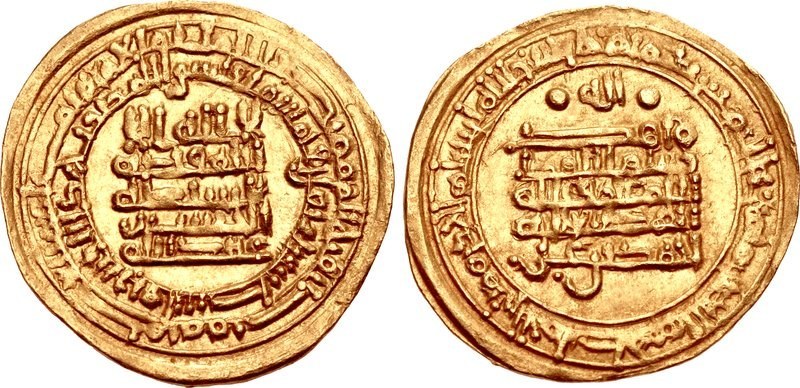
Gold Dinar of Abu'l-Fawaris Ahmad (Buyid)
A hand-struck gold dinar of the Iranian Buyid dynasty, naming the emir Abu'l-Fawaris Ahmad and dated AH 358, covered entirely in Kufic Arabic with no imagery.
- Country
- Islamic (Buyid Dynasty)
- Denomination
- Dinar
- Metal
- Gold
Got a coin like this?
Identify any coin from a photo, free.
Overview
This is a hand-struck gold dinar of the Buyid (Buwayhid) dynasty, a Shia Iranian family that dominated Iraq and much of Iran during the tenth and eleventh centuries. The coin is dated AH 358 (968-969 CE) and carries the name of the Buyid emir Abu'l-Fawaris Ahmad within its Arabic legends.
Both faces are filled entirely with calligraphic Kufic Arabic set inside circular borders, with no portrait, animal, or figural design of any kind. In keeping with Islamic coinage of the period, the inscriptions record religious declarations, the name of the ruling authority, and the mint-and-date formula rather than any pictorial device.
The example shown matches this pattern closely: an obverse of central inscription framed by a decorative border, and a reverse of further calligraphy arranged within an ornamental design. Its identity rests on reading those legends, above all the emir's name and the AH 358 date.
History & Background
The Buyid dynasty rose in the 930s when three brothers of Daylamite (northern Iranian) origin carved out territories across Iran and Iraq. In 945 CE they entered Baghdad and took control of the Abbasid caliphate, ruling as powerful emirs while the Abbasid caliph remained the nominal spiritual head of the Sunni Muslim world. This arrangement, a Shia military dynasty governing in the name of a Sunni caliph, defines the political backdrop of their coinage.
Buyid gold dinars typically name the reigning Abbasid caliph alongside the Buyid emir who actually held power in the region of striking. A coin dated AH 358 falls within the caliphate of al-Muti' li'llah (reigned 946-974 CE) and within the era when the second generation of Buyid emirs was consolidating the dynasty's hold over Iraq and Fars.
The coin's honorand, given by the kunya Abu'l-Fawaris and the name Ahmad, was one of these Buyid emirs. Buyid rulers are usually remembered by grand honorific titles (laqabs) granted by the caliph, but their coins commonly also cite the personal name and kunya, which is how this piece identifies its authority.
How to Identify
A Buyid gold dinar of this type is a thin, broad gold disc, generally in the range of about 22-26 mm across and roughly 3-5 grams, though hand-striking makes each flan slightly irregular in shape and weight. The metal is high-purity gold and shows the warm, soft yellow tone typical of medieval Islamic dinars.
The design is wholly aniconic: there is no image, only Arabic script. The central area of each face carries several lines of Kufic legend, and a circular marginal inscription runs around the rim inside a beaded or linear border. One side generally gives the Islamic declaration of faith together with the mint-and-date formula, while the other names the caliph and the Buyid emir. Reading Abu'l-Fawaris Ahmad in the ruler's legend, and the words giving the year AH 358, is the surest way to confirm the attribution.
Because the dies were engraved by hand and the strike was manual, expect uneven relief, some flatness where the legend runs off the flan, and letters that vary from coin to coin. The absence of any figural image, the Kufic (rather than later cursive) script, and the AH 358 date together separate this issue from later Islamic gold and from other dynasties.
Value & Collectibility
Buyid gold dinars are collected as historical medieval Islamic gold and trade well above their bullion content when the ruler, mint, and date can be read clearly. Value is driven far more by the specific emir named, the mint city, the completeness and legibility of the Kufic legends, and overall condition than by the gold weight alone.
Within the series, coins from scarce mints, well-centered strikes showing the full inscription, and pieces tied to notable emirs command stronger interest, while worn or weakly struck examples with partial legends sell for less. Because these are hand-struck coins nearly a thousand years old, precise pricing depends heavily on grade, eye appeal, and specialist demand.
Figures here are general context rather than fixed values. For a coin like this, an accurate reading of the emir's name, the mint, and the AH date is the single biggest factor in placing it within the market, so a confident attribution is worth far more than a rough guess at gold value.
Frequently asked questions
Who were the Buyids?
The Buyids (Buwayhids) were a Shia Iranian dynasty of Daylamite origin who controlled Iraq and much of Iran from the 930s into the eleventh century. From 945 CE they ruled Baghdad as emirs in the name of the Abbasid caliph.
What does the date AH 358 mean?
AH refers to the Islamic Hijri calendar. AH 358 corresponds to roughly 968-969 CE, placing this dinar in the mid-tenth century, during the caliphate of al-Muti' li'llah.
Why is there no picture on the coin?
Islamic coinage of this era was aniconic, meaning it avoided portraits and figures. Instead the dinar is covered entirely in Kufic Arabic calligraphy giving religious phrases, the ruling authorities' names, and the mint and date.
Is the coin real gold?
Yes. The dinar was the standard high-purity gold coin of the medieval Islamic world, and Buyid dinars follow that standard. This piece is essentially gold rather than a base-metal alloy.
Who is Abu'l-Fawaris Ahmad?
That is the name and kunya of the Buyid emir whose authority the coin cites. Buyid dinars typically name the Abbasid caliph together with the local Buyid emir, and here the emir is identified as Abu'l-Fawaris Ahmad.
Gold Dinar of Abu'l-Fawaris Ahmad (Buyid) guides
In-depth guides for identifying, valuing, and collecting Gold Dinar of Abu'l-Fawaris Ahmad (Buyid).
Other coins you may enjoy
Gold Dinar of Jaqmaq
1438-1453 CE
Ilkhanid Dirham
13th–14th century (Ilkhanate, c. 1256–1335 CE)
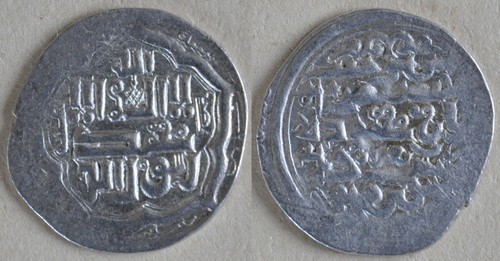
Ilkhanid Dirham of Ghazan
14th century (c. 1295-1304 CE)
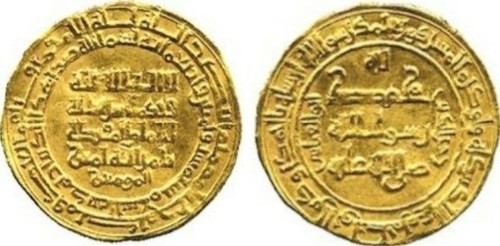
Gold Dinar of al-Muqtadi
c. 467-475 AH (1074-1082 CE)
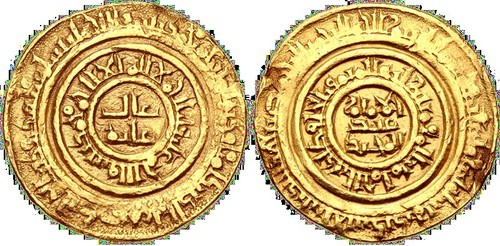
Gold Dinar of al-Hafiz li-Din Allah
AH 544 (AD 1149–1150)
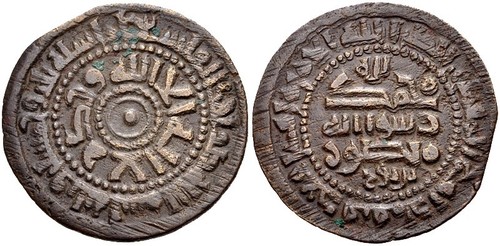
Samanid Dirham
9th–10th century CE (roughly AH 3rd–4th century)
Copper Fals of Barquq
1382–1389 CE (first reign of Barquq)
Copper Fals of as-Salih Salih
Mid-14th century CE (reign of as-Salih Salih, AH 752–755 / 1351–1354 CE)
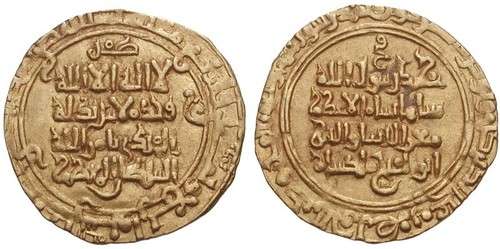
Gold Dinar of Malik Shah I
AH 465–485 (1072–1092 CE)
Ilkhanid Dirham of Abu Said
c. 1316-1335 CE (AH 716-736)
Silver Dirham of Salm ibn Ziyad
c. 682-683 CE
Silver Dirham (LACMA M.2002.1.437)
8th century CE (roughly AH 80s–190s)