
How to Identify the Gold Dinar of Abu'l-Fawaris Ahmad (Buyid)
A collector's guide to attributing a Buyid gold dinar: reading the Kufic legends, the emir's name and AH 358 date, checking size and metal, and spotting fakes.
Read the full Gold Dinar of Abu'l-Fawaris Ahmad (Buyid) encyclopedia entry →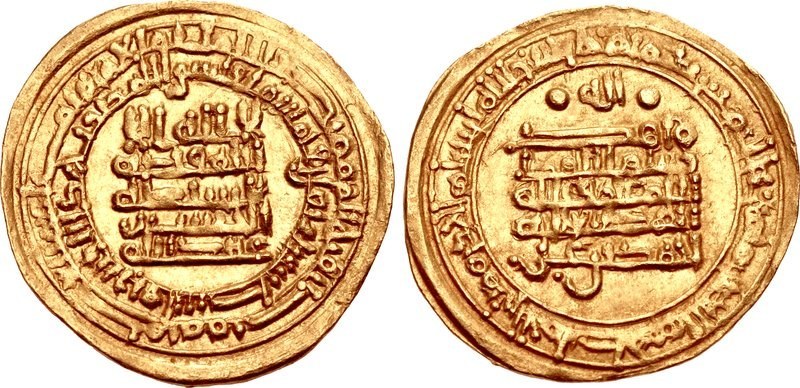
Begin with the flan itself. A Buyid gold dinar should be a thin, broad disc of warm yellow gold, generally about 22-26 mm across and roughly 3-5 grams, with a slightly irregular outline from hand-striking. Gold does not rust or turn magnetic, so a coin that is magnetic, discolored with corrosion, or noticeably too heavy or too light for its size is a warning sign rather than a genuine medieval dinar.
Confirm that the design is entirely calligraphic. Both faces should show lines of Kufic (angular, early) Arabic script in the center, surrounded by a circular marginal legend inside a beaded or linear border, with no portrait, animal, or emblem anywhere. This all-text, aniconic layout is characteristic of tenth-century Islamic gold and helps separate it from later cursive-script issues and from non-Islamic coinages.
Attribution depends on reading the legends. One side typically carries the Islamic declaration of faith along with the mint-and-date formula, while the other names the reigning Abbasid caliph and the Buyid emir. Look for the emir's name and kunya, Abu'l-Fawaris Ahmad, and for the words giving the year AH 358 (968-969 CE). Correctly reading the mint city in the marginal legend is equally important, because within the Buyid series rarity and value hinge on the combination of emir, mint, and date.
Be alert to look-alikes and forgeries. Other Islamic dynasties, and other Buyid emirs, issued visually similar aniconic Kufic dinars, so never assume a gold Arabic coin is this specific issue without reading the name and date. Modern cast reproductions and gilded base-metal copies exist: genuine dinars are struck, not cast, so casting seams, surface bubbles, a soft or grainy texture, or a mold line around the edge all point to a fake. Weight and diameter that fall outside the expected range are further red flags.
When in doubt, weigh and measure the coin, photograph both faces in good light, and have the Kufic legend read by someone familiar with Islamic epigraphy or checked against standard references for Buyid coinage. A confident reading of the emir, mint, and AH date not only verifies that the coin is what it claims to be but also determines where it stands among common and scarce Buyid issues.
Frequently asked questions
How do I confirm the coin is a Buyid dinar and not another Islamic dynasty's?
Read the legends. Buyid dinars name the Abbasid caliph together with a Buyid emir, here Abu'l-Fawaris Ahmad, and are dated in the AH calendar. The emir's name and the AH 358 date are the definitive identifiers, alongside the mint reading.
Where is the date on the coin?
The date is written out in words as part of the mint-and-date formula in the marginal or central legend, not as numerals. On this coin it gives the year AH 358, roughly 968-969 CE.
Why is part of the writing missing or uneven?
That is normal for hand-struck medieval coins. Manual striking and dies engraved by hand mean the relief is often uneven and some of the legend can run off the flan, so few examples are perfectly complete and centered.
How can I spot a fake?
Genuine dinars are struck in high-purity gold, never cast. Watch for casting seams, air bubbles, a soft or grainy surface, magnetism, corrosion, or a weight and diameter outside the expected range. When unsure, verify the metal and have the legend checked against reference material.