
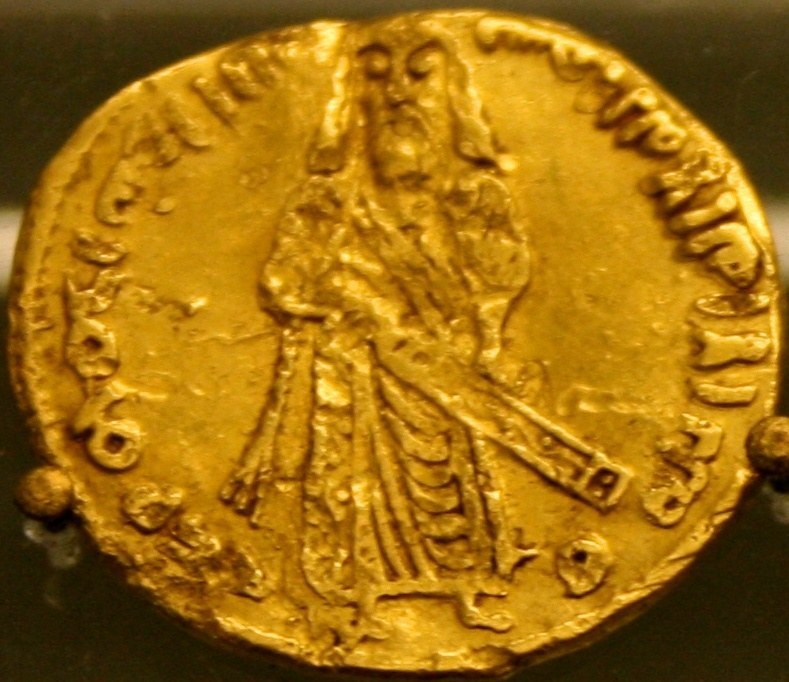
Gold Dinar of Abd al-Malik
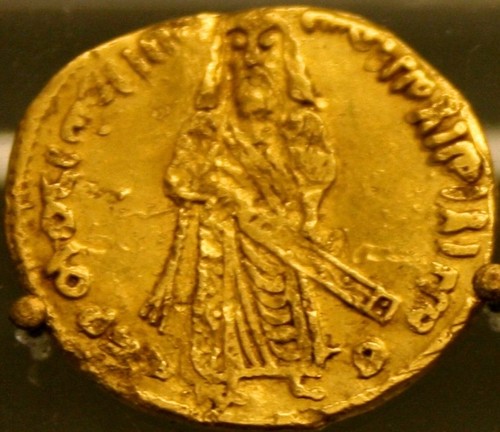
An early Umayyad gold dinar of Caliph Abd al-Malik, the 'Standing Caliph' type, bearing a robed standing figure and Arabic religious inscriptions.
- Country
- Islamic Caliphate (Umayyad)
- Denomination
- Dinar
- Metal
- Gold
Got a coin like this?
Identify any coin from a photo, free.
Overview
The Gold Dinar of Abd al-Malik is an early Islamic gold coin struck under the fifth Umayyad caliph, Abd al-Malik ibn Marwan (reigned 685–705 CE). The example photographed belongs to the transitional 'Standing Caliph' phase: the obverse shows a full-length standing figure in long robes, surrounded by an Arabic calligraphic inscription, while the reverse carries further Arabic legends around a central design. It is a small, thick gold disc struck by hand.
This type sits at a pivotal moment in monetary history. Early Umayyad gold at first imitated the Byzantine solidus, then experimented with an Islamic standing ruler in place of the emperor, before Abd al-Malik's famous reform of 77 AH (696–697 CE) swept away all imagery in favor of a purely inscriptional coinage. The Standing Caliph dinar is the intermediate step, blending a human figure with Arabic religious text.
Because it bridges Byzantine and Islamic coin design and was struck only briefly, the type is historically important and is prized by collectors of early Islamic and world gold coinage.
History & Background
Abd al-Malik ibn Marwan consolidated Umayyad rule after a period of civil war and undertook a sweeping reform of administration and currency. In the early years gold coinage circulating in the caliphate still followed Byzantine models, showing imperial figures and Christian crosses, which was increasingly at odds with the new Islamic state.
As a transitional measure the mint produced 'Standing Caliph' coinage, replacing the Byzantine emperors with a single upright robed figure — often understood as an idealized image of the caliph — and adding Arabic inscriptions drawn from Islamic religious formulae. This experiment ran in the years leading up to the reform. In 77 AH (696–697 CE) Abd al-Malik introduced the fully reformed, aniconic dinar bearing only Arabic text, including the Islamic profession of faith, which became the enduring template for Islamic gold for centuries.
The dinar itself took its name and weight tradition from the Roman-Byzantine denarius aureus / solidus, standardized at roughly 4.25 grams of gold. Abd al-Malik's reforms established the dinar as the flagship gold denomination of the Islamic world, and coins of his reign mark the birth of a distinctly Islamic coinage.
How to Identify
The defining feature of this transitional type is the obverse: a single standing human figure in long flowing robes, shown frontally, ringed by an Arabic inscription rather than Latin or Greek lettering. This immediately separates it from the Byzantine solidi it evolved from (which show one or more crowned emperors and a cross) and from the later reform dinars (which have no figure at all). The reverse bears additional Arabic calligraphy around a central motif.
The coin is struck in gold, small and comparatively thick, in the dinar tradition of about 4.2–4.3 grams and roughly 19–20 mm across, with hand-struck, slightly irregular flans typical of the era. The inscriptions are in early Kufic-style Arabic script. Because these were individually struck by hand, centering, weight and legend completeness vary from coin to coin.
Attribution to Abd al-Malik and to the Standing Caliph phase rests on the combination of the robed standing figure with Arabic religious legends and the absence of the fully aniconic reform layout. Specialists read the Arabic legends and any mint or date elements to place a given coin precisely within the transitional series.
Value & Collectibility
Early Umayyad gold dinars are scarce, historically significant, and made of gold, so they command substantial prices well above bullion value. The Standing Caliph transitional types in particular are sought after because they were struck only briefly and document the moment Islamic coinage broke from Byzantine models.
Value depends heavily on the exact sub-type, the completeness and legibility of the Arabic legends, centering, and overall preservation, as well as authenticity and provenance. Well-struck, fully legible examples of desirable transitional issues rank among the more valuable early Islamic gold coins, while off-center or weakly struck pieces bring less. Precise figures vary widely by variety and market, so these coins should be assessed individually by a specialist.
Because of their value and demand, early Islamic gold dinars are frequently counterfeited or reproduced, so verified authenticity and documented provenance materially affect price. Buyers should treat any unattributed example with caution and seek expert opinion.
Frequently asked questions
Who was Abd al-Malik?
Abd al-Malik ibn Marwan was the fifth Umayyad caliph, who ruled from 685 to 705 CE. He is remembered for major administrative and monetary reforms, including creating the first distinctly Islamic gold and silver coinage.
Why does this gold dinar show a standing figure?
It belongs to the transitional 'Standing Caliph' phase before Abd al-Malik's full coin reform. The robed standing figure, paired with Arabic religious inscriptions, replaced the Byzantine emperor images that earlier Islamic gold had copied.
How is this different from a reformed Islamic dinar?
The reformed dinar introduced in 77 AH (696–697 CE) carries only Arabic inscriptions and no images at all. The Standing Caliph dinar is the earlier, transitional step that still shows a human figure.
How much gold is in a dinar?
The dinar followed the late Roman/Byzantine gold standard of roughly 4.25 grams of gold. Individual hand-struck coins vary slightly around that weight.
Are these coins rare?
Yes. Early Umayyad gold dinars, and the short-lived Standing Caliph transitional types in particular, are scarce and highly collectible. They are also frequently faked, so authentication matters.
Gold Dinar of Abd al-Malik guides
In-depth guides for identifying, valuing, and collecting Gold Dinar of Abd al-Malik.
Other coins you may enjoy
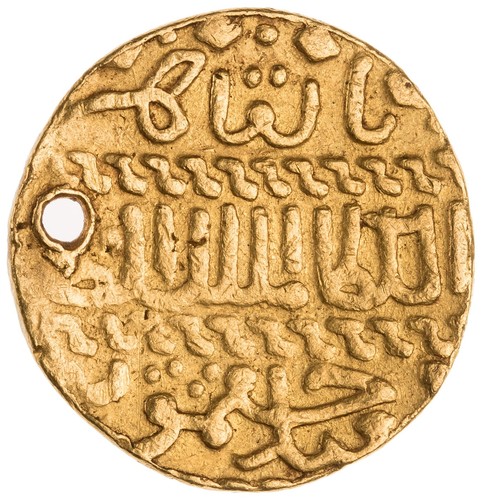
Gold Dinar of Jaqmaq
1438-1453 CE
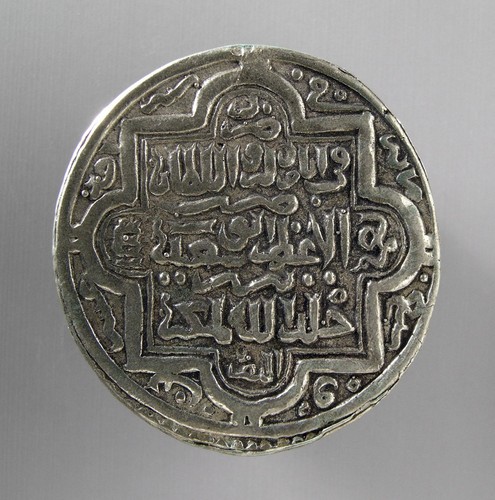
Ilkhanid Dirham
13th–14th century (Ilkhanate, c. 1256–1335 CE)
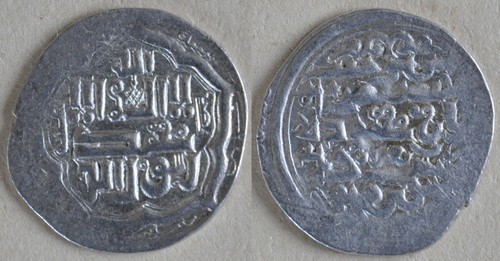
Ilkhanid Dirham of Ghazan
14th century (c. 1295-1304 CE)
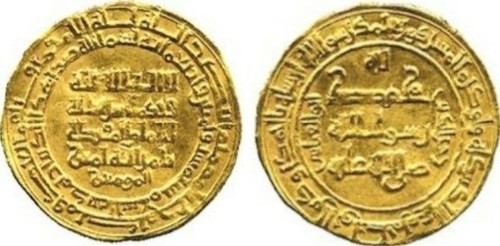
Gold Dinar of al-Muqtadi
c. 467-475 AH (1074-1082 CE)
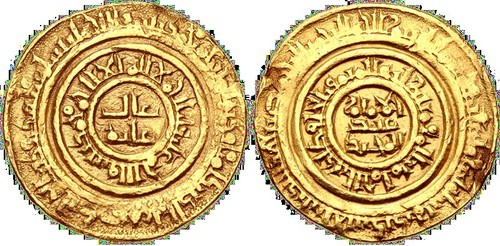
Gold Dinar of al-Hafiz li-Din Allah
AH 544 (AD 1149–1150)
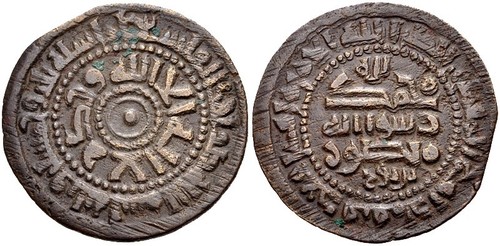
Samanid Dirham
9th–10th century CE (roughly AH 3rd–4th century)
Copper Fals of Barquq
1382–1389 CE (first reign of Barquq)
Copper Fals of as-Salih Salih
Mid-14th century CE (reign of as-Salih Salih, AH 752–755 / 1351–1354 CE)
Gold Dinar of Malik Shah I
AH 465–485 (1072–1092 CE)
Ilkhanid Dirham of Abu Said
c. 1316-1335 CE (AH 716-736)
Silver Dirham of Salm ibn Ziyad
c. 682-683 CE
Silver Dirham (LACMA M.2002.1.437)
8th century CE (roughly AH 80s–190s)