
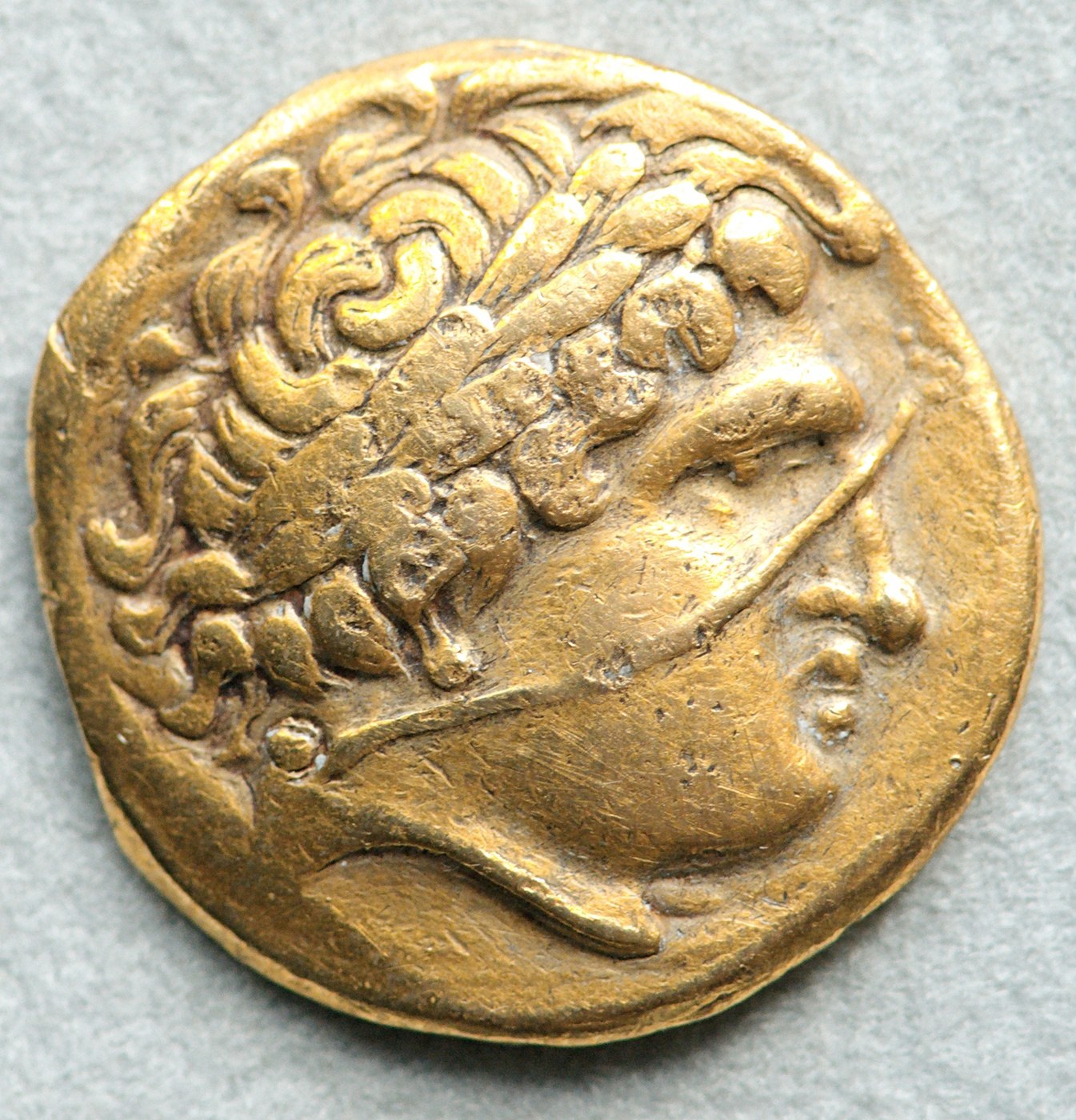
Gallic Imitation Stater
A gold stater struck by the tribes of Gaul, whose stylized head and single horse descend from Greek Macedonian prototypes reworked into abstract Celtic art.
- Country
- Gaul
- Denomination
- Stater
- Metal
- Gold
Got a coin like this?
Identify any coin from a photo, free.
Overview
The Gallic imitation stater is a gold coin struck by the Celtic peoples of Gaul, most abundantly during the 1st century BC. Its designs are loose, native reinterpretations of a Greek prototype rather than direct copies, and over generations of imitation the borrowed imagery grew steadily more abstract and ornamental.
The obverse observed on this coin shows a head facing right with heavily stylized hair, a distant echo of a classical laureate portrait broken up into flowing curls, crescents, and disjointed locks. The reverse shows a horse, again highly stylized, surrounded by ornamental pellets, rosettes, wheels, and other geometric motifs that fill the field in the characteristic Celtic manner.
Struck in gold and produced by numerous tribes across Gaul, these staters are among the most recognizable products of Iron Age Celtic coinage. They served as high-value money for trade, tribute, mercenary payment, and prestige rather than everyday small change.
History & Background
Celtic gold coinage began when Greek gold staters entered the Celtic world through trade, tribute, and above all the pay of Gallic mercenaries who served in Mediterranean armies. The ultimate model for most Gallic gold was the stater of Philip II of Macedon, which carried a laureate head of Apollo on the obverse and a horse-drawn chariot (biga) on the reverse.
As the design was copied and re-copied by successive Gallic engravers, none of whom aimed at a faithful likeness, the Apollo head dissolved into patterns of hair and abstract elements, and the two-horse chariot was reduced to a single horse amid scattered ornament. This progressive stylization, spread over the 3rd, 2nd, and 1st centuries BC, is one of the classic examples of Celtic art transforming a foreign image into something wholly its own.
Many different Gallic tribes struck their own gold staters, and the coinage as a whole is associated with the world Julius Caesar encountered during the Gallic Wars of the mid-1st century BC. Because these issues were not centrally controlled, they vary widely in weight, purity, and design from region to region, and precise mints and dates are often uncertain.
How to Identify
The defining trait is the pairing of a stylized head on the obverse with a horse on the reverse, both rendered in the abstract Celtic idiom rather than in naturalistic Greek style. On this coin the obverse is a head facing right whose hair is broken into curls, crescents, and loose locks; the original facial features may be reduced, displaced, or nearly lost among the ornament. The reverse shows a single horse in profile, often accompanied by pellets, rosettes, wheels, exergual lines, or a driver or symbol above.
Gallic staters were struck in gold, though the metal ranges from rich yellow gold to paler, debased alloys and electrum in later or regional issues. A full stater is typically a small, thick flan roughly 15-20 mm across and on the order of 6-8 grams, with smaller denominations such as quarter staters also produced; exact standards vary by tribe. There are no Latin legends of the kind found on Roman coins, and any inscriptions, where present at all, are short tribal names or are absent entirely.
Attribution to a specific tribe rests on the exact treatment of the hair, the pose and ornament around the horse, and the fabric and weight of the flan, compared against published Celtic coin references. Because the types are abstract, small differences in the arrangement of motifs are the primary clues to the issuing people and region.
Value & Collectibility
Gallic gold staters are actively collected and, as ancient gold, generally command prices well above base-metal ancients. Ordinary examples in modest condition typically trade in the mid hundreds of dollars, while bold, well-centered coins in high grade, or issues from sought-after tribes and with especially artistic designs, can reach into the low thousands and beyond.
Value is driven by the gold content and weight, the tribe and specific type, the quality of the strike and centering, the artistry of the stylization, and provenance. Debased or lightweight later staters, and worn or clipped pieces, sit at the lower end, while full-weight, high-purity gold with a striking design brings a premium.
The figures here are general context rather than appraisals; condition, attribution, and provenance can move an individual coin well outside these ranges. Because gold Celtic coins are frequently forged, documented provenance and specialist attribution add materially to both confidence and value.
Frequently asked questions
What is a Gallic imitation stater imitating?
It ultimately derives from the gold stater of Philip II of Macedon, which showed a laureate head of Apollo and a horse-drawn chariot. Gallic engravers copied and re-copied this design over generations until the head became stylized hair and the chariot was reduced to a single horse amid ornament.
Is it really made of gold?
Yes, these are gold coins, though purity varies. Early and full-weight issues are rich gold, while later or regional staters can be paler debased alloys or electrum. Weight and color help gauge the gold content of a particular piece.
Why does the design look so abstract?
The abstraction is deliberate Celtic artistic style. Successive Gallic engravers were not aiming to reproduce the Greek original faithfully, so the head dissolved into curls and crescents and the horse became a pattern of lines and pellets. This stylization is a hallmark of Iron Age Celtic art.
Can it be attributed to a specific tribe?
Often yes, but not always. The exact treatment of the hair, the pose and ornament around the horse, and the flan's weight and fabric are compared against reference works to assign an issue to a tribe such as the Ambiani, Parisii, or Aulerci. Many pieces remain broadly attributed to a region.
Are these coins rare?
Gallic gold staters survive in reasonable numbers overall, but as ancient gold they are far scarcer and more valuable than base-metal ancients. Certain tribes, types, and high grades are genuinely rare and command strong premiums.
Gallic Imitation Stater guides
In-depth guides for identifying, valuing, and collecting Gallic Imitation Stater.
Other coins you may enjoy
Tetradrachm of Ptolemy XII
80-51 BC
Tetradrachm of Ptolemy I
305-283 BC
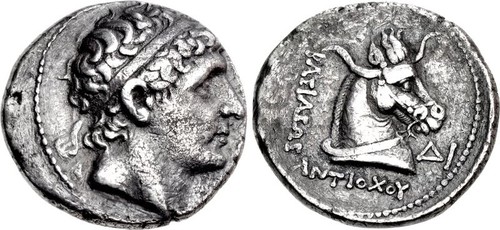
Tetradrachm of Antiochos I Soter
281-261 BC
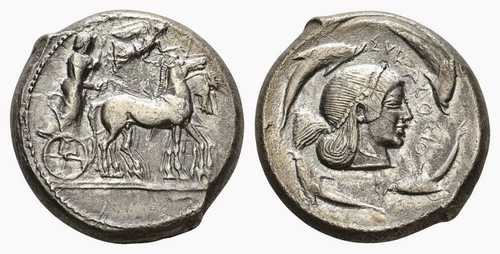
Syracuse Tetradrachm
c. 5th-4th century BC (Classical period)
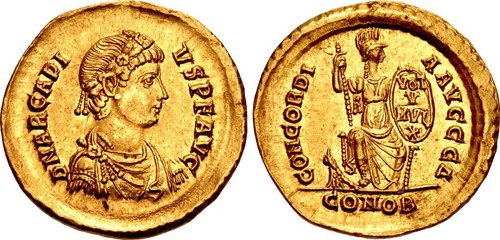
Solidus of Arcadius
AD 395-402
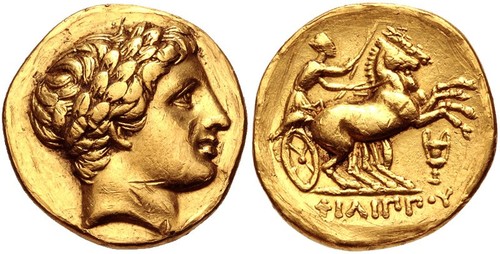
Philip III Gold Stater
323-317 BC
Siliqua of Gratian
AD 367-383
Sestertius of Maximinus Thrax
235-238 AD
Solidus of Valentinian III
AD 425-455
Seleucus I Nicator Tetradrachm
Late 4th-3rd century BC
Nummus of Magnentius
AD 350-353
Follis of Galerius
AD 308-310