
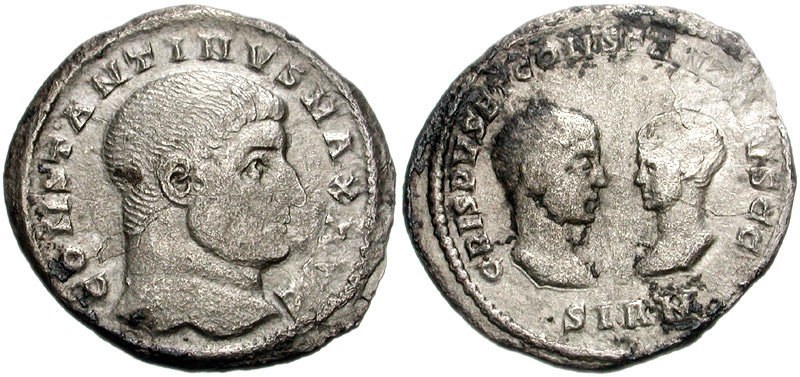
Follis of Constantine I and Crispus
A late-Roman bronze follis linking Constantine the Great to his son Crispus, with the emperor's right-facing portrait and a paired father-and-son bust reverse.
- Country
- Roman Empire
- Denomination
- Follis
- Metal
- Bronze/Silver
Got a coin like this?
Identify any coin from a photo, free.
Overview
This is a small late-Roman bronze coin, the reduced follis (also called a nummus or AE3), struck under Constantine I, "the Great," and associated with his eldest son and Caesar, Crispus. The obverse carries Constantine's right-facing portrait ringed by a Latin imperial legend. The reverse shows two busts facing right, representing Constantine and Crispus together, a dynastic image that advertised the ruling house and Crispus's place within it.
The follis of this period was the workhorse base-metal coin of the empire, struck in enormous quantity at mints from Britain to the eastern provinces. By the 320s it had shrunk from the large silvered piece of Diocletian's reform to a smaller, thinner coin roughly 18 to 20 mm across, made of bronze that originally carried a thin silver wash.
Because the coin spans roughly AD 317 to 326, the exact reverse legend, portrait style, and mint marks vary from piece to piece. Reading those details is what places an individual coin within the broad Constantinian series and confirms its tie to the short-lived Caesar Crispus.
History & Background
Constantine I ruled from AD 306 to 337 and reshaped the Roman world, defeating his rivals to reunite the empire, favoring Christianity, and founding Constantinople. To secure his dynasty he elevated his sons to the junior rank of Caesar. His eldest son Crispus, born to Constantine's first partner Minervina, was made Caesar in AD 317 alongside his half-brother Constantine II and his cousin Licinius II.
Crispus proved an effective commander, winning campaigns on the Rhine and a decisive naval victory over Licinius in AD 324 that helped make his father sole ruler. Coins bearing his portrait or naming him were struck across the empire during his years as Caesar. In AD 326, however, Crispus was suddenly arrested and executed on Constantine's orders under circumstances the sources never fully explain, and he was subject to damnatio memoriae, the official erasure of his name and image. Coinage tied to him effectively ends at that point, which fixes the type's window at roughly 317 to 326.
The dynastic message of a father-and-son bust reverse belongs squarely to this era, when Constantine used the coinage to project stability and a clear line of succession. The later fate of Crispus gives such pieces an added historical poignancy.
How to Identify
Confirm the ruler from the obverse: a right-facing portrait, typically laureate, diademed, or helmeted depending on the issue, surrounded by a legend built on the name CONSTANTINVS, often in forms such as CONSTANTINVS AVG or CONSTANTINVS P F AVG. This is the anchor for the type. Do not confuse it with coins simply reading CONSTANTINVS IVN NOB C, which name his son Constantine II rather than the senior emperor.
The defining feature here is the reverse showing two busts facing right, representing Constantine and Crispus. Read the surrounding legend and any exergue letters carefully: legends naming CRISPVS (for example CRISPVS NOB CAES) or dynastic wording confirm the son's presence, while a line of letters in the exergue below the busts is the mint mark identifying the city and workshop. Constantinian mints of the 320s include Trier, Lyon, Arles, Rome, Siscia, Thessalonica, Antioch, and others.
The metal is bronze, originally coated with a thin silver wash that is usually worn away to leave a brown or green patina, with silvering sometimes surviving in protected recesses. Expect a small module of roughly 18 to 20 mm and a light weight of around 2 to 3.5 grams for issues of this date. Size, weight, and a clearly legible legend together separate a genuine period follis from later coins and modern copies.
Value & Collectibility
Constantinian bronze folles were struck in vast numbers and remain among the most affordable of all ancient Roman coins. Common, worn examples typically trade in the low tens of US dollars, while sharp, well-centered pieces with full legends, attractive patina, or surviving silvering command more. A clear dynastic type naming or depicting Crispus can carry a modest premium because of its story and its narrower date range, though it is condition and eye appeal, not the emperor's name, that drive most of the value.
Grade dominates price. A legible obverse legend, a complete reverse with readable detail on both busts, and a clear mint mark matter far more than age. Green or brown patina is normal and desirable; harsh cleaning, corrosion pits, tooling, or smoothing all reduce value.
Because modern fakes and tourist replicas of Constantinian bronzes exist, and because precise attribution depends on legends and mint marks, treat any single online price as rough guidance only. Have higher-value or uncertain pieces confirmed by a specialist in ancient coins or a reputable third-party grading service before buying or selling.
Frequently asked questions
Who are the two figures on this coin?
Constantine I, "the Great," appears on the obverse portrait, and the reverse pairs him with his eldest son and Caesar, Crispus. The two-bust reverse was a dynastic image promoting the ruling house.
Who was Crispus?
Crispus was Constantine's eldest son, made Caesar in AD 317 and a successful general. He was executed on his father's orders in AD 326 and struck from official record, which is why coins tied to him end around that date.
Is the coin silver or bronze?
It is bronze that originally carried a thin silver wash. The silvering usually wears away, leaving a brown or green patina, though traces can survive in the recesses of the design.
What is a follis?
It is the base-metal coin introduced by Diocletian's reform around AD 294. By the 320s it had shrunk to a small, thin bronze piece; modern catalogues often call this reduced coin a nummus or AE3.
Are these coins rare or valuable?
Constantinian folles were produced in huge numbers and are common and affordable. Value depends mainly on condition, mint, surviving silvering, and the specific type rather than rarity of the emperor.
Follis of Constantine I and Crispus guides
In-depth guides for identifying, valuing, and collecting Follis of Constantine I and Crispus.
Other coins you may enjoy
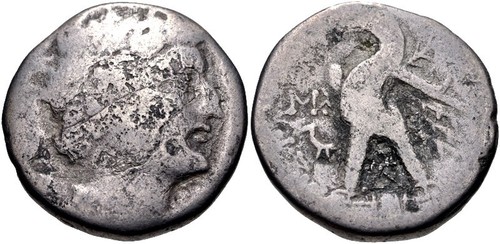
Tetradrachm of Ptolemy XII
80-51 BC
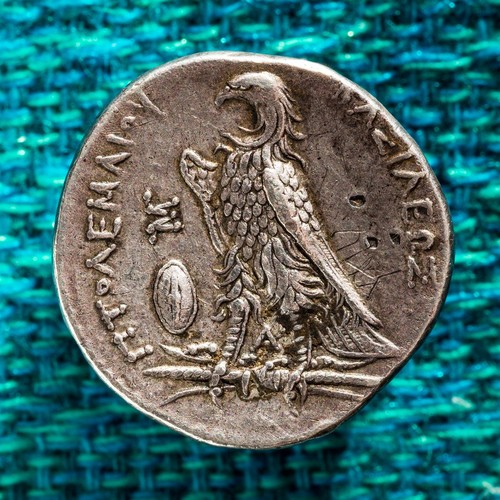
Tetradrachm of Ptolemy I
305-283 BC
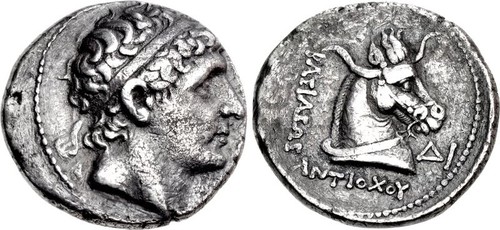
Tetradrachm of Antiochos I Soter
281-261 BC
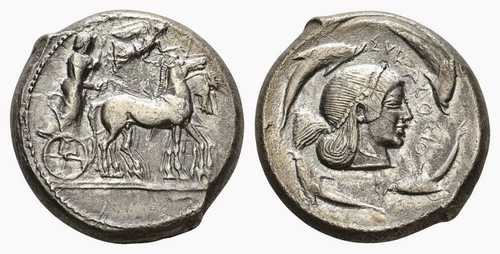
Syracuse Tetradrachm
c. 5th-4th century BC (Classical period)
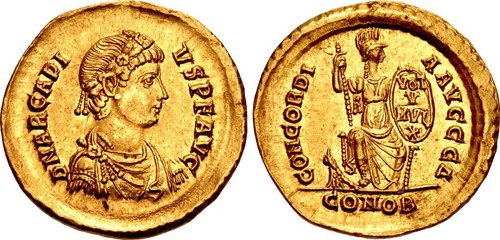
Solidus of Arcadius
AD 395-402
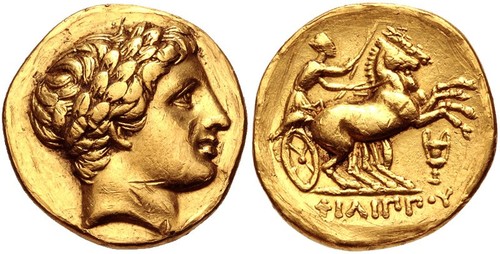
Philip III Gold Stater
323-317 BC
Siliqua of Gratian
AD 367-383
Sestertius of Maximinus Thrax
235-238 AD
Solidus of Valentinian III
AD 425-455
Seleucus I Nicator Tetradrachm
Late 4th-3rd century BC
Nummus of Magnentius
AD 350-353
Follis of Galerius
AD 308-310